How Aircraft Carriers Work and Why They Matter
Aircraft carriers are floating military air bases capable of deploying fighter jets anywhere on the ocean. Here is how their catapult systems, nuclear reactors, and strike groups work — and why they remain central to global power projection.
A Floating Air Base
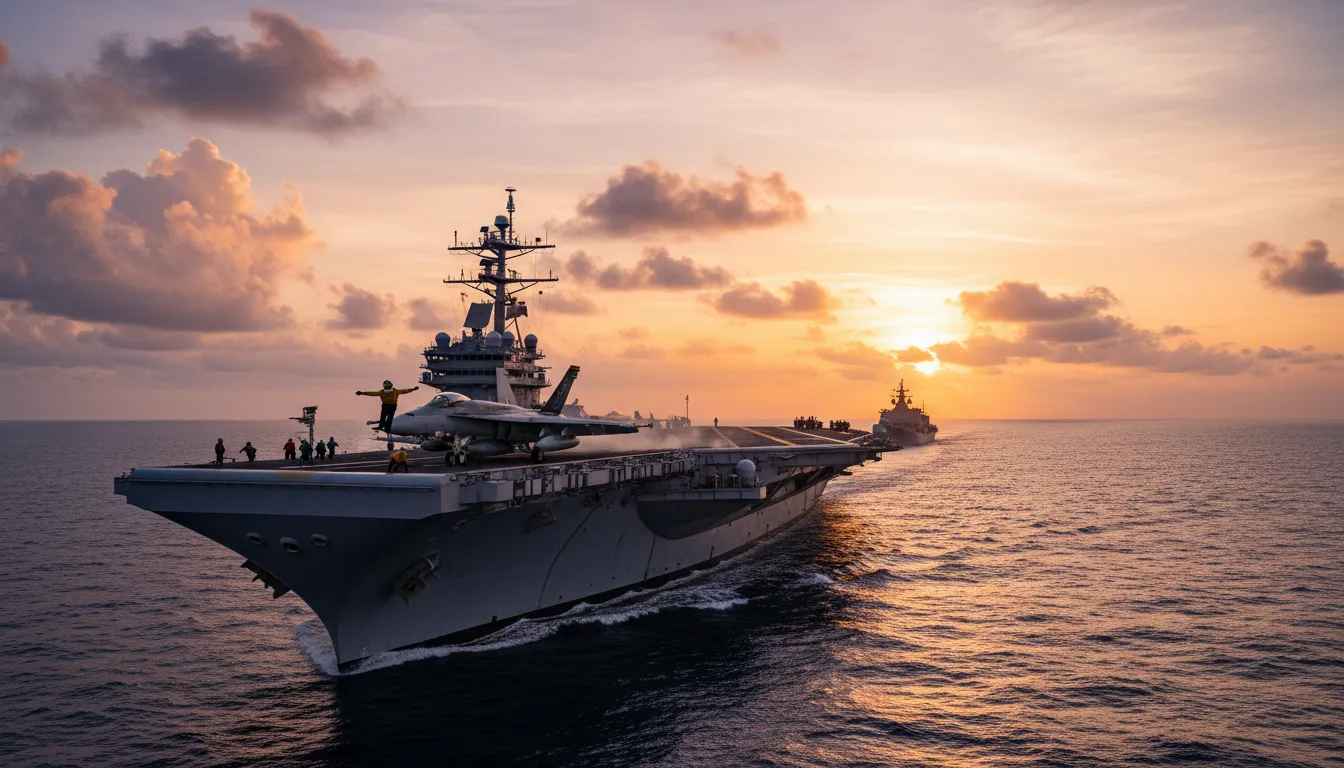
An aircraft carrier is, at its core, a movable military airfield — a warship with a flight deck long enough for jet aircraft to take off and land at sea. At their most powerful, modern carriers stretch more than 300 metres, displace over 100,000 tonnes of water, and can embark up to 90 aircraft. They are among the most complex machines ever built, and they remain the ultimate symbol of naval power in the 21st century.
Launch and Recovery: The CATOBAR System
Getting a fighter jet airborne from a pitching ship deck demands extraordinary engineering. The dominant system used by the United States and France is called CATOBAR — Catapult-Assisted Take-Off But Arrested Recovery. A steam- or electromagnetic catapult accelerates an aircraft from zero to roughly 240 km/h in under 100 metres, providing the velocity its engines need to sustain flight. The US Navy's electromagnetic catapult (EMALS), introduced on the Gerald R. Ford class, allows more precise control than older steam-powered versions and reduces mechanical stress on airframes.
Landing is equally dramatic. The pilot aims for one of four steel arresting wires stretched across the deck, catching one with a hook beneath the aircraft's tail. The wire brings the jet from roughly 250 km/h to a full stop in about two seconds — generating forces that would snap a spine if the pilot were not braced and warned.
Other navies, including the United Kingdom, India, and China with its earlier carriers, use a ski-jump ramp at the bow. Simpler and cheaper, this method lets lighter aircraft launch without a catapult but limits the fuel and weapons load each aircraft can carry, reducing overall striking power.
Nuclear vs. Conventional Propulsion
The United States operates 11 nuclear-powered carriers; France's Charles de Gaulle is the only nuclear-powered carrier completed outside the US fleet. Nuclear propulsion gives a ship virtually unlimited range — a reactor can power the vessel for 20 to 25 years without refuelling, freeing up enormous internal space for aviation fuel and ordnance rather than propulsion fuel. France's Charles de Gaulle, for example, can sustain operations in the Mediterranean indefinitely without relying on a friendly port.
Conventional carriers — driven by diesel turbines or gas turbines — are cheaper to build and maintain. China, the UK, Italy, and Spain all rely on conventional propulsion for their current fleets. China is widely reported to be developing a nuclear-powered carrier for future service.
The Strike Group: Carriers Never Sail Alone
A carrier never operates in isolation. A modern carrier strike group typically comprises the carrier itself, several guided-missile destroyers or cruisers, at least one attack submarine, and a logistics support ship. According to Defense Feeds, a US carrier air wing alone includes 36–48 strike fighters, electronic warfare aircraft, early-warning planes, and anti-submarine helicopters. Together, these assets form a self-contained combat unit capable of projecting power across hundreds of kilometres while defending itself from air, surface, and underwater threats.
Power Projection: Why Nations Build Them
The strategic value of a carrier lies in what military planners call power projection — the ability to deliver overwhelming force anywhere on earth without depending on host nations for land-based airfields. A carrier can be repositioned within days in response to a crisis, operate freely in international waters beyond any country's jurisdiction, and launch strikes, enforce no-fly zones, or deliver humanitarian aid as the situation demands.
During the Cold War, US carrier battle groups served as the primary instrument for deterring Soviet aggression. That logic has not changed. The Joint Air Power Competence Centre notes that carriers offer "a unique combination of versatility and force" unavailable through any land-based alternative. When a nation deploys a carrier toward a conflict zone, the political signal is unmistakable.
Are Carriers Becoming Obsolete?
Critics argue that modern anti-ship missiles — such as China's DF-21D, dubbed the "carrier killer" — put large carriers at unacceptable risk in high-intensity warfare. A single missile costing a fraction of a percent of a carrier's value could theoretically threaten a vessel worth $13 billion. In response, navies have invested heavily in layered missile defences, electronic warfare, and longer-range, stealthier aircraft that extend a carrier's reach beyond enemy missile envelopes.
Defenders of the carrier point out that no nuclear-powered carrier has ever been sunk in combat, and that their capacity to pivot from strike missions to drone operations to disaster relief makes them uniquely adaptable. The US Naval Institute has argued that carriers remain "indispensable" for the foreseeable future, precisely because no adversary has yet neutralised their fundamental advantage: the ability to bring the airfield to the fight.
An Exclusive Club
Fewer than a dozen nations operate fixed-wing carriers. The United States leads with 11, followed by China with three. The United Kingdom, France, India, Italy, and Spain each maintain one or two. Building and sustaining a carrier programme demands vast financial resources, advanced shipbuilding capacity, and decades of hard-won operational experience — barriers that keep carrier ownership among the most exclusive distinctions in global military power.