How Archaeologists Decode Ancient Mass Graves
When archaeologists uncover a prehistoric mass grave, a battery of modern forensic techniques—from isotopic analysis to ancient DNA—can reconstruct who the victims were, where they came from, and exactly how they died.
A Window Into Violent Prehistory
A shallow pit in the Serbian lowlands. Dozens of skeletons, mostly women and children, stacked in a single layer. Blunt trauma marks on nearly every skull. Such discoveries do not remain mysteries for long. Modern archaeology has assembled a forensic toolkit so powerful that a 2,800-year-old crime scene can be read almost like a police report—revealing the victims' origins, diet, family relationships, and the precise mechanics of their deaths.
Understanding how researchers extract this information illuminates not just individual tragedies, but broader patterns in how human societies have organized—and unleashed—violence across millennia.
Finding and Excavating a Mass Grave
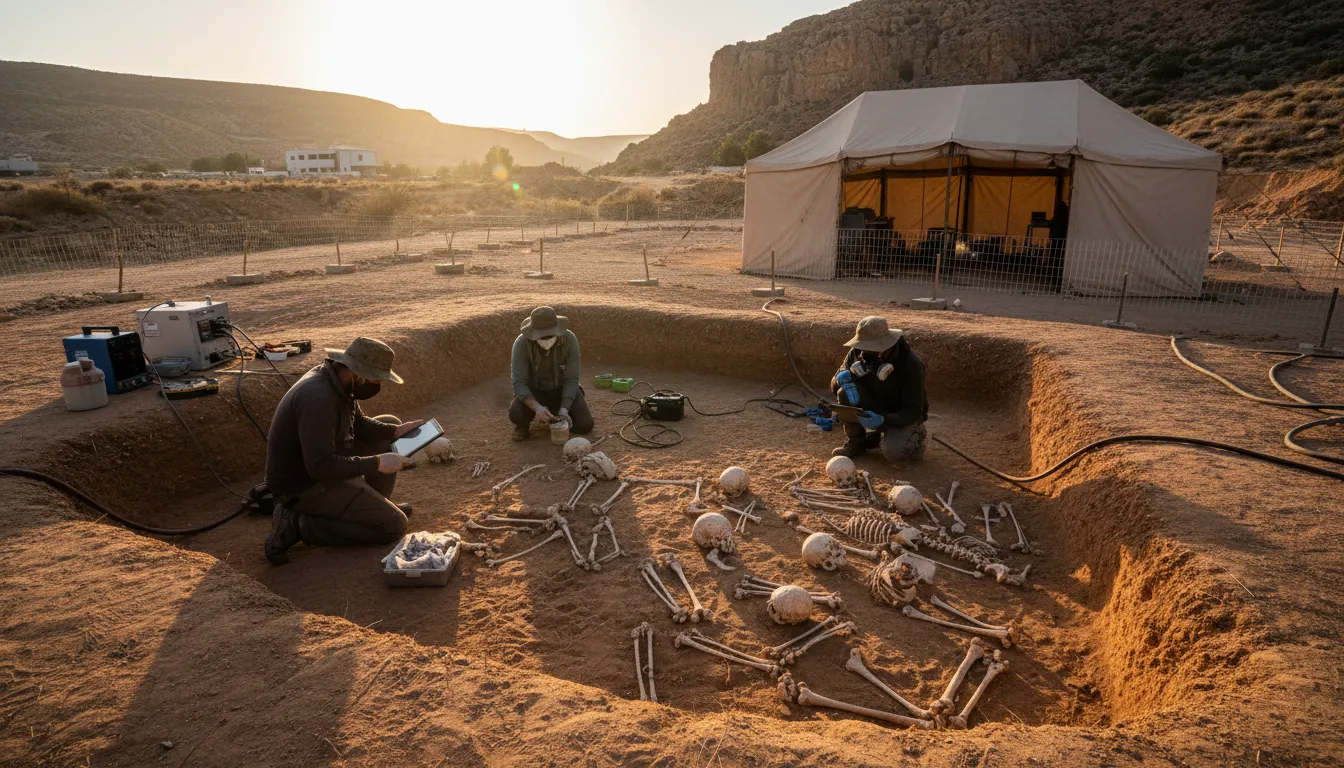
Before a single bone is lifted, archaeologists must locate the site. Aerial photography, LiDAR scanning, and ground-penetrating radar can reveal soil disturbances invisible to the naked eye. Shallow pits filled with decomposed organic matter produce distinctive radar signatures and subtle colour differences in vegetation overhead.
Excavation itself is painstaking. Bones are mapped three-dimensionally so that their spatial relationships—who lay on top of whom, which direction heads faced—can be reconstructed digitally. The arrangement of bodies can indicate whether victims were thrown in hastily or placed with some degree of care, a clue to the perpetrators' intentions and cultural norms.
Reading Trauma in Bone
Skeletal trauma analysis, a branch of bioarchaeology, distinguishes between injuries that occurred during life (antemortem), at or around the moment of death (perimortem), and after death (postmortem). Only perimortem injuries—those showing fresh bone fractures with no signs of healing—are direct evidence of cause of death.
Researchers examine fracture patterns under microscopes. Blunt-force trauma to the cranium leaves characteristic star-shaped radiating fractures; sharp-force trauma from blades leaves clean cuts with bevelled edges. The location and angle of wounds can reveal the position of an attacker relative to the victim—evidence of whether victims were standing, kneeling, or already on the ground when struck.
According to researchers writing in Science, the pattern of skull injuries in mass graves often distinguishes executions from battlefield casualties, since execution wounds cluster on the back of the head while combat wounds appear more randomly distributed.
Isotopic Analysis: Tracing Origins and Diet
Stable isotope analysis is one of the most powerful tools in a bioarchaeologist's arsenal. Different chemical isotopes are incorporated into bones and teeth during life, encoding a record of diet and geography that survives for thousands of years.
- Strontium (⁸⁷Sr/⁸⁶Sr): The ratio of strontium isotopes in tooth enamel reflects the local geology of the region where a person grew up. Because tooth enamel forms in childhood and does not remodel, it provides a permanent record of birthplace. Comparing enamel ratios across individuals in a grave can reveal whether they came from the same community or were gathered from multiple locations.
- Oxygen (¹⁸O/¹⁶O): Oxygen isotope ratios vary with latitude and altitude and are captured in drinking water. Combined with strontium, they help narrow down geographic origin with surprising precision.
- Carbon and nitrogen (¹³C, ¹⁵N): These isotopes, found in bone collagen, reconstruct diet—distinguishing, for example, between people who ate mostly marine fish versus terrestrial animals, or those with access to high-protein diets versus those who subsisted on grain.
As Live Science reported in its coverage of the Serbian Iron Age site, isotopic evidence showed that victims had diverse childhood diets, suggesting they were gathered from multiple settlements—making the massacre a deliberate, coordinated act rather than a local family tragedy.
Ancient DNA: The Genetic Record
The most revolutionary addition to the toolkit is ancient DNA (aDNA) analysis. DNA survives in bones and teeth for tens of thousands of years under the right conditions, though it degrades into short, fragmented strands. Modern massive parallel sequencing technology can reconstruct a genome even from thousands of tiny fragments.
According to a review in PMC (NCBI), the petrous bone of the inner ear and the roots of molar teeth are the best sources of ancient DNA because their dense structure shields genetic material from contamination and environmental damage.
Ancient DNA can establish:
- Kinship: Whether victims were close relatives, distant relatives, or strangers
- Sex: More reliably than skeletal morphology alone, especially in children
- Population origin: Which ancient population group the individuals belonged to, and how they relate to modern populations
- Disease: Pathogens preserved in aDNA can identify epidemic diseases that may have contributed to a community's vulnerability
Putting It All Together
No single technique tells the full story. The power lies in integrating all lines of evidence. Skeletal trauma establishes how people died. Isotopes establish where they were from and what they ate. Ancient DNA establishes how they were related to one another. Radiocarbon dating pins down when the event occurred. Together, these tools can transform a pit of bones into a richly documented historical event.
As the Smithsonian Magazine noted, such interdisciplinary studies are rewriting our understanding of prehistoric society—showing that organised, targeted violence against specific demographic groups is not a modern invention, but a pattern stretching back to the earliest complex societies.
Each excavated grave, however grim, adds a data point to humanity's long and complicated relationship with collective violence—and offers a chance to understand, in forensic detail, how and why such events unfolded.