How Carrier Strike Groups Work—Floating Fortresses
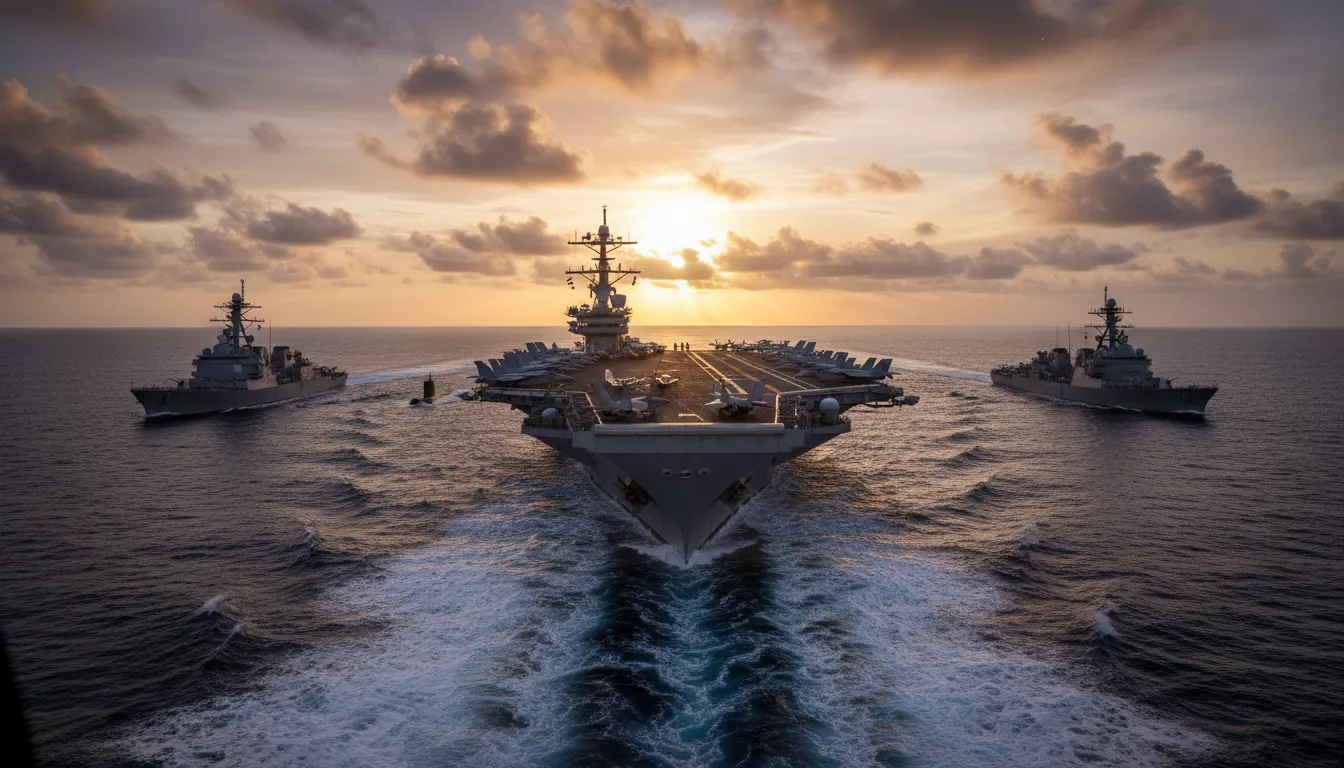
A carrier strike group is the most powerful naval formation on Earth, combining an aircraft carrier, escort warships, submarines, and 65–70 aircraft into a single fighting force that costs billions to build and millions per day to operate.
A Navy Within a Navy
When a crisis erupts anywhere on the globe, the first question decision-makers often ask is: Where are the carriers? A carrier strike group (CSG) is the U.S. Navy's primary tool for projecting power overseas—a self-contained naval task force built around a single nuclear-powered supercarrier, escorted by cruisers, destroyers, submarines, and a full air wing. It is, in effect, a floating military base capable of parking itself off any coastline on Earth.
What's Inside a Strike Group
A typical CSG comprises roughly 7,500 personnel spread across several warships and a carrier air wing of 65 to 70 aircraft. The core components are:
- One supercarrier — a nuclear-powered vessel displacing over 100,000 tonnes that serves as the group's flagship and airfield.
- One or two Aegis guided-missile cruisers (Ticonderoga class) — equipped with advanced radar and Tomahawk cruise missiles for long-range strike and air defense.
- Two to three guided-missile destroyers (Arleigh Burke class) — the workhorses of anti-aircraft and anti-submarine warfare, also carrying Tomahawks.
- One or two attack submarines — screening the group against undersea threats while adding their own strike capability.
- A supply ship — a combined ammunition, oiler, and provisions vessel that keeps the group operating far from port.
The air wing typically includes F/A-18 Super Hornets (and increasingly F-35C Lightning IIs), E-2D Hawkeye early-warning aircraft, EA-18G Growler electronic warfare jets, and MH-60 Seahawk helicopters. Together, they give the strike group the ability to control the air, strike land targets, and hunt submarines simultaneously.
Why Carriers Travel in Packs
An aircraft carrier is the most valuable single warship afloat — and that makes it a prime target. The escort vessels exist to form a layered defensive shield. Aegis cruisers and destroyers provide overlapping radar coverage and missile defense against incoming aircraft, cruise missiles, and ballistic threats. Submarines lurk beneath the surface, detecting enemy subs before they can get within torpedo range. The carrier itself rarely fires a weapon in self-defense; instead, its aircraft extend the group's offensive and defensive reach hundreds of miles in every direction.
This layered approach means an adversary must penetrate multiple defensive rings — electronic warfare, fighter patrols, surface-to-air missiles, and torpedo screens — before reaching the carrier.
The Price Tag
Carrier strike groups are staggeringly expensive. The carrier alone costs roughly $13 billion to build. Add six destroyers ($1.9 billion each), an air wing of 70-plus aircraft, and a cruiser, and the total capital cost of a single strike group approaches $33 billion, according to defense cost analyses. Operating costs run to an estimated $6.5 million per day, covering crew pay, fuel for escort ships, aircraft maintenance, and resupply.
The U.S. Navy maintains 11 supercarriers — more than every other nation combined. Fourteen countries operate some form of aircraft carrier, but no other navy fields a comparable strike group structure. China operates three carriers, the United Kingdom two, and France one, but none match the scale or integrated firepower of a U.S. CSG.
Deployment and Rotation
Under the Navy's Optimized Fleet Response Plan, each strike group follows a roughly 36-month cycle: seven months of maintenance, seven months of training and certification exercises, followed by a deployment of six to nine months. After deployment, the group enters a sustainment phase, ready for emergency "surge" operations if a crisis demands it.
In practice, deployments have stretched longer. The USS Gerald R. Ford's deployment approached 300 days, one of the longest modern carrier rotations. Analysts have argued deployments should be shortened to three or four months to reduce wear on crews and equipment, but global demand for carrier presence consistently pushes timelines beyond plan.
Why It Matters
A carrier strike group is more than a weapons platform. It is a diplomatic signal. Positioning a CSG near a conflict zone communicates resolve without firing a shot. The group can launch airstrikes, enforce no-fly zones, evacuate civilians, deliver humanitarian aid, and gather intelligence — all without needing a foreign government's permission to use a land base. That combination of flexibility, firepower, and political independence is why carrier strike groups remain central to U.S. defense strategy, even as new threats from hypersonic missiles and autonomous drones challenge their dominance.