How Digital Pathology Works—and Why It Matters
Digital pathology uses AI and high-resolution scanners to transform traditional glass tissue slides into powerful diagnostic tools, enabling faster cancer detection and more precise treatment decisions.
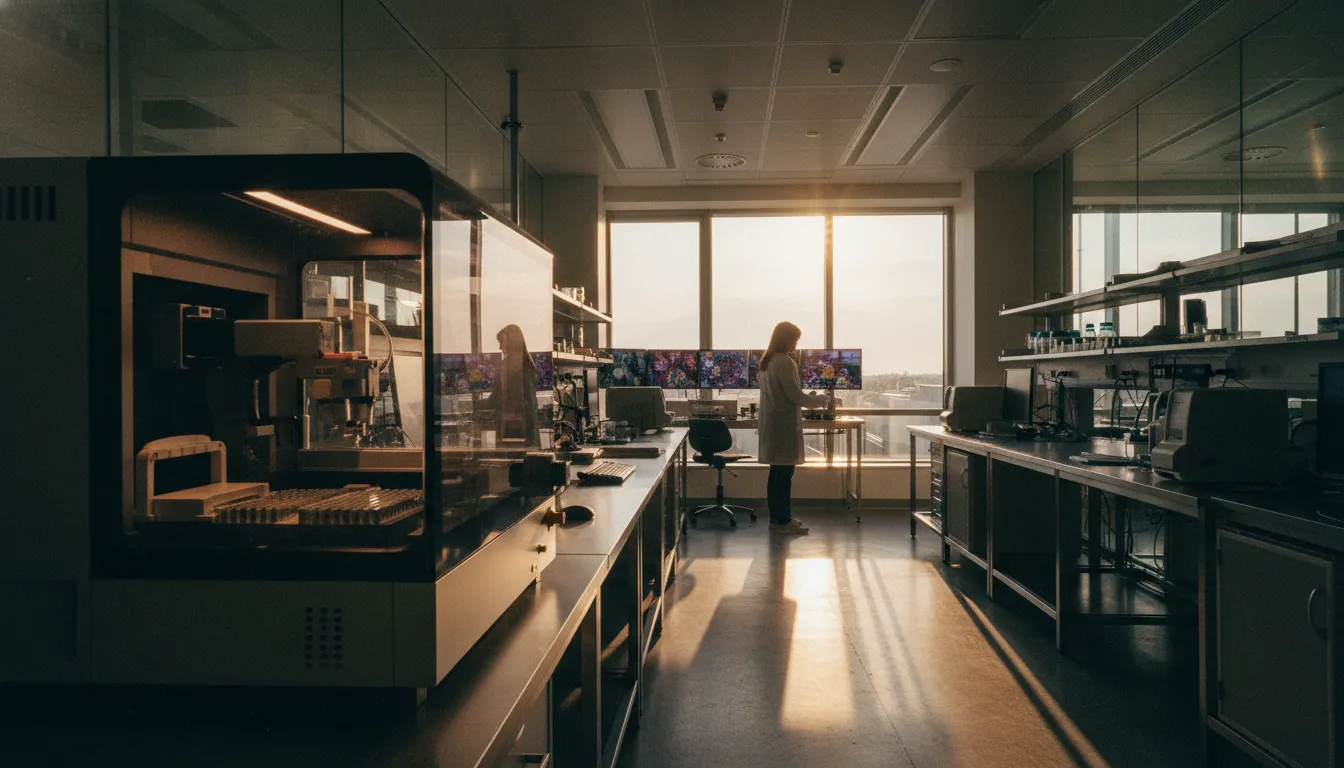
From Microscope to Monitor
For more than a century, diagnosing cancer has relied on a pathologist peering through a microscope at a thin slice of tissue mounted on a glass slide. The tissue is typically stained with hematoxylin and eosin (H&E)—a cheap, routine procedure costing as little as $5 to $10 per slide. While effective, this process is slow, subjective, and difficult to scale.
Digital pathology changes the equation. High-resolution whole slide image (WSI) scanners convert physical glass slides into detailed digital files that pathologists can view, annotate, and share on a screen—no microscope required. Modern scanners can image a single slide in two to three minutes and process up to 450 slides in a single run, according to Yale School of Medicine.
How AI Enters the Picture
Digitizing slides is only the first step. The real transformation comes when artificial intelligence algorithms analyze those images. Deep learning models—particularly convolutional neural networks and transformer architectures—can examine millions of cells in a single scan, identifying patterns that even experienced pathologists might miss.
These AI tools can automatically detect cancerous regions, classify cell types, measure immune cell infiltration, quantify biomarker expression, and even predict patient outcomes based on tissue structure. Critically, AI does not replace pathologists. Instead, it works alongside them in what researchers call augmented intelligence—flagging suspicious areas, reducing repetitive work, and improving consistency across diagnoses.
As a review published in Nature Medicine notes, AI-powered computational pathology tools have shown particular promise in precision oncology, where they help match patients to targeted therapies based on tumor characteristics visible in tissue slides.
What AI Can See That Humans Cannot
Standard H&E staining reveals basic tissue architecture, but more advanced techniques like multiplex immunofluorescence (mIF) can map protein activity across a tumor—showing how immune cells interact with cancerous tissue. The problem is that mIF imaging costs thousands of dollars per slide and is available only at specialized centers.
This is where newer AI models push the boundary further. Microsoft's GigaTIME system, developed with Providence Health and the University of Washington and published in Cell, demonstrated that AI trained on 40 million paired cells can generate virtual mIF images from cheap, routine H&E slides. Applied across more than 14,000 patients and 24 cancer types, the system uncovered over 1,200 statistically significant associations between protein activation patterns and clinical outcomes—insights previously locked behind expensive imaging.
FDA Approvals and Clinical Adoption
Digital pathology AI is no longer experimental. Several tools have cleared regulatory hurdles:
- Paige Prostate became one of the first FDA-approved AI pathology tools in 2021, assisting in prostate cancer detection.
- Paige PanCancer Detect, approved in 2025, extends AI-assisted cancer detection across multiple tissue types and organs.
- Roche Digital Pathology Dx received FDA 510(k) clearance in early 2025 for its whole slide imaging system.
- PathAI's AIM-MASH became the first AI-powered drug development tool qualified by the FDA for clinical trials.
The global digital pathology market, valued at roughly $1.2 billion in 2024, is projected to surpass $2.6 billion by 2032, driven by rising cancer incidence, telepathology adoption, and integration with electronic health records, according to Fortune Business Insights.
Why It Matters
The implications extend well beyond efficiency gains. In regions with pathologist shortages—common across sub-Saharan Africa and parts of Southeast Asia—digital pathology enables remote diagnosis via telepathology. A specialist thousands of miles away can review a scan and deliver a diagnosis without the slide ever leaving the hospital.
For patients, faster and more consistent diagnoses can mean earlier treatment, better-matched therapies, and improved survival rates. For researchers, massive digitized slide databases paired with AI analysis are accelerating drug development and clinical trial design.
Digital pathology represents a fundamental shift: the microscope slide, once a static artifact examined by a single pair of eyes, becomes a dynamic data source analyzed by algorithms trained on millions of cases. The pathologist's expertise remains essential—but now it is amplified by machines that never tire and never miss a pixel.