How Ice Melt Slows Earth's Spin—and Warps Time
Melting polar ice redistributes mass from the poles to the equator, slowing Earth's rotation and lengthening days by milliseconds per century—with real consequences for GPS, computing, and global timekeeping.
The Ice Skater Effect on a Planetary Scale
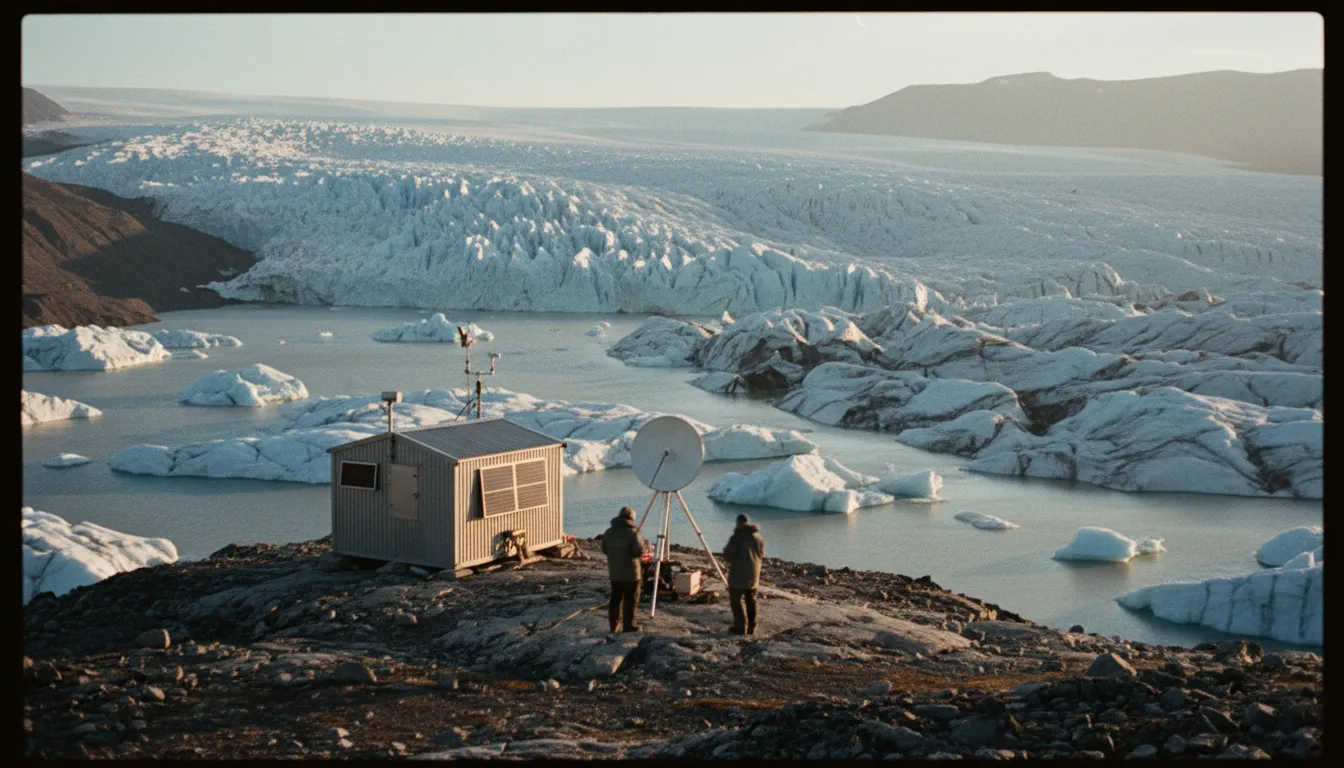
Earth is not a perfect timekeeper. Our planet's spin has been gradually slowing for billions of years, mostly due to the gravitational tug of the Moon. But a new force has entered the equation: melting ice sheets. As polar ice disappears into the oceans, it redistributes billions of tonnes of mass from the poles toward the equator, forcing the planet to spin more slowly—much like a figure skater who extends their arms mid-spin.
The physics is straightforward. The law of conservation of angular momentum dictates that when a spinning object's mass moves farther from its axis, the rotation slows. As meltwater flows from Greenland and Antarctica into the world's oceans, it increases the equatorial bulge, raises the planet's moment of inertia, and puts the brakes on Earth's spin.
Milliseconds That Matter
The numbers sound trivially small. Since 2000, days have been lengthening by roughly 1.33 milliseconds per century—a rate unmatched in the past 3.6 million years, according to research from the University of Vienna and ETH Zurich. If greenhouse-gas emissions remain high, that figure could double to 2.62 milliseconds per century by 2100.
Researchers reconstructed past rotation rates using benthic foraminifera—tiny fossils of single-celled marine organisms whose chemistry records ancient ocean conditions. The record shows that today's rate of change far outpaces anything in millions of years of geological history.
Why GPS and Computers Care
A millisecond may seem insignificant, but modern civilization runs on precise timekeeping. GPS satellites, stock exchanges, power grids, and telecommunications networks all rely on synchronization accurate to billionths of a second. Even small drifts between atomic time (TAI) and observed solar time (UT1) must be corrected.
That correction comes in the form of leap seconds—one-second adjustments added to Coordinated Universal Time (UTC). Since 1972, 27 leap seconds have been inserted, all positive. But a competing trend—a slight acceleration in Earth's core rotation—recently raised the prospect of the first-ever negative leap second, which would have required subtracting a second from global clocks.
Here is where ice melt creates an ironic twist. According to a study published in Nature, polar melting has slowed Earth's spin enough to delay that unprecedented negative leap second by about three years, pushing it from 2026 to roughly 2029. In effect, climate change is buying the world's computer networks extra time to prepare for an adjustment that, as NASA's Jet Propulsion Laboratory notes, most systems have never been designed to handle.
A Problem Nobody Has Solved
Subtracting a leap second poses a challenge that some experts compare to the Y2K bug. While software has been patched over decades to add a second at midnight UTC, virtually no major network or web service has been tested for deleting one. Going from 23:59:59 backward would mean real-time systems must skip a beat—a scenario ripe for glitches in aviation, finance, and cloud computing.
The broader scientific community has pushed back on leap seconds altogether. In 2022, the General Conference on Weights and Measures voted to abolish leap seconds by 2035, allowing atomic time and solar time to drift apart within a wider tolerance. Until then, engineers face the uncomfortable reality that Earth's spin is no longer a reliable clock.
The Bigger Picture
The slowing of Earth's rotation is not, by itself, a catastrophe. Days will not noticeably lengthen in any human lifetime. But it serves as a striking illustration of how profoundly human activity reshapes the planet—not just its atmosphere and oceans, but its fundamental motion through space. When enough ice melts to measurably alter how fast a 6-sextillion-tonne rock spins, the scale of change is difficult to dismiss.