How Lunar Bases Work—and What It Takes to Build One
Building a permanent outpost on the Moon requires solving extreme challenges from radiation and temperature swings to construction with local soil. Here is how engineers plan to make it happen.
Why the Moon Needs a Base
Since the Apollo era ended in 1972, every human visit to the Moon has been a short stay. A permanent lunar base would change that fundamentally—turning the Moon from a destination into a platform for science, resource extraction, and deeper space exploration. But building a habitable outpost 384,000 kilometers from Earth is one of the hardest engineering challenges humanity has ever attempted.
The Hostile Environment
The Moon offers no atmosphere, no magnetic field, and no mercy. Without Earth's protective layers, the lunar surface is bombarded by galactic cosmic rays and solar particle events that can damage human DNA within hours of unshielded exposure. According to research published in Applied Sciences, a regolith shield roughly 2.5 meters thick is needed to reduce radiation to safe occupational levels.
Temperature is equally brutal. Near the south pole—the leading candidate for a base site—sunlit areas reach 54°C while permanently shadowed craters plunge to −246°C. Micrometeorites strike the surface at velocities up to 72 km/s, and the fine, electrostatically charged lunar dust clings to everything, abrading seals, clogging mechanisms, and irritating lungs.
Building With Moon Dirt
Launching construction materials from Earth costs roughly $1 million per kilogram delivered to the lunar surface. That makes in-situ resource utilization (ISRU)—using what is already there—essential. The Moon's regolith, a blanite-like mix of crusite fragments and glass beads, turns out to be a surprisingly versatile building material.
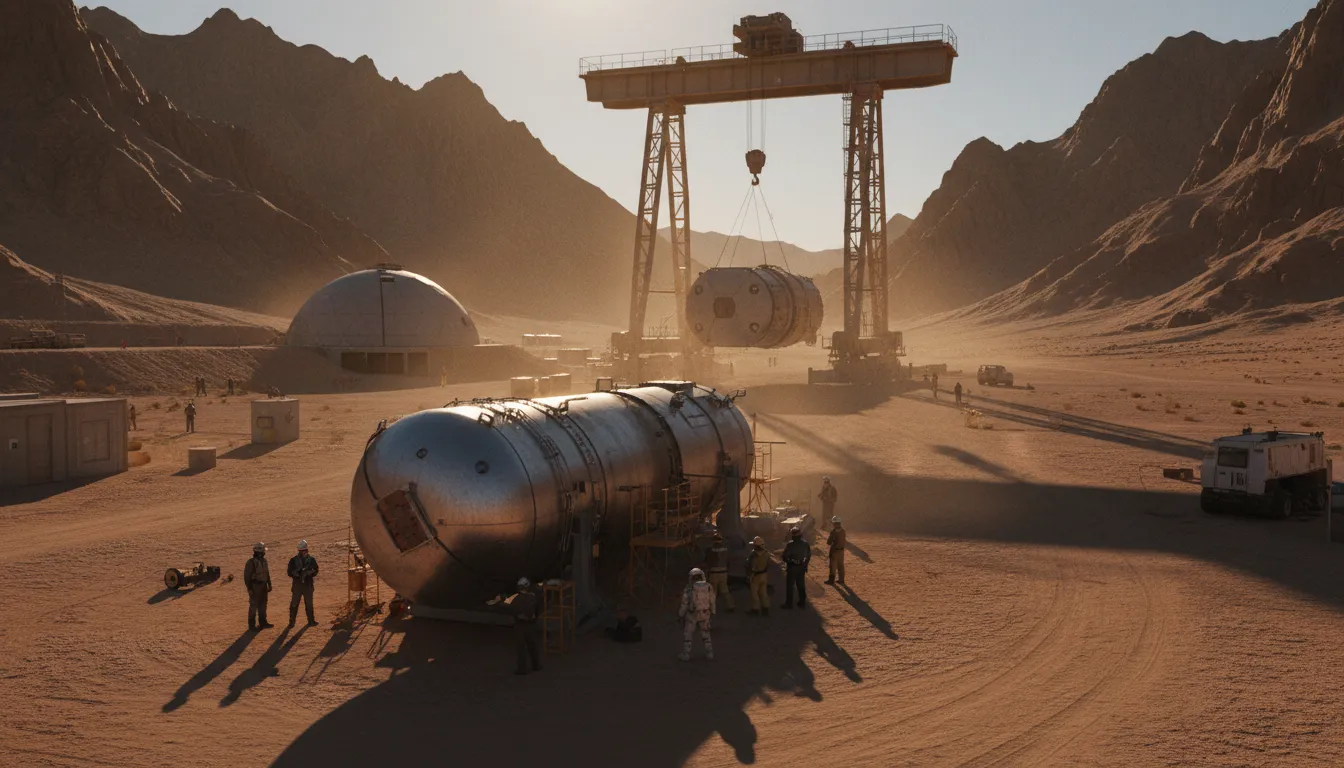
Several 3D-printing approaches are under development. The European Space Agency has partnered with architecture firm Foster + Partners and 3D-printing company D-Shape to demonstrate regolith-based additive manufacturing, producing 1.5-tonne structural blocks from simulated lunar soil mixed with a magnesium-oxide binder. Texas-based company ICON uses a different method: high-powered lasers melt regolith directly, which then solidifies into strong, ceramic-like structures—no binder needed.
The leading habitat concept pairs an inflatable pressurized module brought from Earth with a 3D-printed regolith shell built around it. The inner membrane provides breathable atmosphere; the outer shell handles radiation shielding, thermal insulation, and micrometeorite protection.
Water, Air, and Fuel From Ice
The south pole's permanently shadowed craters contain water ice—a resource that changes everything. Data from NASA's Lunar Reconnaissance Orbiter shows these ice deposits are more extensive than previously thought, scattered across dozens of cold traps.
Extracted water serves triple duty. Purified, it becomes drinking water. Split through electrolysis, it yields breathable oxygen and hydrogen fuel. NASA has outlined plans to demonstrate large-scale oxygen extraction on the Moon, with extracted oxygen supplying both life-support systems and rocket propellant for vehicles departing the lunar surface. A proposed oxygen pipeline would connect extraction sites to habitat and launch areas.
Living in One-Sixth Gravity
Even with shelter, water, and air solved, the human body poses its own challenge. Lunar gravity is just one-sixth of Earth's, and scientists do not yet know whether that is enough to prevent the bone loss, muscle atrophy, and vision problems seen in microgravity on the International Space Station. Long-duration stays on the Moon will be the first real test of partial-gravity physiology.
From Outpost to Settlement
Most space agencies envision a phased approach. Early missions deploy robotic rovers, scientific instruments, and power-generation equipment. Next come semi-habitable modules with regular crew rotations lasting weeks. Eventually, heavier infrastructure enables continuous occupation—a true lunar settlement rather than a campsite.
International collaboration will be critical. The European Space Agency, Japan's JAXA, and India's ISRO have all invested in lunar ISRU and habitat research. China's space agency has outlined parallel plans for a base at the south pole by the early 2030s.
The engineering problems are immense but increasingly solvable. 3D-printed regolith shelters, ice-derived life support, and inflatable habitats have all moved from concept to prototype. The question is no longer whether humans can live on the Moon—it is when the first permanent residents will arrive.