How Naval Mine Clearing Works—and Why It's So Hard
Naval mines are among the cheapest weapons to deploy yet the most expensive and dangerous to remove. Here is how navies detect, sweep, and neutralize these hidden threats lurking beneath the waves.
The Ocean's Hidden Killers
A naval mine costs a fraction of a torpedo, takes minutes to deploy, and can shut down an entire shipping lane for months. Since the American Civil War, mines have sunk or damaged more warships than missiles, torpedoes, and gunfire combined. Removing them is slow, expensive, and extraordinarily dangerous—by some estimates it takes up to 200 times longer to clear a minefield than to lay one, and the cost of removal can exceed the cost of the mine itself by a factor of 100.
What Naval Mines Are and How They Work
A naval mine is a self-contained explosive device placed in water to damage or destroy ships and submarines. Mines fall into several categories based on how they sit in the water and how they detonate.
Contact mines are the oldest type. They float at a set depth, tethered to an anchor on the seabed by a mooring cable. When a ship's hull physically strikes the mine's protruding horns, a chemical reaction triggers detonation. Bottom mines rest directly on the seafloor in shallow water and are far harder to spot. Drifting mines float freely with ocean currents, making them unpredictable.
The most sophisticated modern variants are influence mines. Rather than requiring physical contact, they detect a passing vessel's magnetic field, acoustic signature, or pressure wave. Some are programmed to recognize a specific ship class, ignoring everything else. Others use a "ship counter," allowing a set number of vessels to pass safely before detonating under a high-value target.
How Navies Clear Them
Mine countermeasures (MCM) generally involve three phases: sweeping, hunting, and neutralization.
Minesweeping
Sweeping aims to trigger or disable mines before any ship reaches them. Contact sweeps drag a heavy wire through the water to cut mooring cables, sending mines bobbing to the surface where they can be destroyed by gunfire. Influence sweeps tow equipment that mimics a ship's magnetic and acoustic signatures, tricking mines into detonating harmlessly. However, modern influence mines are designed to discriminate against false inputs, requiring sweepers to accurately replicate a specific target signature—a task complicated by the fact that a single mine may be programmed with one of a hundred different trigger profiles.
Minehunting
Hunting uses high-resolution sonar to locate and classify objects on the seabed. Operators distinguish mines from rocks, debris, and shipwrecks—a painstaking process. Once a suspected mine is identified, a remotely operated vehicle (ROV) moves in for visual confirmation.
Neutralization
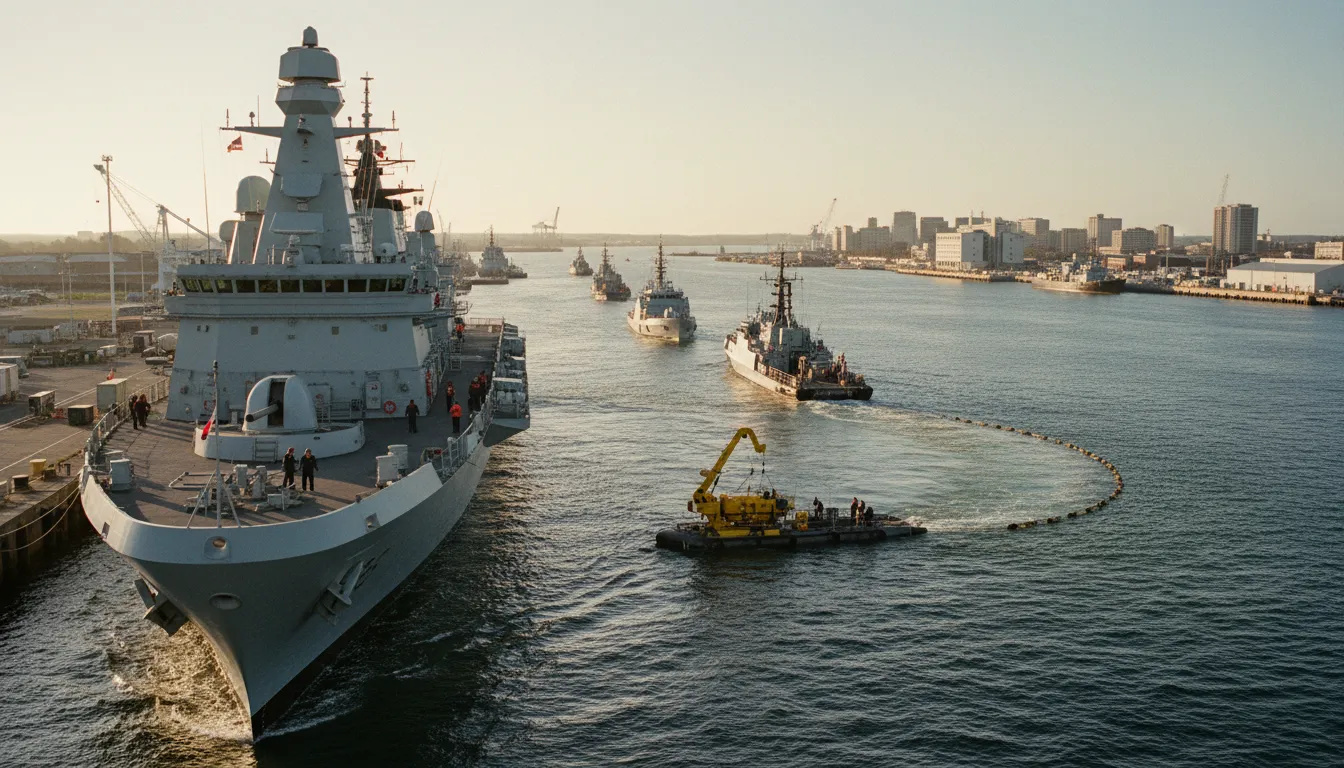
Confirmed mines are destroyed in place, typically by an ROV placing a small explosive charge beside the mine or by divers attaching demolition packs. Both methods carry significant risk, especially in murky or current-swept waters.
The Shift to Unmanned Systems
Traditionally, mine clearance relied on purpose-built minesweepers—ships constructed from wood or fiberglass to minimize their magnetic signature. The U.S. Navy's Avenger-class minesweepers served for decades, but the last forward-deployed vessels were retired in September 2025.
Their replacement marks a generational shift. The Navy now deploys autonomous Mine Countermeasures Unmanned Surface Vehicles (MCM USVs), the first of which were delivered by Bollinger Shipyards in April 2025. These crewless vessels can sweep, hunt, and neutralize mines without putting sailors directly in harm's way. Underwater, the Knifefish unmanned underwater vehicle is designed to hunt sophisticated bottom mines buried in sediment—though the program has faced developmental challenges.
NATO allies are pursuing similar technology. France's Exail produces integrated unmanned MCM systems combining surface drones with autonomous underwater vehicles and towed sonar arrays, all coordinated from a safe command vessel kilometers away.
Why It Matters
Mines remain one of the most cost-effective weapons in any military arsenal. A single minefield can halt commercial shipping, blockade a port, or deny an entire strait to naval forces. During the 1991 Gulf War, two U.S. warships struck mines in the Persian Gulf, and the threat of further mines delayed an amphibious assault. The 255 minesweepers that cleared German mines from the English Channel hours before D-Day in 1944 were essential to the entire Allied invasion.
As unmanned technology matures, mine warfare is entering a new chapter—but the fundamental asymmetry endures. Mines are cheap to make and easy to hide. Finding and removing them remains one of the hardest, most dangerous jobs at sea.