How Small Modular Reactors Work—and Why Big Tech Wants Them
Small modular reactors promise factory-built nuclear power in a fraction of the size of conventional plants. Here is how SMR technology works, why tech giants are investing billions, and what challenges remain.
A New Scale of Nuclear Power
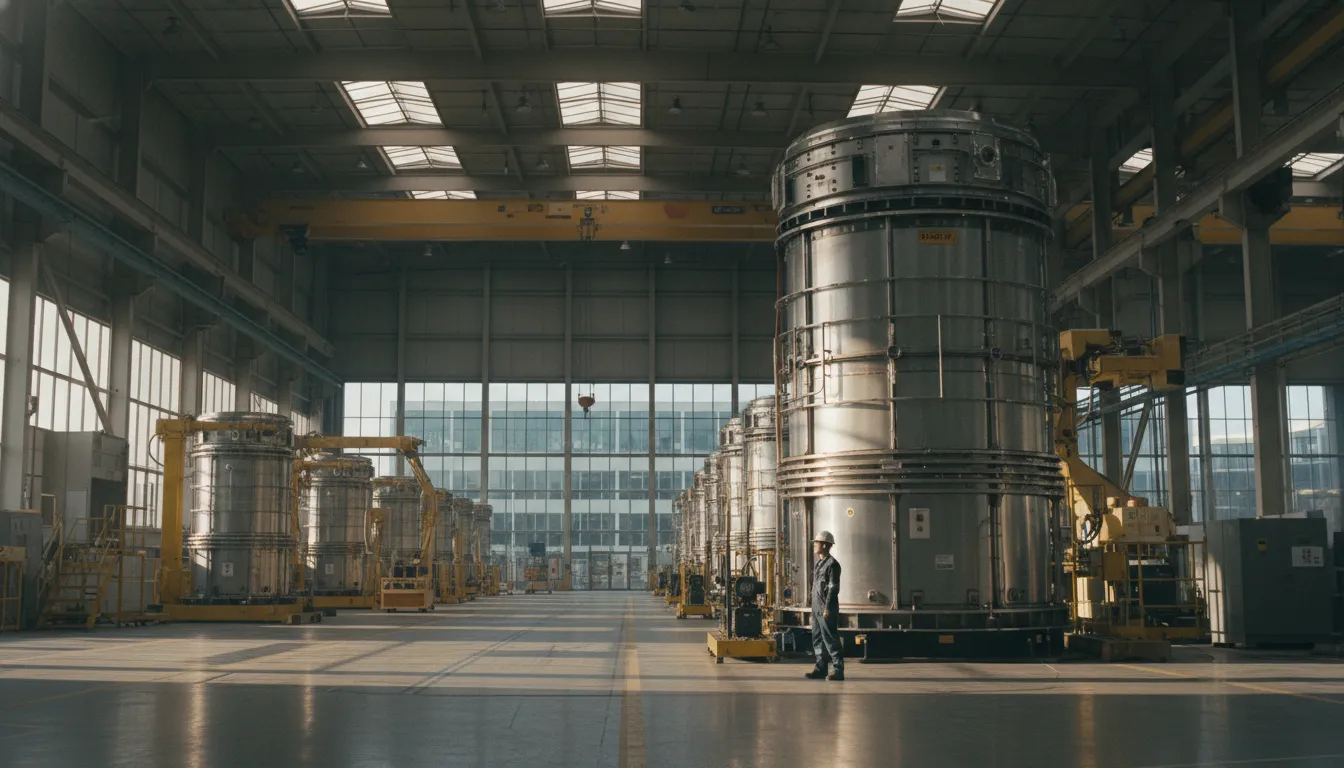
For decades, nuclear energy meant enormous plants costing tens of billions of dollars and taking a decade or more to build. Small modular reactors, or SMRs, aim to change that equation. These compact reactors generate between 10 and 300 megawatts of electricity—roughly a third or less of a conventional reactor's output—and are designed so that major components can be manufactured in a factory and shipped to their final location for assembly.
The concept is not entirely new. Nuclear submarines have used compact reactors since the 1950s. But the civilian push to commercialize SMRs has accelerated sharply, driven by the twin pressures of climate change and surging electricity demand from artificial intelligence data centers.
How SMRs Work
At their core, SMRs operate on the same principle as traditional nuclear plants: controlled nuclear fission splits atoms of uranium or other fuel, releasing heat. That heat converts water into steam, which spins a turbine to generate electricity. The difference lies in engineering and scale.
SMR designs fall into several technology families. Light-water reactors, like those developed by NuScale Power, use pressurized water as both coolant and moderator—the same proven approach used in most existing nuclear plants, but shrunk into modules that can be combined. NuScale's design stacks up to six 77-megawatt modules inside a single facility, allowing operators to scale output from roughly 300 to over 900 megawatts.
Other designs break from tradition entirely. TerraPower's Natrium reactor uses liquid sodium as a coolant instead of water, paired with a molten-salt energy storage system. This lets the plant ramp output from 345 megawatts to 500 megawatts during peak demand—a flexibility that conventional nuclear plants struggle to match. Still other concepts use high-temperature gas or molten salt fuel, each with trade-offs in efficiency, waste production, and technological maturity.
The Safety Advantage
Perhaps the most significant innovation in SMR design is passive safety. Traditional reactors rely on pumps, backup generators, and human operators to keep the core cool during emergencies. Many SMRs instead use natural physical processes—gravity, convection, and the natural circulation of coolant—to shut down and cool the reactor without any external power or human intervention.
According to the U.S. Department of Energy, advanced SMR designs can passively cool themselves for days after shutdown. NuScale's reactor, for instance, can self-cool for at least seven days with no electricity and no operator action. This dramatically reduces the risk of a meltdown scenario like those at Fukushima or Three Mile Island.
Why Big Tech Is Betting Billions
The global push toward SMRs has found an unlikely champion: Silicon Valley. As AI models grow larger and data centers consume ever more electricity, tech companies need reliable, carbon-free power around the clock. Solar and wind are intermittent; SMRs offer capacity factors above 90 percent, meaning they can run nearly continuously.
Meta has signed deals potentially totaling more than six gigawatts of nuclear capacity—enough to power roughly five million homes—including agreements with TerraPower and Oklo, according to Bloomberg. Microsoft revived a unit at Pennsylvania's Three Mile Island under a 20-year power purchase agreement. Google and Amazon have also announced nuclear energy partnerships.
The International Atomic Energy Agency counts roughly 100 SMR designs in development worldwide, with about 74 active projects moving toward construction or licensing.
The Challenges Ahead
For all the enthusiasm, SMRs face real hurdles. Cost remains the biggest question mark. First-of-a-kind projects carry capital costs of $3,000 to $6,000 per kilowatt, and NuScale saw its projected construction cost for a planned Idaho project rise by 75 percent before the project was ultimately shelved. Proponents argue that factory production and serial manufacturing will drive costs down over time, but that has yet to be proven at scale.
SMRs also still produce radioactive waste. Some studies suggest that certain SMR designs may generate spent fuel with higher radiotoxicity per unit of energy than conventional reactors, complicating long-term storage. Licensing timelines remain long: only two SMR designs operate commercially anywhere in the world—Russia's KLT-40S floating reactor and China's HTR-PM high-temperature gas reactor.
The European Commission unveiled a strategy in March 2026 to bring Europe's first SMRs online by the early 2030s, signaling political momentum. But turning blueprints into operating power plants will require regulators, investors, and communities to align—a process that nuclear energy has historically found difficult.
A Bridge Technology?
SMRs will not single-handedly solve the energy transition. But their combination of zero-carbon baseload power, enhanced safety, and flexible siting makes them a compelling complement to renewables. Whether they fulfill that promise depends on whether the industry can deliver on cost and schedule—something nuclear power has rarely managed in the past.