What Is the AMOC—and Why Its Slowdown Matters
The Atlantic Meridional Overturning Circulation is a massive ocean conveyor belt that carries heat northward, keeping Europe warm. Scientists warn it is weakening—and a collapse could reshape global climate.
The Ocean's Giant Conveyor Belt
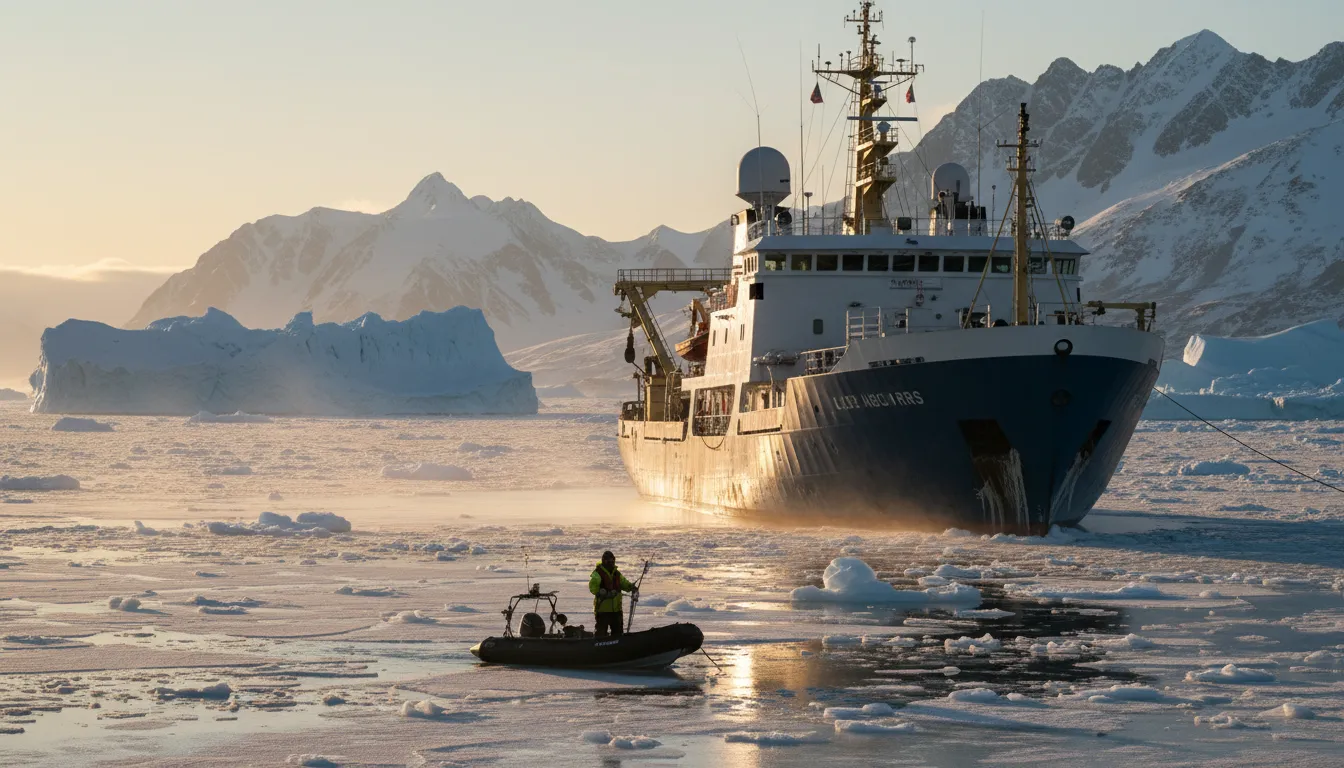
Deep beneath the Atlantic Ocean, a vast system of currents moves water in a continuous loop from the tropics to the Arctic and back again. Known as the Atlantic Meridional Overturning Circulation, or AMOC, this system transports enormous quantities of heat, salt, and nutrients across thousands of kilometres. Scientists often compare it to a giant conveyor belt—one that has kept Europe's climate remarkably mild for millennia.
Every second, the AMOC moves roughly 17 million cubic metres of water northward—equivalent to about 6,800 Olympic swimming pools, according to the National Oceanography Centre. With it comes approximately 1.2 petawatts of thermal energy, roughly 100 times more than all global energy production combined. Without it, Northern Europe would be dramatically colder.
How the AMOC Works
The circulation operates through a process called thermohaline circulation, driven by differences in temperature and salinity. Warm, salty surface water—carried north partly by the Gulf Stream—travels toward the Arctic. As it reaches high latitudes, it cools, and when sea ice forms, salt is left behind in the surrounding water. This cold, dense, salty water sinks deep below the surface and begins flowing southward along the ocean floor.
Eventually, this deep water is drawn back toward the surface through a process called upwelling, warming again as it rises in the Southern Ocean and tropics. The full cycle takes an estimated 1,000 years, according to the Woods Hole Oceanographic Institution.
The key engine of the system lies in the sinking zones of the North Atlantic, particularly in the Labrador and Nordic Seas. If the water arriving there is not cold or salty enough, it will not sink—and the conveyor belt slows.
Why Scientists Are Worried
Multiple lines of evidence suggest the AMOC is weakening. Data from the RAPID-MOCHA monitoring array—a network of buoys stretching across the Atlantic at 26.5°N—shows the circulation's flow rate has declined by roughly 10 percent between 2004 and 2023. A study published in Communications Earth & Environment found that shifts in the Gulf Stream's path near Cape Hatteras may serve as early warning signs of a potential collapse decades in advance.
The primary suspect is freshwater from Greenland's melting ice sheet. As glacial meltwater pours into the North Atlantic, it dilutes the salty water that needs to be dense enough to sink. Less sinking means weaker circulation. Climate models have long predicted this mechanism, and observational data increasingly supports it.
What Would Happen If the AMOC Collapsed?
The consequences of a full AMOC shutdown would be severe and far-reaching. According to the MIT Climate Portal, Europe could cool by an average of 3°C, with Northern Europe experiencing temperature drops exceeding 3°C per decade—far too fast for meaningful adaptation.
Research modelled by Carbon Brief suggests London could face one-in-ten winters with extremes approaching −20°C, while Oslo could see temperatures plunge to −48°C. Beyond cold, Europe would also face significantly reduced rainfall and more frequent droughts, as the AMOC collapse disrupts moisture delivery from the tropics.
The impacts would extend well beyond Europe. The northeastern United States would experience additional sea-level rise as the current's gravitational pull on water weakened. Tropical monsoon systems in Africa and Asia could be severely disrupted, threatening food and water security for billions.
How Likely Is a Collapse?
Scientists remain divided on timing. The Intergovernmental Panel on Climate Change has assessed a full collapse as unlikely this century, but several recent studies have pushed estimated tipping points closer—some as early as mid-century under high-emissions scenarios. The AMOC has shut down before, most notably during the last Ice Age in events called Heinrich events, when massive iceberg discharges flooded the North Atlantic with freshwater.
What is no longer debated is that the AMOC is slowing. Whether this weakening remains gradual or accelerates toward a tipping point depends largely on the pace of ice-sheet melting—and, ultimately, on global emissions trajectories. For a system that takes a millennium to complete one cycle, recovery from a shutdown would not be swift.