How the Haber-Bosch Process Feeds Half the World
The Haber-Bosch process turns atmospheric nitrogen into ammonia for fertilizer, sustaining nearly half the global population — but its massive carbon footprint is driving the search for greener alternatives.
The Invention That Changed Everything
Nitrogen is essential for all living things. It builds proteins, DNA, and the chlorophyll that makes plants green. Although nitrogen gas makes up 78% of Earth's atmosphere, it exists as N₂ — two atoms locked together by one of the strongest bonds in chemistry. Plants cannot use it in that form. For most of human history, farmers relied on manure, crop rotation, and rare mineral deposits to replenish soil nitrogen. Then, in 1909, German chemist Fritz Haber found a way to break that stubborn bond in a laboratory. By 1913, engineer Carl Bosch had scaled the reaction to industrial production. The Haber-Bosch process was born, and it would reshape civilization.
How the Chemistry Works
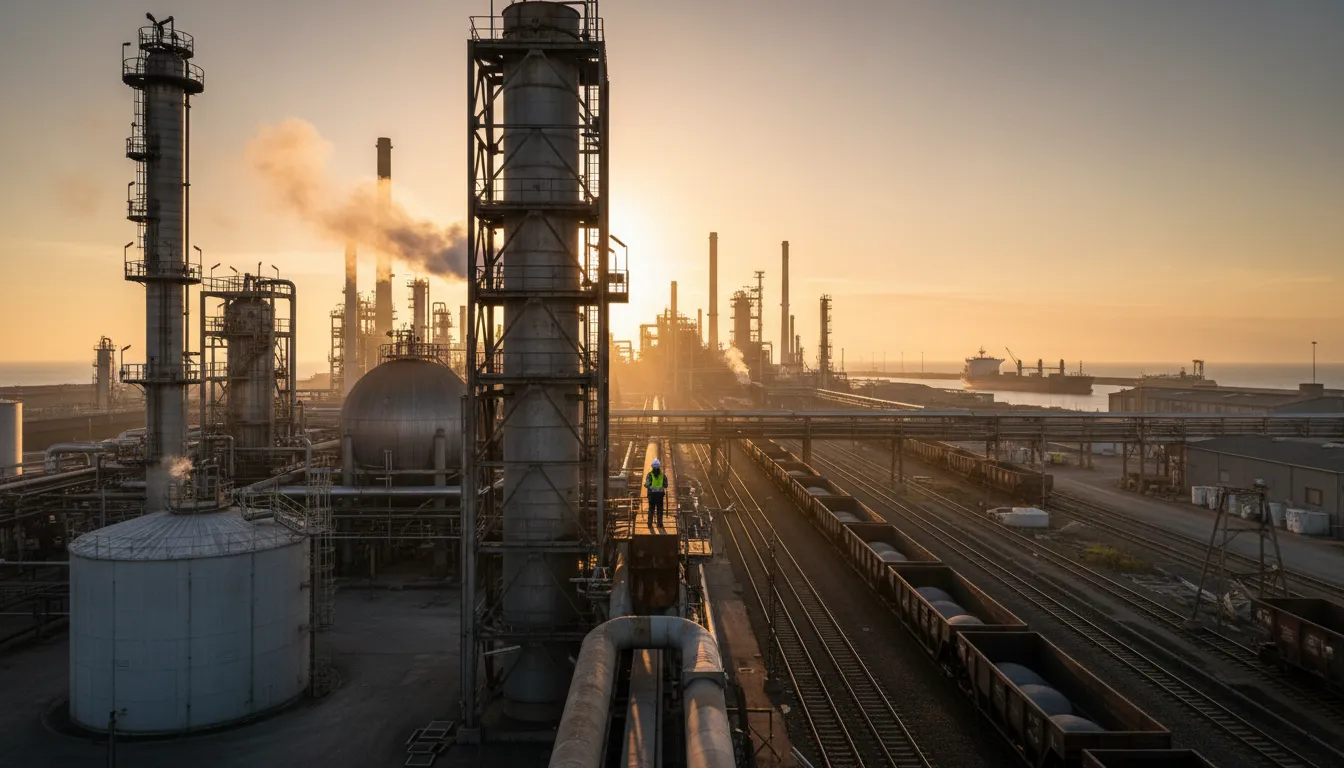
The core reaction is deceptively simple: one molecule of nitrogen gas (N₂) combines with three molecules of hydrogen gas (H₂) to produce two molecules of ammonia (NH₃). In practice, making this happen requires brute force. The reaction runs at roughly 450 °C and 200 atmospheres of pressure inside massive steel reactors, with an iron-based catalyst accelerating the conversion.
Even under these extreme conditions, only about 15% of the gas converts to ammonia in a single pass. Engineers solve this by recycling unreacted gas through the reactor in a continuous loop. The hydrogen feedstock typically comes from steam methane reforming — splitting natural gas with high-temperature steam — which is why the process consumes roughly 1–2% of the world's total energy supply.
The resulting ammonia is either applied directly to fields or converted into products like urea, ammonium nitrate, and other nitrogen fertilizers that farmers spread across billions of hectares every year.
Why It Matters for Food Security
The numbers are staggering. According to Our World in Data, roughly half of global food production depends on synthetic nitrogen fertilizers. A landmark study published in Nature Geoscience estimated that without the Haber-Bosch process, Earth could sustain only about 3–4 billion people — less than half the current population. Nearly 50% of the nitrogen atoms in human body tissue originated from an industrial reactor, not from nature.
Global nitrogen fertilizer consumption reached approximately 110 million metric tons in 2022–2023, a 300% increase since 1961. East and South Asia are the largest consumers, with China alone using over 23 million metric tons annually. The process underpins corn, wheat, and rice yields that would be impossible with organic nitrogen sources alone.
The Environmental Price Tag
The Haber-Bosch process carries a heavy carbon burden. Producing one tonne of ammonia releases roughly 1.6 tonnes of CO₂, and the industry accounts for about 1.2% of global greenhouse gas emissions — more than the entire aviation sector, according to the Rocky Mountain Institute. Over 70% of the hydrogen used comes from natural gas, making ammonia production deeply reliant on fossil fuels.
The environmental costs do not stop at the factory gate. When nitrogen fertilizers are applied to soil, microbes convert a portion into nitrous oxide (N₂O), a greenhouse gas roughly 300 times more potent than CO₂ over a century. Excess nitrogen also washes into rivers and oceans, fuelling algal blooms and aquatic dead zones.
The Search for Greener Alternatives
Researchers and companies are pursuing several paths to decarbonise ammonia production:
- Green ammonia replaces fossil-derived hydrogen with hydrogen from water electrolysis powered by renewable electricity, eliminating direct CO₂ emissions entirely.
- Blue ammonia pairs conventional natural-gas reforming with carbon capture and storage (CCS), reducing but not eliminating emissions.
- Electrochemical synthesis uses electric current to combine nitrogen and hydrogen at low temperatures and pressures in a single step, potentially bypassing the Haber-Bosch reactor altogether.
- Plasma catalysis uses ionised gas to activate nitrogen molecules at near-ambient conditions, a technology still largely in the laboratory stage.
None of these alternatives yet operates at the scale or cost of the conventional process. For the foreseeable future, the century-old Haber-Bosch reaction remains the backbone of global food production — an invention that saves billions of lives while placing an enormous strain on the planet's climate and ecosystems.