How PET Scans Work—and What They Reveal
Positron emission tomography uses radioactive tracers and gamma-ray detection to map metabolic activity inside the body, making it a vital tool for diagnosing cancer, heart disease, and brain disorders.
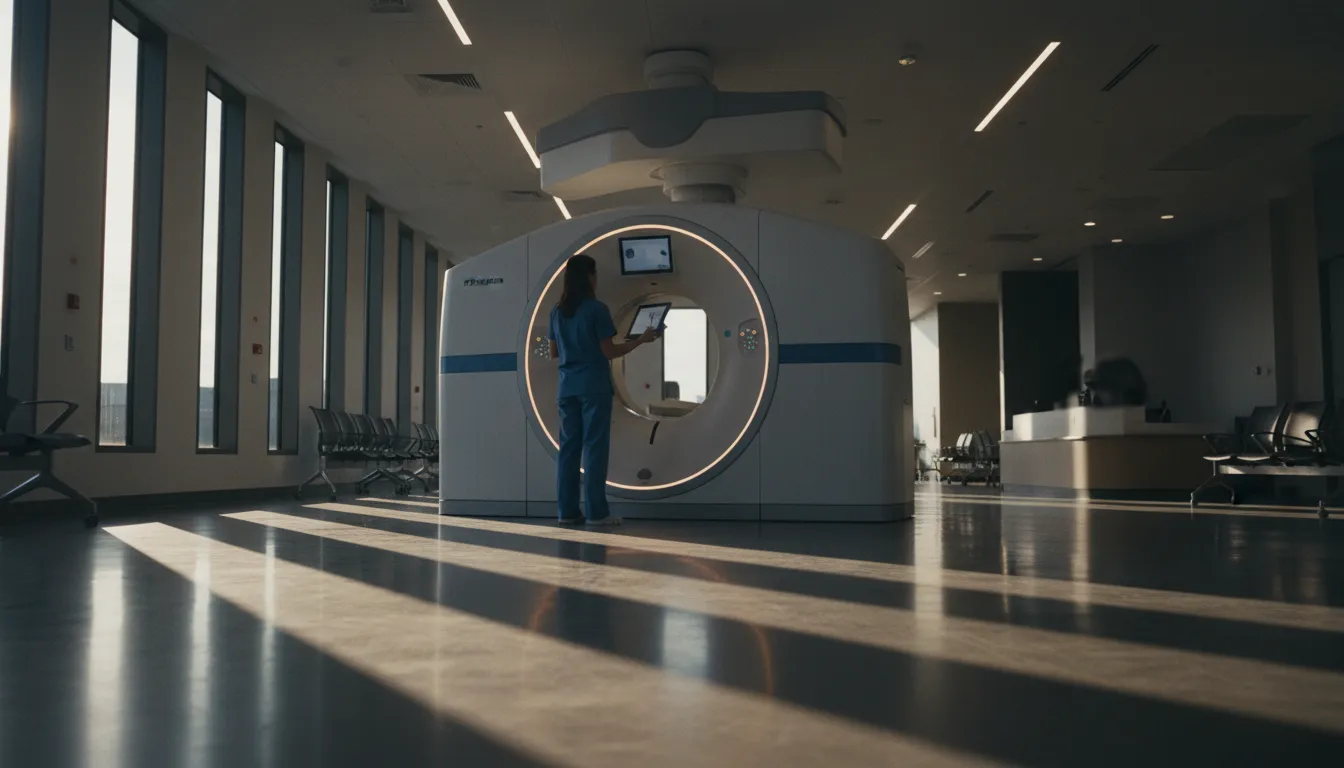
A Window Into the Body's Chemistry
When doctors need to see not just the shape of an organ but how actively its cells are working, they turn to a positron emission tomography (PET) scan. Unlike X-rays or CT scans, which mainly show anatomy, PET reveals metabolic activity—how cells consume energy, absorb nutrients, and function at the molecular level. That distinction makes PET one of the most powerful diagnostic tools in modern medicine.
How the Physics Works
A PET scan begins with a radiotracer—a small amount of radioactive material attached to a biologically active molecule. The most common tracer is fluorodeoxyglucose (FDG), a modified form of glucose. Because cancer cells, active brain regions, and inflamed tissues consume more glucose than surrounding tissue, FDG concentrates wherever metabolic activity is highest.
Once injected into a vein, the tracer circulates for roughly 30 to 60 minutes. During that time, the radioactive atoms in FDG undergo beta-plus decay, emitting tiny particles called positrons. Each positron almost immediately collides with a nearby electron, and the two annihilate each other—producing a pair of gamma rays that fly off in exactly opposite directions.
A ring of detectors surrounding the patient catches these paired gamma rays. Because the two photons arrive at detectors 180 degrees apart within nanoseconds of each other, the scanner pinpoints where the annihilation occurred. A computer then assembles millions of these events into a detailed three-dimensional map of tracer concentration throughout the body.
What PET Scans Detect
PET's ability to measure biochemical activity—rather than just structure—gives it unique clinical value:
- Cancer: Roughly 90% of clinical PET scans use FDG to detect, stage, and monitor tumours. Malignant cells typically have elevated glucose metabolism, so they light up on PET images long before a tumour grows large enough to appear on a CT scan.
- Heart disease: PET can assess blood flow to the heart muscle and identify tissue that is damaged versus tissue that is still alive but receiving reduced blood supply—critical information for deciding whether bypass surgery will help.
- Brain disorders: Neurologists use PET to map brain metabolism in conditions such as Alzheimer's disease, epilepsy, and Parkinson's disease. Specialised tracers can now bind to specific proteins like amyloid plaques or tau tangles, offering a window into neurodegeneration years before symptoms appear.
PET/CT: Combining Function and Form
Most modern PET scanners are paired with a CT (computed tomography) scanner in a single machine called a PET/CT. The CT provides a high-resolution anatomical image, while the PET overlay shows metabolic hotspots. Fusing the two lets radiologists say not only that something is metabolically abnormal but precisely where it sits in the body. According to RadiologyInfo.org, this combined approach has become the standard of care for cancer staging worldwide.
Beyond FDG: New Tracers, New Answers
While FDG remains the workhorse, researchers are developing dozens of specialised radiotracers. Some bind to prostate-specific membrane antigen (PSMA) for prostate cancer detection. Others target somatostatin receptors to find neuroendocrine tumours. Newer tracers measure oxygen consumption, cell proliferation, and even the density of synapses in the brain—expanding PET's reach well beyond glucose metabolism.
Total-Body PET: The Next Leap
Conventional PET scanners image the body in segments, stitching slices together. A new generation of total-body PET systems—with detector rings long enough to capture the entire patient at once—is now entering clinical use. These machines offer dramatically higher sensitivity, enabling scans with lower radiation doses, shorter acquisition times, and the ability to track a tracer's journey through every organ simultaneously. Researchers at UC Davis, who built one of the first total-body scanners called EXPLORER, have used it to study drug distribution and infectious disease spread in real time.
Limitations and Risks
PET scans are not perfect. False positives can occur when inflammation or infection mimics cancer's metabolic signature. False negatives happen with slow-growing tumours that consume little glucose. The radiation dose from a single scan is modest—roughly equivalent to a few years of natural background radiation—but repeated scanning requires careful justification. Additionally, PET scanners are expensive to operate, partly because some radiotracers must be produced in a nearby cyclotron and used within hours before they decay.
Despite these constraints, PET remains indispensable. By revealing the body's chemistry in action, it catches diseases earlier, guides treatment decisions more precisely, and continues to evolve as new tracers and faster scanners push the boundaries of what medicine can see.