How Atoms Could Detect Gravitational Waves
Scientists propose a radical new method to sense gravitational waves by tracking how they shift the light atoms emit, potentially shrinking detectors from kilometers to millimeters.
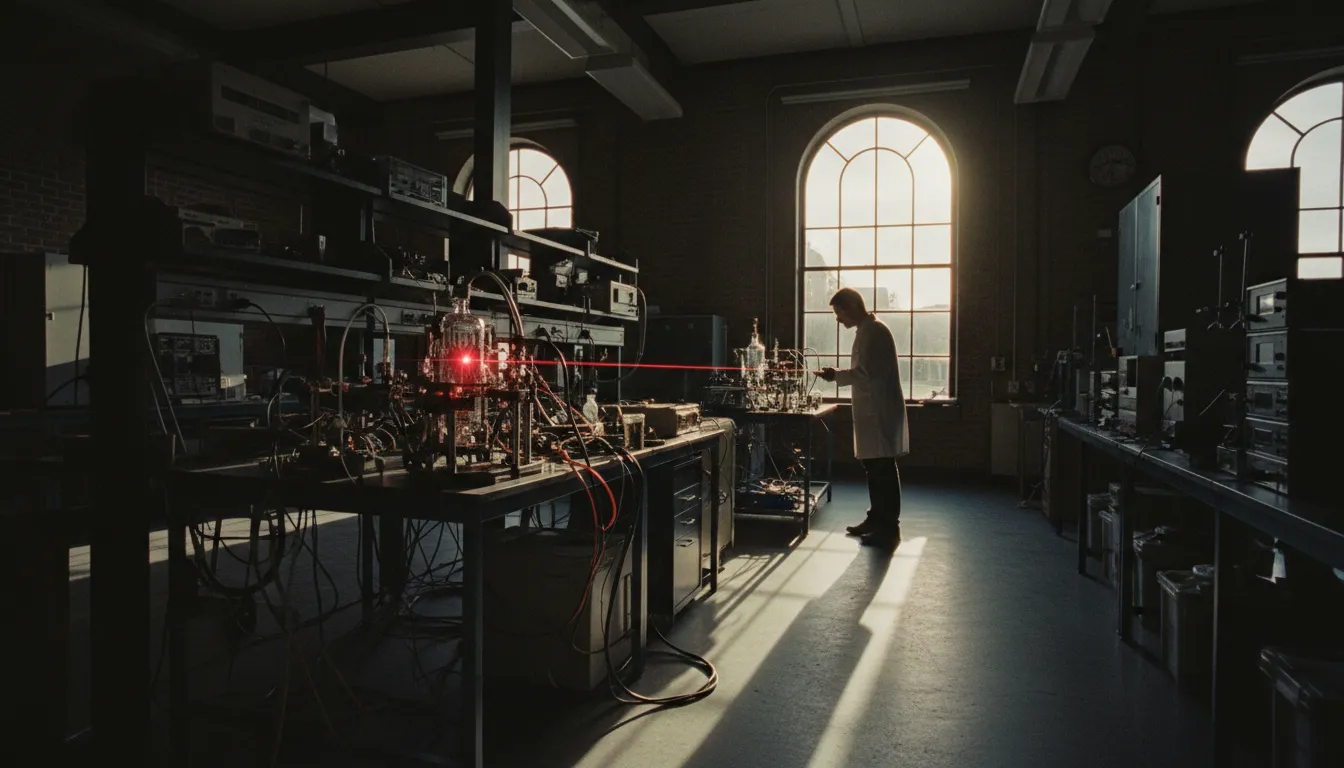
Ripples in Spacetime, Caught by Atoms
Gravitational waves — ripples in the fabric of spacetime generated by cataclysmic cosmic events like colliding black holes and neutron stars — rank among the most elusive phenomena in physics. Since LIGO (Laser Interferometer Gravitational-Wave Observatory) first detected them directly in 2015, scientists have relied on enormous, kilometer-scale instruments to catch these faint distortions. But a theoretical breakthrough suggests there may be another way: listening for gravitational waves through the light that atoms emit.
How Current Detectors Work
Today's gravitational wave observatories, including LIGO's two facilities in the United States and the Virgo detector in Italy, use laser interferometry. A laser beam is split in two and sent down perpendicular arms — each stretching 4 kilometers. Mirrors at the far ends bounce the beams back. When a gravitational wave passes through, it stretches one arm and compresses the other by an almost inconceivably small amount, roughly one ten-thousandth the diameter of a proton. The resulting mismatch in the returning beams produces a telltale interference pattern.
These instruments are engineering marvels, but they come with constraints. They require pristine vacuum tubes spanning kilometers, elaborate vibration isolation, and multiple detectors separated by thousands of kilometers to distinguish real signals from local noise such as earthquakes, traffic, and even ocean waves.
The Atomic Light Approach
A study published in Physical Review Letters by researchers at Stockholm University, Nordita, and the University of Tübingen proposes a fundamentally different strategy. Instead of measuring how spacetime stretches a laser beam's path, the team shows theoretically that gravitational waves alter the spontaneous emission of atoms — the natural process by which an excited atom releases a photon of light as it drops to a lower energy state.
The key insight is subtle. A passing gravitational wave modulates the quantum electromagnetic field surrounding an atom. This does not change how often the atom emits photons. Instead, it shifts the frequency of emitted photons depending on the direction they travel. The result is a distinctive directional pattern stamped onto the atom's emission spectrum.
"Gravitational waves modulate the quantum field, which in turn affects spontaneous emission," explained Jerzy Paczos, a Ph.D. student at Stockholm University and lead author of the study. The photon frequencies vary with emission direction, creating a spectral fingerprint that encodes the wave's origin and polarization.
Why Size Matters
The most exciting implication is scale. While LIGO needs 4-kilometer arms, the atomic ensemble required for this method could be millimeter-sized. Narrow optical transitions already used in atomic-clock platforms offer the long interaction times needed to detect the effect, and today's cold-atom laboratories already operate at the required precision.
"Our findings may open a route toward compact gravitational-wave sensing," said postdoctoral researcher Navdeep Arya. Such miniaturized detectors would not replace LIGO, but could complement existing observatories — particularly for low-frequency gravitational waves that current instruments struggle to measure.
From Theory to Lab
The work remains theoretical. The researchers' own analysis suggests the effect could be measured in state-of-the-art cold-atom experiments, but they caution that a thorough noise analysis is necessary to assess practical feasibility. Isolating the gravitational wave signal from other influences on photon frequencies will be a significant engineering challenge.
Still, the proposal joins a growing family of alternative gravitational wave detection concepts, including space-based atomic clock networks and atom interferometers. Each targets different parts of the gravitational wave spectrum, and together they could open windows onto cosmic events invisible to current detectors — from the slow orbital dances of supermassive black holes to echoes of the early universe.
If the atomic light method survives experimental scrutiny, it could mark a shift from building ever-larger instruments to engineering ever-more-precise ones — proving that sometimes, to hear the universe, you just need to watch an atom glow.