How Spacecraft Splashdown Recovery Works
From parachute deployment to Navy diver extraction, here is how space agencies recover astronauts and capsules from the ocean — a method used since the dawn of human spaceflight.
Why Spacecraft Land in the Ocean
Every human spacecraft that has carried NASA astronauts beyond low Earth orbit — from Mercury in 1961 to Orion in 2026 — has ended its mission the same way: plunging into the ocean under parachutes. The reason is physics. Water's density and viscosity make it a natural shock absorber, cushioning a multi-ton capsule enough that no braking rockets are needed for the final descent. A land landing demands either retro-rockets, airbags, or both, adding weight and complexity. For American capsule designers, the ocean has always been the simpler, lighter solution.
Slowing Down: 25,000 mph to 20 mph
A returning capsule hits the upper atmosphere at roughly 25,000 mph. Its heat shield absorbs temperatures exceeding 2,700 °C during the initial deceleration. Once speed drops to around 300 mph, a carefully sequenced parachute system takes over.
NASA's Orion capsule, for example, carries 11 parachutes made from 36,000 square feet of Kevlar and nylon canopy, connected by more than 13 miles of Kevlar suspension lines. The sequence unfolds in stages:
- Drogue chutes deploy at about 20,000 feet — two 23-foot-diameter canopies that stabilize and slow the capsule.
- After roughly 30 seconds, the drogues are cut away and three pilot chutes pull out the main parachutes.
- The mains inflate in controlled stages using reefing lines — textile bands that restrict the canopy to just 3.5% of its full area, then 11%, before finally opening completely. This staged inflation prevents the sudden shock loads that could tear the fabric or snap the lines.
By the time the capsule hits the water, it is traveling at roughly 20 mph — a hard jolt for the crew, but a survivable one.
The Recovery Fleet
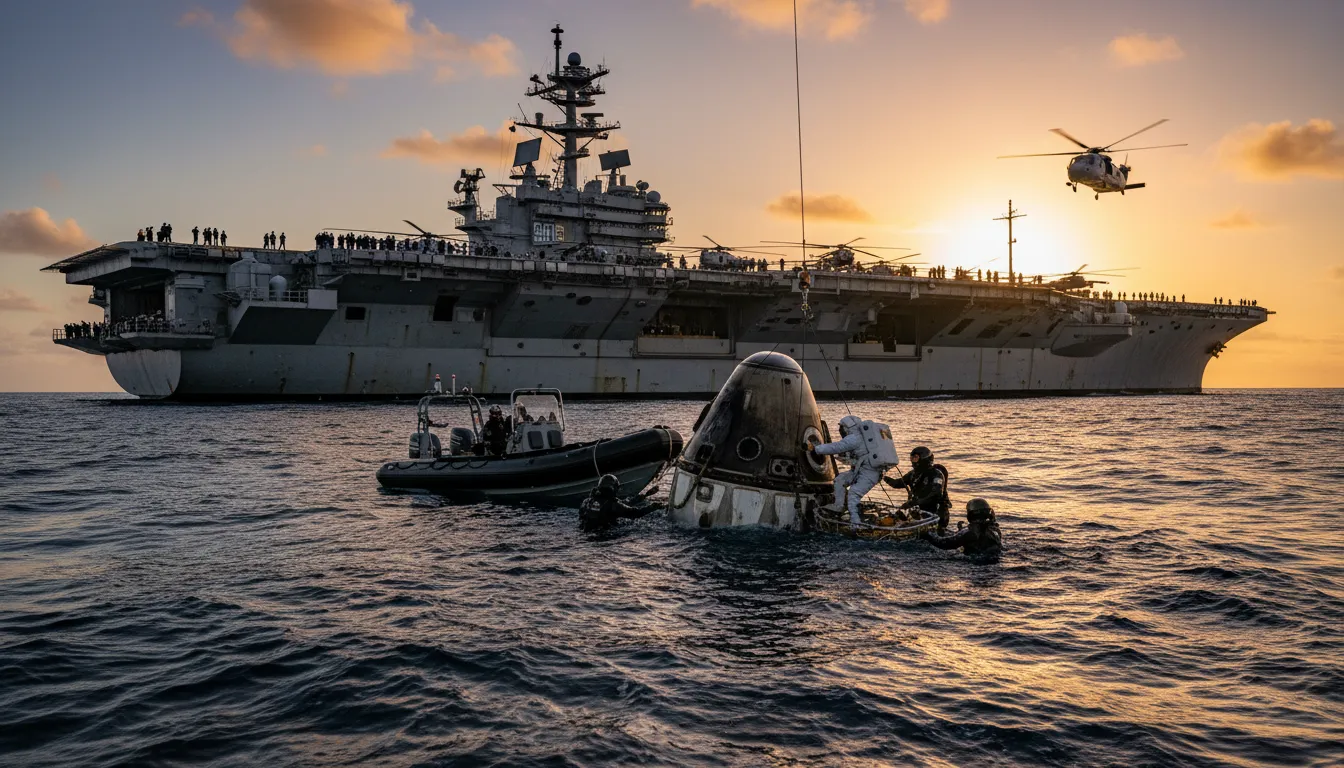
Recovery is not improvised. The U.S. Navy pre-positions a recovery ship, helicopters, small boats, and teams of specialist divers at the predicted splashdown zone 12 to 14 hours before the capsule arrives. NASA sets strict weather criteria: wave heights below six feet, winds under 29 mph, and no lightning within a 30-nautical-mile radius.
The practice dates back to Project Mercury. On early flights, a helicopter simply hooked a cable to the capsule and lifted it to a carrier deck. That method nearly ended in disaster when Liberty Bell 7 sank in 1961 after its hatch blew prematurely. Every subsequent program adopted more robust procedures.
From Ocean to Ship: Step by Step
Modern recovery follows a precise choreography:
- Hazard assessment. Navy divers approach the floating capsule by small boat to check for toxic propellant leaks, structural damage, or unstable orientation.
- Flotation collar. Divers attach an inflatable ring around the capsule's base — essentially a large rubber life raft — to prevent it from capsizing in waves. This device was introduced after the Apollo program and remains standard.
- The "front porch." An inflatable platform, nearly as large as the capsule itself, is secured beneath the side hatch. It gives astronauts a stable surface to stand on as they exit.
- Crew extraction. Medical personnel perform initial health checks inside the capsule. Astronauts then climb onto the front porch, are fitted with recovery vests, and are hoisted by helicopter to the recovery ship.
- Capsule retrieval. A crane aboard the ship lifts the empty capsule from the water for transport back to the manufacturer for inspection.
The entire crew extraction typically takes one to two hours from the moment of splashdown.
A Method That Endures
Russia's Soyuz capsules land on the steppes of Kazakhstan using retro-rockets, and China's Shenzhou follows a similar approach. But every American crew vehicle currently flying — NASA's Orion and SpaceX's Dragon — uses ocean splashdown. SpaceX revived the technique in 2020 when its Crew Dragon brought astronauts home for the first U.S. splashdown in 45 years.
The fundamentals have barely changed since the 1960s: parachutes slow the fall, water cushions the impact, and Navy divers pull the crew to safety. What has improved is precision — modern GPS guidance can place a capsule within a few miles of the recovery ship, compared to the wider dispersions of the Apollo era. The ocean remains, as it has for six decades, humanity's preferred runway from space.