How Octopus Intelligence Works—a Distributed Mind
Octopuses possess 500 million neurons, two-thirds of which reside in their arms rather than their central brain. This distributed nervous system enables remarkable cognition—from tool use to individual human recognition—offering scientists a radically different model of how intelligence evolves.
A Brain Unlike Any Other
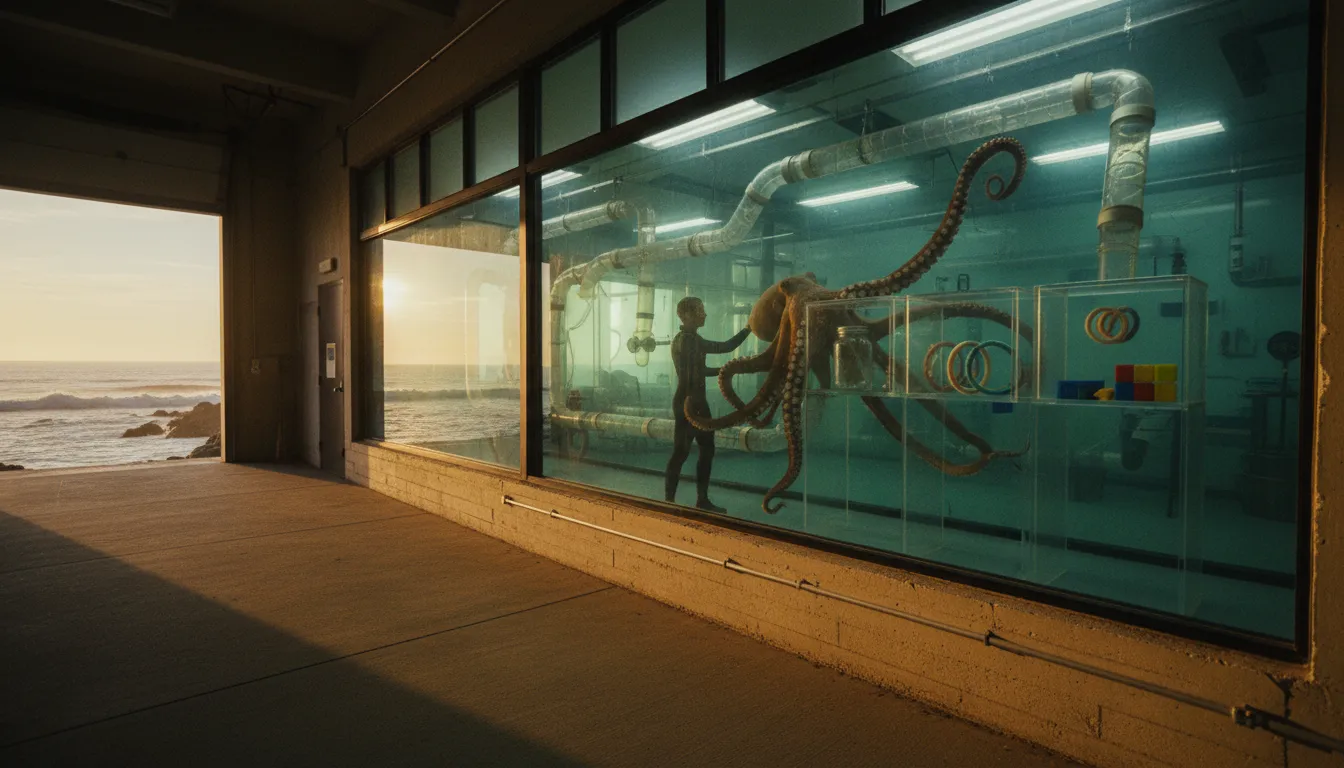
Octopuses are the closest thing Earth has to an alien intelligence. With roughly 500 million neurons—comparable to a dog—they can solve puzzles, use tools, and even recognize individual human faces. Yet their last common ancestor with humans was a simple, worm-like creature that lived more than 600 million years ago. Everything about the octopus mind evolved independently from our own, making it one of the most fascinating case studies in all of neuroscience.
Two-Thirds of the Brain Lives in the Arms
The most striking feature of octopus neurology is its decentralized architecture. In humans, the brain sits in the skull and sends commands down the spinal cord. In an octopus, roughly two-thirds of all neurons reside not in the central brain but in the nerve cords running through the eight arms, according to researchers at Stanford's Wu Tsai Neurosciences Institute.
Each arm functions as a semi-autonomous "mini brain." The arms can taste, touch, and execute complex movements—even hunt prey—without waiting for instructions from the central brain. In laboratory experiments, electrically stimulated isolated arms reproduced the precise bending motion octopuses use to capture food, proving that motor programs are embedded locally in the arm's neural tissue.
The arms also communicate directly with one another through a neural ring that bypasses the central brain entirely. As a result, the octopus brain sets broad goals and direction, while the arms handle real-time execution on their own.
Problem-Solving, Tools, and Play
This distributed design does not come at the cost of sophistication. Octopuses demonstrate cognitive feats that rival many vertebrates:
- Tool use: The veined octopus collects coconut shell halves and carries them across the seafloor to assemble into portable shelters—a clear case of planning ahead.
- Puzzle solving: They can unscrew jar lids from both inside and outside, open latched acrylic boxes, and navigate simple mazes using visual cues.
- Individual recognition: Octopuses distinguish among individual people, even when those people wear identical uniforms. In lab settings, they behave differently toward "nice" keepers who feed them versus "mean" keepers who poke them with a bristly stick.
- Play: They have been observed repeatedly blowing bottles back and forth in a jet of water—an activity with no apparent survival function, meeting the scientific definition of play.
Notably, octopuses do not rely on simple trial-and-error. Research published in PLOS ONE found that individuals develop distinct problem-solving strategies, and their personality traits—such as boldness toward new objects—affect how they approach challenges.
Why Scientists Are So Interested
Vertebrate brains, from fish to humans, share a common evolutionary blueprint. Octopus brains represent an entirely separate experiment in building intelligence. By studying how cephalopods process information, neuroscientists gain insight into which features of cognition are universal requirements for intelligence and which are merely one evolutionary solution among many.
This question has taken on new urgency. A May 2026 feature in Nature reported that neuroscientists are increasingly turning to cephalopods to understand whether complex brains must be centralized—or whether distributed processing can achieve comparable results. The research has implications not just for biology but for fields like robotics and artificial intelligence, where engineers are experimenting with decentralized control systems inspired by octopus arm coordination.
The Limits of Octopus Intelligence
For all their cognitive power, octopuses face a crucial limitation: they cannot pass knowledge to the next generation. Most species live only one to two years, and mothers typically die shortly after their eggs hatch. Without parental teaching or social learning, every octopus must figure out the world from scratch—a stark contrast to the cumulative culture that defines human intelligence.
Yet within a single short lifetime, these soft-bodied mollusks learn to deceive predators, plan escapes, and outwit laboratory containment. Their existence is a powerful reminder that intelligence is not a single ladder with humans at the top, but a branching tree with many remarkable routes to cognition.