How Multistage Rockets Work—and Why They Must
Multistage rockets solve the fundamental physics problem that makes single-stage-to-orbit nearly impossible, shedding dead weight stage by stage to reach orbital velocity.
The Physics Problem Every Rocket Must Solve
Every rocket faces the same cruel arithmetic: to reach orbit, a vehicle must accelerate to roughly 7.8 kilometres per second. That requires enormous amounts of propellant—but propellant has mass, and more mass demands still more fuel to carry it. Engineers call this the tyranny of the rocket equation, a term rooted in the mathematics that Russian theorist Konstantin Tsiolkovsky first described in 1903.
The Tsiolkovsky rocket equation shows that a single-stage vehicle reaching orbit would need about 88% of its total launch mass to be propellant, leaving barely 12% for engines, tanks, and payload. In practice, no material is light and strong enough to make that work with useful cargo aboard. The solution, used by every orbital rocket ever flown, is staging—building a rocket in sections that are discarded once empty.
How Staging Works
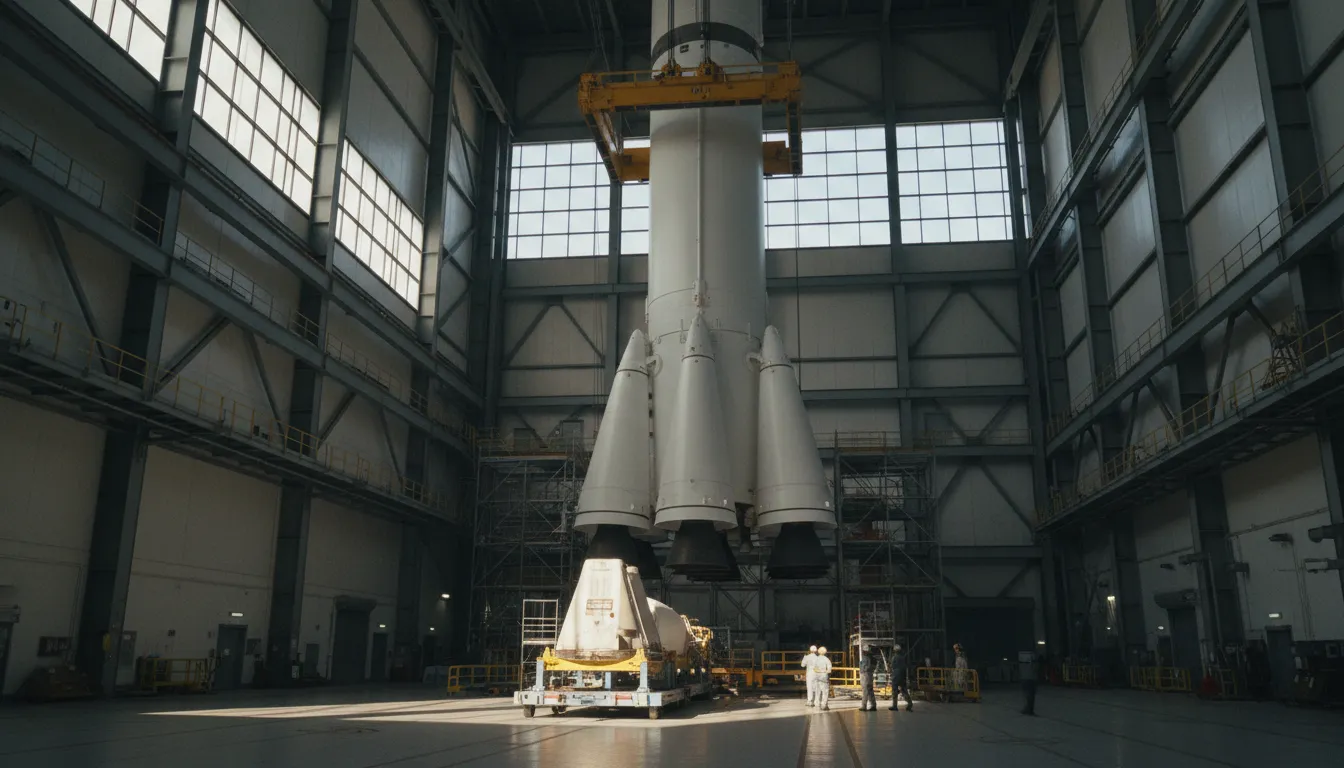
A multistage rocket is essentially two or more rockets stacked together. Each stage contains its own engines, propellant tanks, and guidance systems. The stages fire in sequence:
- First stage (and any strap-on boosters): Ignites at launch, producing maximum thrust to overcome gravity and atmospheric drag. When its fuel is spent, explosive bolts or mechanical latches release it from the vehicle.
- Upper stage(s): Ignite after separation. Because the dead weight of the empty first stage has been jettisoned, each kilogram of remaining propellant now accelerates a much lighter vehicle, yielding far more velocity per unit of fuel.
Most modern orbital rockets use two or three stages. Russia's veteran Soyuz family uses a parallel-staging design where strap-on boosters fall away first, followed by a central core and then an upper stage. SpaceX's Falcon 9 uses a simpler two-stage serial configuration, recovering and reusing the first stage after separation.
Why Each Stage Is Different
Staging isn't just about shedding mass—it allows engineers to optimise each section for its flight regime. First-stage engines must operate efficiently at sea-level atmospheric pressure, so they use relatively small exhaust nozzles. Upper-stage engines, firing in near-vacuum, use large bell-shaped nozzles that extract more energy from expanding gases. Propellant choices may also differ: some vehicles pair kerosene-fuelled first stages with hydrogen-fuelled upper stages for maximum efficiency at altitude.
The Numbers Behind the Trick
Consider a simplified example. A single-stage rocket needing 9 km/s of delta-v (velocity change) with an exhaust velocity of 3.5 km/s would require a mass ratio of about 13:1—meaning only 8% of launch mass could be structure and payload. Split that same mission across two stages, and each stage only needs a mass ratio around 3.6:1, a far more achievable engineering target. The total rocket is heavier at launch, but it can actually carry meaningful cargo to orbit.
According to NASA and aerospace references, no single-stage chemical rocket has ever reached orbit. Every successful orbital launch—from Sputnik in 1957 to the newest vehicles flying in 2026—has relied on staging.
Modern Innovations
While the principle hasn't changed since the 1950s, how engineers implement staging continues to evolve:
- Reusable first stages: SpaceX lands and reflies Falcon 9 boosters, dramatically cutting costs while retaining the physics benefits of staging.
- Parallel staging: Strap-on boosters (used on Ariane 5, Atlas V, and Soyuz) add thrust at liftoff without requiring a taller rocket.
- Stage-and-a-half designs: Some rockets jettison engines but keep tanks, reducing mechanical complexity.
Russia's newly tested Soyuz-5, which completed its maiden flight in April 2026, carries up to 17 tonnes to low-Earth orbit using a conventional two-stage architecture optimised for cost and reliability.
Why It Still Matters
Staging remains the only proven method of reaching orbit with chemical propulsion. Until a revolutionary new technology—perhaps nuclear thermal or advanced air-breathing engines—can deliver far higher exhaust velocities, every rocket headed to space will continue shedding its skin on the way up, obeying the same equation Tsiolkovsky wrote down more than a century ago.