How Air Force One Works—the Flying White House
Air Force One is more than a plane — it's a mobile command center with missile defenses, nuclear-hardened electronics, and 238 miles of wiring that lets the president govern from 45,000 feet.
Not a Plane — a Call Sign
"Air Force One" is not the name of a specific aircraft. It is the air traffic control call sign for any U.S. Air Force plane carrying the sitting president. If the president boards a Marine helicopter, it becomes Marine One. A Navy jet becomes Navy One. Even a civilian flight would be designated Executive One. The call sign was created in 1954 after a Lockheed Constellation carrying President Eisenhower entered the same airspace as a commercial flight with an identical flight number, creating dangerous confusion.
The Current Fleet: Two Modified 747s
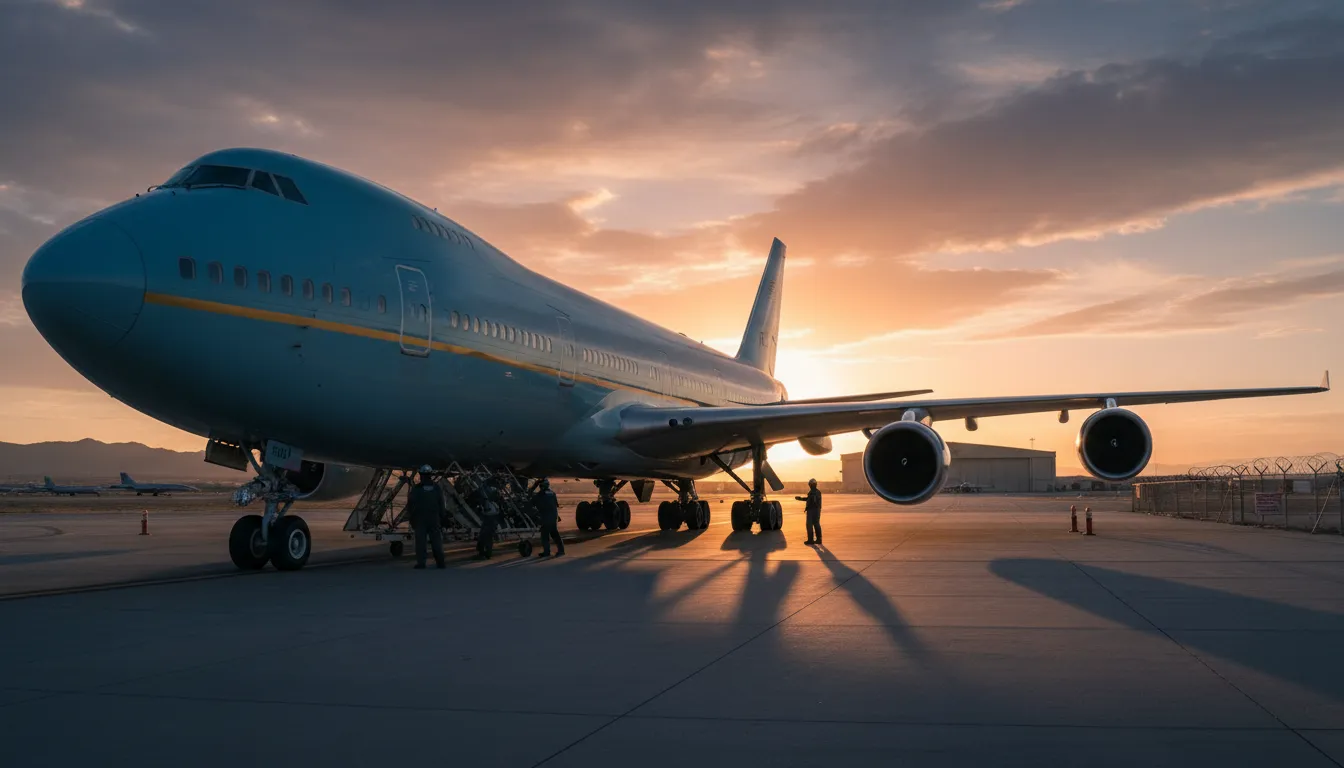
In practice, the president almost always flies on one of two identical Boeing VC-25A aircraft — heavily modified 747-200Bs with tail numbers 28000 and 29000. Delivered in 1990 during the George H.W. Bush administration, these planes feature interiors designed by First Lady Nancy Reagan with a color palette evoking the American Southwest.
Key specifications include four General Electric CF6-80C2B1 engines producing 56,700 pounds of thrust each, a maximum speed of 630 mph (Mach 0.92), a range of 7,800 miles without refueling, and a ceiling of 45,100 feet. The aircraft spans 4,000 square feet across three levels — roughly the size of a large house.
A Flying Command Center
Inside, the president has a private suite with an office, bedroom, and bathroom. A medical bay doubles as a fully equipped operating room with a physician always on board. Two galleys can serve 100 people simultaneously, and 87 phones plus multiple secure fax machines keep the White House connected to the world.
What makes the VC-25A unique is its 238 miles of wiring — double a standard 747 — all shielded against nuclear electromagnetic pulses. Encrypted satellite links, scrambler-protected phone systems, and hardened electronics ensure the president can order a military response or conduct diplomacy even during a nuclear event.
Missile Defenses and Self-Sufficiency
The aircraft carries an AN/AAR-54(V) missile launch warning receiver that detects incoming threats by tracking exhaust signatures. Countermeasures include infrared flares to spoof heat-seeking missiles, chaff to confuse radar-guided weapons, and AN/ALQ-204 Matador electronic jammers. The plane can also refuel mid-air, giving it theoretically unlimited range.
Air Force One needs no airport infrastructure beyond a runway. Retractable stairways and a self-contained baggage loader mean the president can arrive at airfields with minimal ground support — critical for emergency scenarios or visits to austere locations.
When It Flies Without the President
Without the commander-in-chief aboard, these same aircraft use the call signs SAM 28000 and SAM 29000 — "SAM" standing for Special Air Mission. The 89th Airlift Wing at Joint Base Andrews in Maryland operates and maintains both planes, keeping at least one mission-ready at all times.
The Billion-Dollar Replacement Problem
After more than three decades in service, the current VC-25As are being replaced by two Boeing 747-8I aircraft designated VC-25B. Originally budgeted at $3.9 billion with delivery planned for 2024, the program has ballooned to an estimated $6.2 billion with first delivery now projected for mid-2028. The delays forced the Air Force to acquire a Qatar-donated 747 as a temporary stand-in, highlighting how difficult it is to replicate the flying fortress that protects the presidency.