What Is Scarborough Shoal—and Why Big Powers Clash
Scarborough Shoal is a tiny atoll in the South China Sea that has become one of the world's most contested patches of water, pitting China against the Philippines and drawing in the United States.
A Tiny Ring of Rock With Outsized Importance
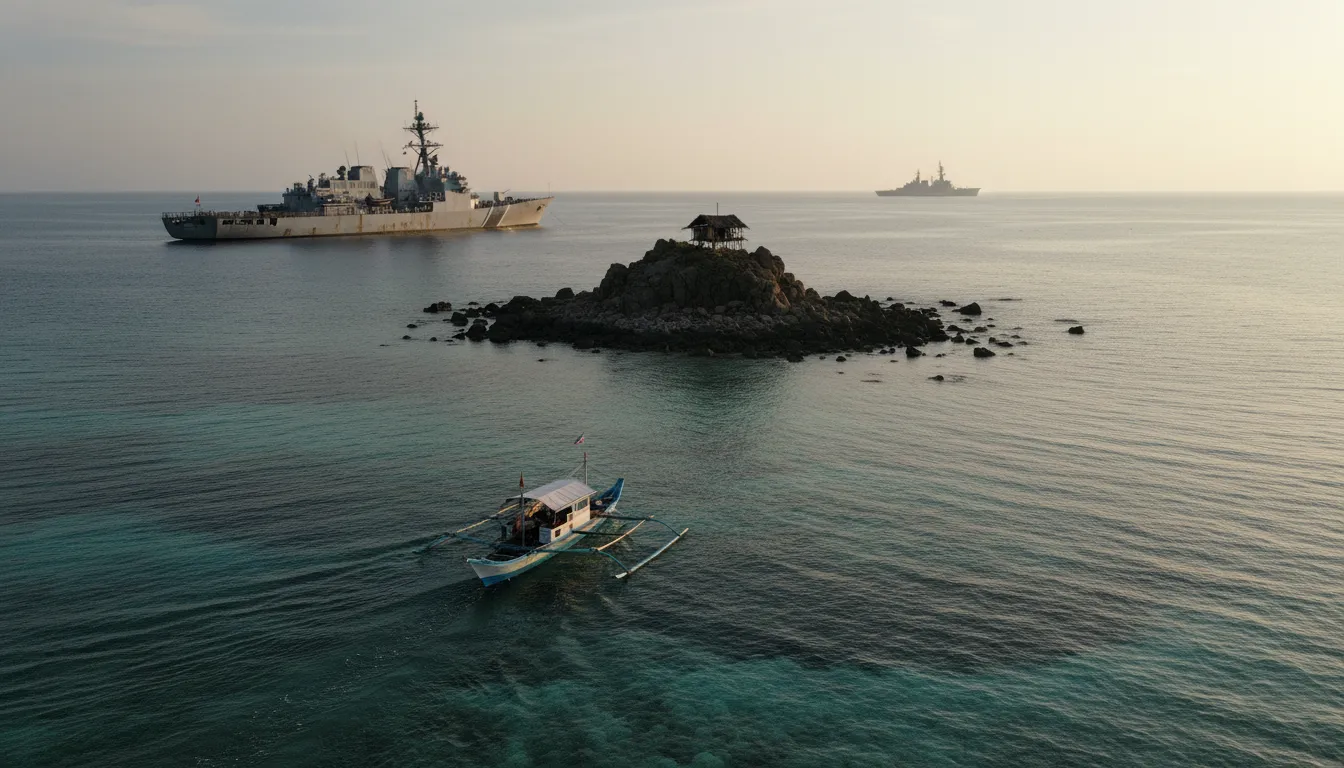
Scarborough Shoal is a roughly triangular chain of rocks and coral reefs in the South China Sea, enclosing a shallow lagoon about 150 square kilometres in area. At high tide, only a handful of boulders break the surface. Yet this remote atoll—claimed by China, the Philippines, and Taiwan—has triggered naval stand-offs, international arbitration, and some of the tensest moments in modern Asia-Pacific relations.
The shoal sits about 220 kilometres west of Luzon, the Philippines' largest island, well within its 370-kilometre exclusive economic zone (EEZ). China's nearest major landmass lies more than 800 kilometres to the northwest. Despite that distance, Beijing insists the feature falls within its historic maritime domain.
Why It Matters: Fish, Ships, and Strategy
Scarborough Shoal's lagoon shelters rich fishing grounds that local Filipino and Chinese fishermen have shared for generations. But the atoll's real significance is strategic. It sits near shipping lanes that carry an estimated $3.4 trillion in annual global trade, according to the Council on Foreign Relations. Control of the shoal extends a country's surveillance and patrol reach across one of the world's busiest maritime corridors.
For the Philippines, losing access threatens the livelihoods of thousands of artisanal fishers. For China, maintaining a presence reinforces its broader claim to nearly the entire South China Sea—a claim visualised by the so-called nine-dash line on Chinese maps.
The Nine-Dash Line and China's Claims
China's sweeping South China Sea claims trace back to a map published by the Nationalist government in 1947, originally featuring eleven dashes. After the Communist takeover in 1949, the line was trimmed to nine. It arcs south from mainland China past Vietnam and the Philippines, enclosing the Paracel Islands, Spratly Islands, and Scarborough Shoal—roughly 90 percent of the South China Sea.
Beijing argues the line reflects centuries of Chinese navigation and fishing activity. Neighbouring states—particularly Vietnam, the Philippines, Malaysia, and Brunei—reject the claim as incompatible with the United Nations Convention on the Law of the Sea (UNCLOS), which allocates maritime zones based on coastal geography, not historical usage.
The 2012 Stand-off That Changed Everything
The modern confrontation at Scarborough Shoal crystallised in April 2012. The Philippine Navy spotted Chinese fishing vessels inside the lagoon and dispatched a warship, the BRP Gregorio del Pilar, to investigate. China responded with its own coast guard vessels, and a tense two-month stand-off followed. It ended with a U.S.-brokered agreement for both sides to withdraw—but only the Philippines pulled back. China's coast guard has maintained a continuous presence ever since, effectively controlling access to the lagoon.
The Landmark 2016 Ruling
In 2013, the Philippines took the dispute to the Permanent Court of Arbitration in The Hague under UNCLOS. The tribunal's July 2016 ruling was sweeping: it found that China's nine-dash line claim had "no legal basis" and that Beijing had violated the Philippines' sovereign rights. It also classified Scarborough Shoal as a "rock" under international law—meaning it generates only a 12-nautical-mile territorial sea, not a full EEZ.
China rejected the ruling as "null and void" and has refused to comply. With no enforcement mechanism, the decision remains a powerful legal precedent but a practical dead letter, according to analysis by the U.S.-China Economic and Security Review Commission.
Floating Barriers and Ongoing Friction
Since 2023, China has repeatedly deployed floating barriers across the entrance to the lagoon, physically blocking Filipino fishing boats. Philippine coast guard crews have cut through some barriers, only for China to reinstall them. Water-cannon blasts, near-collisions between patrol boats, and low-altitude aircraft flyovers have become regular occurrences.
The United States has a mutual defence treaty with the Philippines and has stated that an armed attack on Philippine public vessels in the South China Sea would trigger its treaty obligations. This makes Scarborough Shoal one of the most likely flashpoints for a direct U.S.-China confrontation.
What Comes Next
Despite the legal ruling and international criticism, the status quo appears entrenched. China continues to consolidate control through coast guard patrols and physical obstructions. The Philippines, backed by the U.S. alliance, maintains its challenge but lacks the naval power to dislodge Chinese forces unilaterally. Scarborough Shoal remains what it has been for over a decade: a small ring of rocks at the centre of the world's most dangerous maritime dispute.