How the UN Security Council Presidency Rotates
Every month, a different country takes the helm of the world's most powerful security body. Here's how the UN Security Council presidency rotation works, what powers the president wields, and why the system sparks controversy.
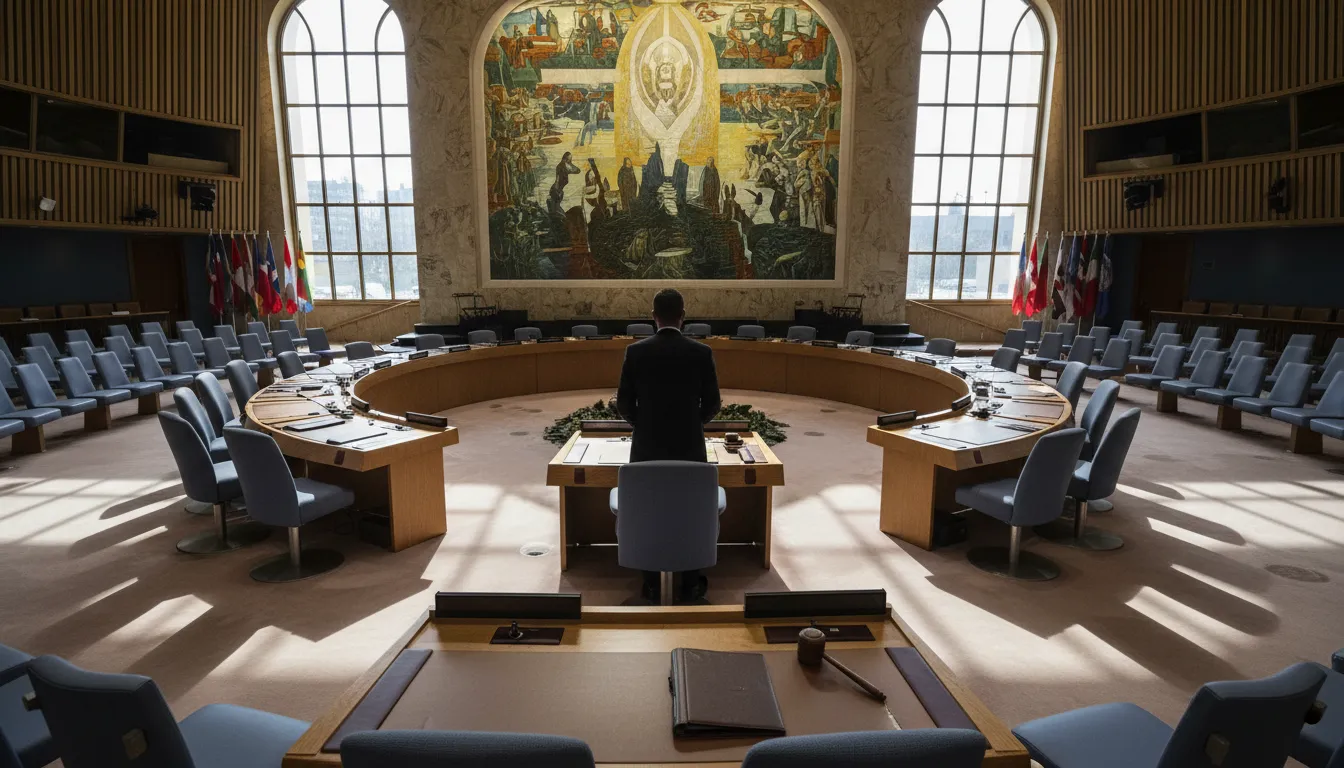
One Month at the Helm
The United Nations Security Council is the only international body with the authority to issue binding resolutions, deploy peacekeepers, and impose sanctions. Yet its leadership changes hands every single month. Under a system established at the Council's very first meeting in January 1946, each of the fifteen member states takes a turn presiding over the body that is charged with maintaining international peace and security.
The rotation follows a simple rule: English alphabetical order of the member states' names. No distinction is made between the five permanent members—China, France, Russia, the United Kingdom, and the United States—and the ten elected members who serve two-year terms. A small country elected for a brief stint wields the gavel under the same rules as a nuclear-armed permanent member.
What the President Actually Does
The Security Council president is not a figurehead. The role carries several concrete powers outlined in Rules 18–20 of the Council's Provisional Rules of Procedure:
- Setting the agenda — The president approves the provisional agenda each month, deciding which crises, conflicts, and thematic issues the Council will discuss.
- Calling and chairing meetings — The president convenes sessions, recognizes speakers, and manages debate.
- Issuing presidential statements — Subject to consensus among all fifteen members, the president can issue formal statements on behalf of the entire Council.
- Representing the Council — The president speaks for the body before other UN organs and member states.
Of these, agenda-setting is widely considered the most consequential. Research from Columbia University's School of International and Public Affairs has shown that the presiding country can influence which issues receive attention—and which are quietly sidelined. Statistical analysis suggests that meetings are far less likely to be called on topics where the permanent members hold sharply divergent views.
A Brief History of the Rotation
The rotation system was adopted on 17 January 1946, when the Council held its inaugural session in London. French alphabetical order was originally proposed—echoing the practice of the League of Nations—but English was chosen instead by the UN Preparatory Commission.
An early quirk emerged that first year: with only eleven members, the Council needed a fix so that future rotations would begin neatly on the first of each month. Security Council Resolution 14 extended the U.S. presidency through December 1946 to resolve the timing. When the Council expanded to fifteen members in 1966, the math improved—each member now serves as president exactly once per year in most circumstances.
When Controversy Takes the Chair
The rotation's strict neutrality means that every member—regardless of its current geopolitical standing—gets its month. This has produced awkward and politically charged situations throughout history.
In 1950, the Soviet Union used its presidency during the Korean War to manipulate Council procedures for partisan purposes. More recently, when Russia assumed the presidency in April 2023, U.S. Ambassador Linda Thomas-Greenfield warned that Moscow would "spread disinformation and promote their own agenda" regarding Ukraine. Western diplomats openly called the rotation an "April Fool's joke."
The rules do include one safeguard: if a president's own country is directly involved in a conflict under discussion, the president is expected to temporarily cede the chair to another member. In practice, enforcement of this norm depends on diplomatic pressure rather than any binding mechanism.
Why the System Endures
Despite criticism, the monthly rotation has survived for eight decades because it serves a fundamental purpose: it gives every Council member—large or small, permanent or elected—an equal opportunity to shape the global security agenda, even if only for thirty days. Reform proposals surface regularly, but changing the presidency would require amending rules that all fifteen members, including the veto-wielding P5, must accept. For now, the gavel keeps passing, one month at a time.