How Pharmaceuticals Get Into Crops Via Wastewater
As water scarcity pushes farmers worldwide to irrigate with treated wastewater, research reveals that crops absorb trace pharmaceuticals—and where exactly those chemicals end up in the plants we eat.
Why Wastewater Ends Up on Farmland
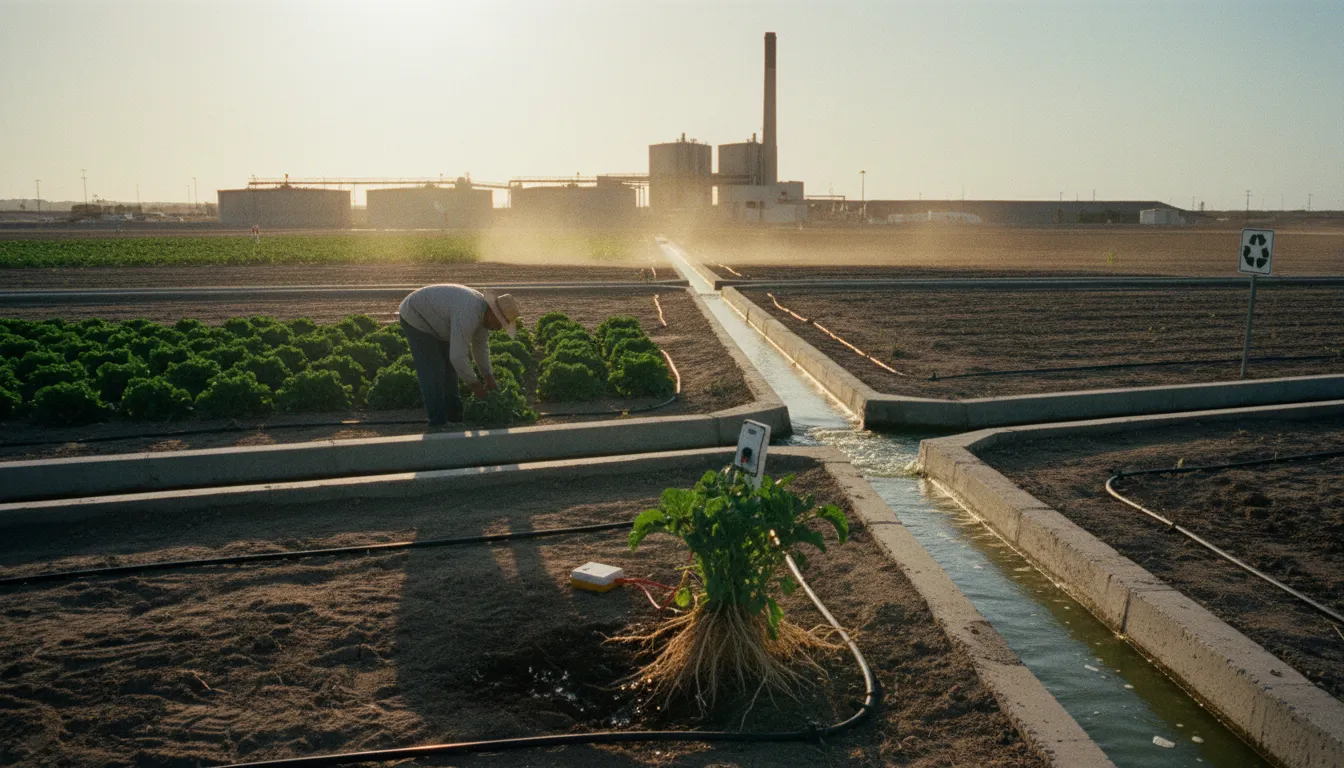
Agriculture consumes roughly 70 percent of the world's freshwater. As droughts intensify and aquifers shrink, farmers in arid regions increasingly turn to a resource that never runs dry: treated municipal wastewater. Over 20 million hectares of farmland worldwide are already irrigated with reclaimed water, according to research published in the journal Sustainability. Israel leads the practice, recycling nearly 90 percent of its wastewater—about four times the rate of any other country—with much of it directed to crop irrigation.
The logic is sound: why discharge nutrient-rich water into rivers when it can grow food? But treated wastewater carries passengers that standard purification does not fully remove—among them, trace amounts of pharmaceutical drugs flushed into sewage systems by millions of people every day.
What Happens When Crops Drink Drug-Laced Water
Plants absorb water through their roots and pull it upward via transpiration, the same process that moves nutrients from soil to stem. Dissolved pharmaceuticals hitchhike along for the ride. As water evaporates through leaf pores called stomata, drug compounds are left behind and gradually concentrate in plant tissue.
"Plants don't have a well-developed mechanism to excrete these drug compounds. They can't easily get rid of waste by peeing, like humans do," explained Daniella Sanchez, a doctoral researcher at Johns Hopkins University, in a university report on her recent findings. Instead, plants stash the chemicals in cell walls and vacuoles—tiny compartments that function as cellular trash bags.
Which Drugs and Which Crops
Sanchez's study, published in Environmental Science & Technology, tested tomatoes, carrots, and lettuce exposed to four psychoactive medications commonly detected in treated wastewater:
- Carbamazepine — used for seizures and bipolar disorder
- Lamotrigine — an epilepsy treatment
- Amitriptyline — a tricyclic antidepressant
- Fluoxetine — the active ingredient in Prozac
The results showed a striking pattern. Tomato leaves contained more than 200 times the pharmaceutical concentration found in the fruit. Carrot leaves held roughly seven times more than the edible roots. Carbamazepine proved the most persistent, accumulating even in edible portions such as carrot roots and tomato fruits. Lamotrigine, by contrast, remained at low levels across all tissues.
Broader field surveys confirm this hierarchy. According to a review in the Journal of Agricultural and Food Chemistry, pharmaceutical uptake generally follows a pattern: leafy vegetables absorb the most, followed by root vegetables, cereals, and finally fruit-bearing crops.
Should Consumers Worry?
The concentrations detected so far are measured in nanograms per gram—millions of times lower than a therapeutic dose. "Just because these medications are commonly found in treated wastewater doesn't mean they'll have any meaningful impact on the plant or plant consumer," said Carsten Prasse, associate professor of environmental health and engineering at Johns Hopkins.
Still, scientists note that long-term, low-dose exposure through diet is poorly understood, and the cocktail effect of multiple pharmaceuticals acting together remains largely unstudied. A 2024 risk assessment published in the Journal of Toxicology and Environmental Health found that while individual drug residues in crops typically fall below safety thresholds, gaps remain in how regulators evaluate cumulative exposure.
What Comes Next
With water scarcity projected to affect two-thirds of the global population within the coming decades, wastewater reuse in agriculture will only grow. Researchers hope that mapping which drugs concentrate in which plant parts can guide smarter regulations—potentially flagging specific pharmaceuticals for tighter wastewater treatment standards or steering irrigation toward crops less prone to uptake.
For now, the science offers a reassuring headline: the edible parts of common vegetables accumulate far less than the leaves that typically end up in the compost bin. But as more of the world's food depends on recycled water, understanding the pharmaceutical trail from drain to dinner plate will become an essential part of food safety.