How Quantum Computing Works and Why It Matters
Quantum computers don't just run faster — they compute in a fundamentally different way. Here's what qubits, superposition, and entanglement actually mean, and why the technology is entering a pivotal new era.
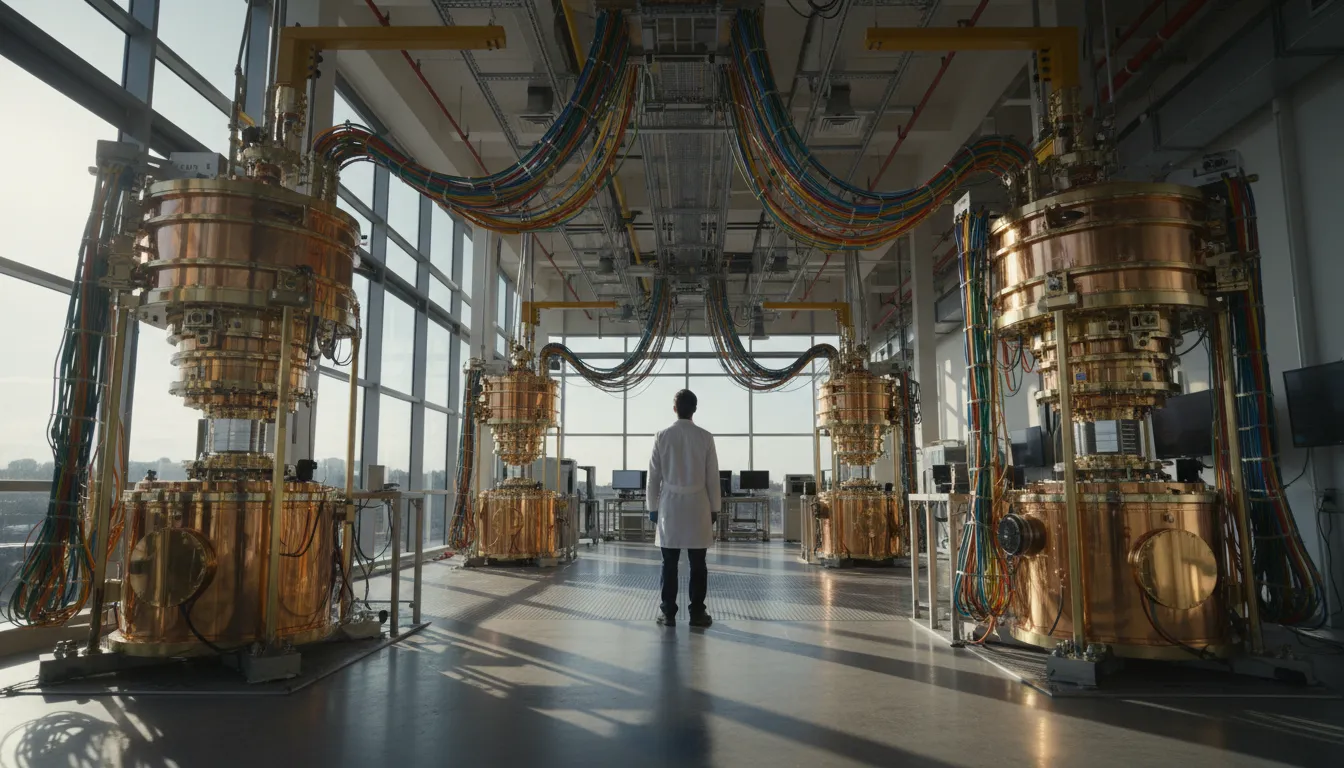
Beyond Ones and Zeros
Every laptop, smartphone, and server on the planet runs on the same basic principle: information is encoded as bits — tiny switches that are either off (0) or on (1). Quantum computers throw out that rulebook entirely. Instead of bits, they use qubits, which exploit the strange laws of quantum mechanics to process information in ways that would be physically impossible for any classical machine.
According to IBM, a qubit can represent 0, 1, or — crucially — both at the same time. This property, called superposition, is the first of three pillars that make quantum computing radically different.
The Three Pillars: Superposition, Entanglement, Interference
Superposition
Imagine spinning a coin: while it's in the air, it is neither heads nor tails — it's both. A qubit works similarly. Because it exists in a superposition of 0 and 1, a quantum computer with just 50 qubits can explore roughly one quadrillion states simultaneously. A classical computer would have to check each possibility one by one. As the National Institute of Standards and Technology (NIST) explains, this parallel exploration is what gives quantum machines their theoretical edge on certain types of problems.
Entanglement
The second pillar is entanglement — a phenomenon Einstein famously called "spooky action at a distance." When two qubits become entangled, the state of one instantly influences the other, no matter how far apart they are. This linkage means that adding more qubits doesn't just add computing power linearly — it multiplies it exponentially. Entanglement allows a quantum processor to coordinate its calculations in a way no network of classical chips can replicate.
Interference
The third pillar is interference. Quantum algorithms are carefully designed so that wrong answers cancel each other out (like waves colliding and flattening), while correct answers reinforce each other and grow stronger. When the machine is finally measured — at which point qubits "collapse" to a definite 0 or 1 — the result that emerges is almost always the right one. This is quantum computing's elegant trick: not brute force, but guided probability.
A "Transistor Moment" for Quantum Tech
For decades, quantum computing lived almost entirely in research labs. That is changing. Scientists writing in the journal Science declared in early 2026 that quantum technology has reached its "transistor moment" — an inflection point analogous to the 1947 invention of the transistor, which triggered the entire digital revolution by replacing bulky vacuum tubes with tiny, efficient switches.
The analogy is apt. Early transistors were slow, expensive, and prone to failure. So are today's qubits. But just as transistors shrank from room-sized computers to the billions packed into a modern smartphone chip, qubits are steadily becoming more stable and practical. The key metric has shifted: engineers no longer just count qubits — they now obsess over error rates, calibration, and whether results are reliably reproducible.
What Can Quantum Computers Actually Do Today?
Quantum computers are not general-purpose machines that will replace your laptop. They excel at a specific class of problems where the number of possible solutions is astronomically large. According to the South Carolina Quantum Association, the most promising near-term applications include:
- Drug discovery: Simulating molecular interactions at the quantum level to identify new medicines far faster than classical computers allow.
- Financial optimization: Banks including Goldman Sachs and JPMorgan have already piloted quantum algorithms for portfolio management and risk analysis.
- Materials science: Designing new superconductors, batteries, and catalysts by modeling atomic behavior precisely.
- Cryptography: Both breaking existing encryption schemes and designing quantum-proof replacements — a race that has significant national security implications.
Most real deployments today use hybrid architectures: a classical computer handles the bulk of the work, while a quantum processor is called in for the steps where it offers a genuine advantage — more like a specialized accelerator than a standalone system.
The Challenges Ahead
The biggest obstacle remains quantum error correction. Qubits are extraordinarily fragile — vibrations, temperature fluctuations, and even stray electromagnetic fields can cause errors. Building a fully fault-tolerant quantum computer requires thousands of physical qubits just to represent a single reliable "logical" qubit. Most experts believe large-scale, error-corrected machines are still a decade or more away.
The global quantum computing market was valued at between $1.8 billion and $3.5 billion in 2025, with projections pointing to over $5 billion by 2029 — driven by investment from governments, tech giants, and startups alike. The United States, China, and the European Union are all funding national quantum strategies, treating the technology as a strategic priority on par with semiconductors and AI.
Why It Ultimately Matters
Quantum computing will not transform everyday life overnight. But for the hardest problems humanity faces — designing life-saving drugs, cracking the chemistry of clean energy, securing global communications — it may one day provide answers that classical computers simply cannot reach. Understanding the basics now means being prepared for a shift that, like the transistor before it, could quietly reshape everything.