How Reusable Rockets Work and Why They Matter
Reusable rockets recover their boosters after launch, refurbish them, and fly again—slashing launch costs by up to 75% and transforming space from a government privilege into a commercial reality.
Why Rockets Were Once Treated Like Paper Cups
For most of the space age, reaching orbit meant destroying the vehicle that got you there. Each rocket—worth tens or hundreds of millions of dollars—plunged into the ocean after a single flight, making space travel extraordinarily expensive and accessible only to governments with vast budgets. Then SpaceX changed the equation.
The core insight is simple: if airlines treated planes the way the aerospace industry once treated rockets, a transatlantic ticket would cost millions of dollars. Reusable rockets apply the same logic to spaceflight—recover the hardware, refurbish it, and fly again.
How a Booster Comes Back to Earth
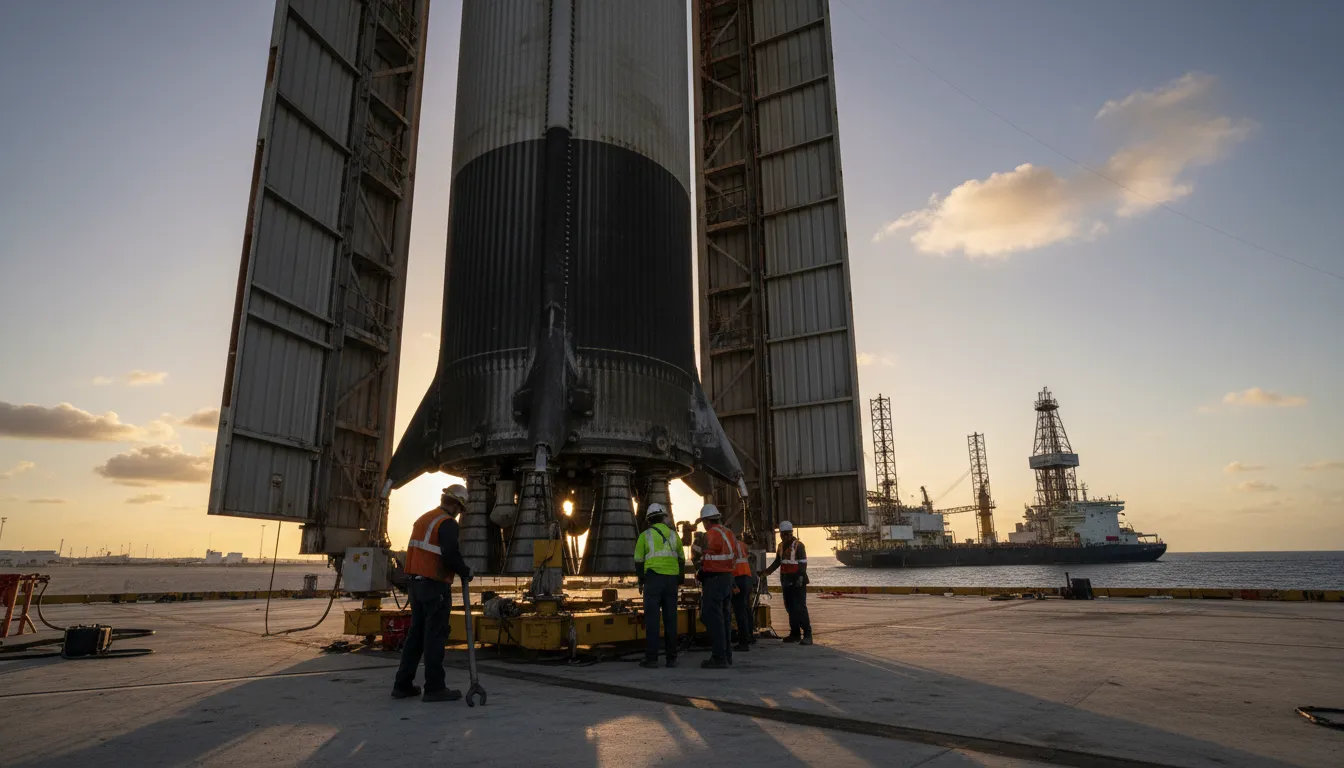
A typical reusable rocket is divided into at least two stages. The first stage—the large lower section housing the main engines—provides most of the thrust during the first few minutes of flight, consuming the majority of fuel. When its job is done, the booster separates from the upper stage (which continues toward orbit) and begins its journey back to Earth.
The return trip relies on three key phases:
- Boostback burn: Shortly after separation, the booster fires its engines briefly to reverse its trajectory toward the landing zone.
- Entry burn: As it plunges back into the denser atmosphere, the engines ignite again to slow the vehicle and manage intense heat from air friction.
- Landing burn: In the final seconds of descent, the engines fire once more for a controlled vertical touchdown—either on solid ground or aboard an ocean-going drone ship.
Foldable metal grid fins extend from the booster during descent, acting like steering surfaces to guide it with precision. The entire sequence takes roughly eight minutes. SpaceX now achieves a 97% success rate for booster landings on its Falcon 9 rocket, with single boosters flying more than 18 times.
The Economics: A 75% Drop in Launch Costs
The financial case for reusability is powerful. A Falcon 9 first stage costs roughly $40–50 million to manufacture, while refurbishing it for another flight costs only around 10% of that figure. Reusing the same booster a handful of times breaks even; by the tenth flight, the savings are enormous.
Before reusable rockets, sending one kilogram of payload to low Earth orbit cost approximately $10,000. With Falcon 9, that figure has fallen to around $2,500—a 75% reduction, according to NASA analysis. SpaceX's Starship aims to drive costs down further still, potentially to a few hundred dollars per kilogram if it achieves rapid, high-frequency reuse.
The impact on the industry has been profound. Over 80% of commercial satellite operators now prefer launching on reusable rockets. Lower costs have opened orbit to startups, universities, and smaller nations that could not have afforded a launch a decade ago.
Beyond SpaceX: A Growing Field
SpaceX's Falcon 9 pioneered commercial booster recovery in 2015, but competitors are closing the gap. Blue Origin's New Glenn rocket successfully landed its first stage at sea in late 2025, entering the orbital reusable launch market. China's private aerospace firms—LandSpace, iSpace, and Deep Blue Aerospace—are advancing rapidly with their own vertical landing programs, according to industry reporting.
In Europe and Japan, a collaborative project called CALLISTO—a joint initiative between France's CNES, Germany's DLR, and Japan's JAXA—is developing reusable rocket technology for future European launchers. JAXA has also been independently testing small vertical-landing demonstrators at its Noshiro Rocket Testing Center, targeting reusability for its H3 rocket family.
The Engineering Challenges
Reusability is not without complications. Every landing and re-entry stresses rocket components: engines endure extreme temperature swings, structural elements flex under aerodynamic loads, and propellant tanks cycle through pressurization repeatedly. Refurbishment requires thorough inspection—including X-ray scans of welds and checks for micro-cracks—before each re-flight.
Developing reusable systems also carries 30–40% higher upfront research and development costs than designing traditional expendable rockets, according to NASA economists. The investment only pays off if rockets fly frequently enough to spread those costs across many missions.
Why It Changes Everything
The shift toward reusability is arguably the most significant change in rocket engineering since the Apollo era. By treating rockets more like aircraft than like ammunition, the industry has begun making space genuinely accessible. As launch costs continue to fall and reuse becomes routine, ambitions that once seemed out of reach—lunar bases, Mars missions, satellite internet for billions of people—move steadily closer to reality.