How Rovers Detect Organic Molecules on Mars
Mars rovers use miniature chemistry labs to heat, dissolve, and analyze Martian rocks, searching for the carbon-based molecules that could hint at ancient life.
A Chemistry Lab on Wheels
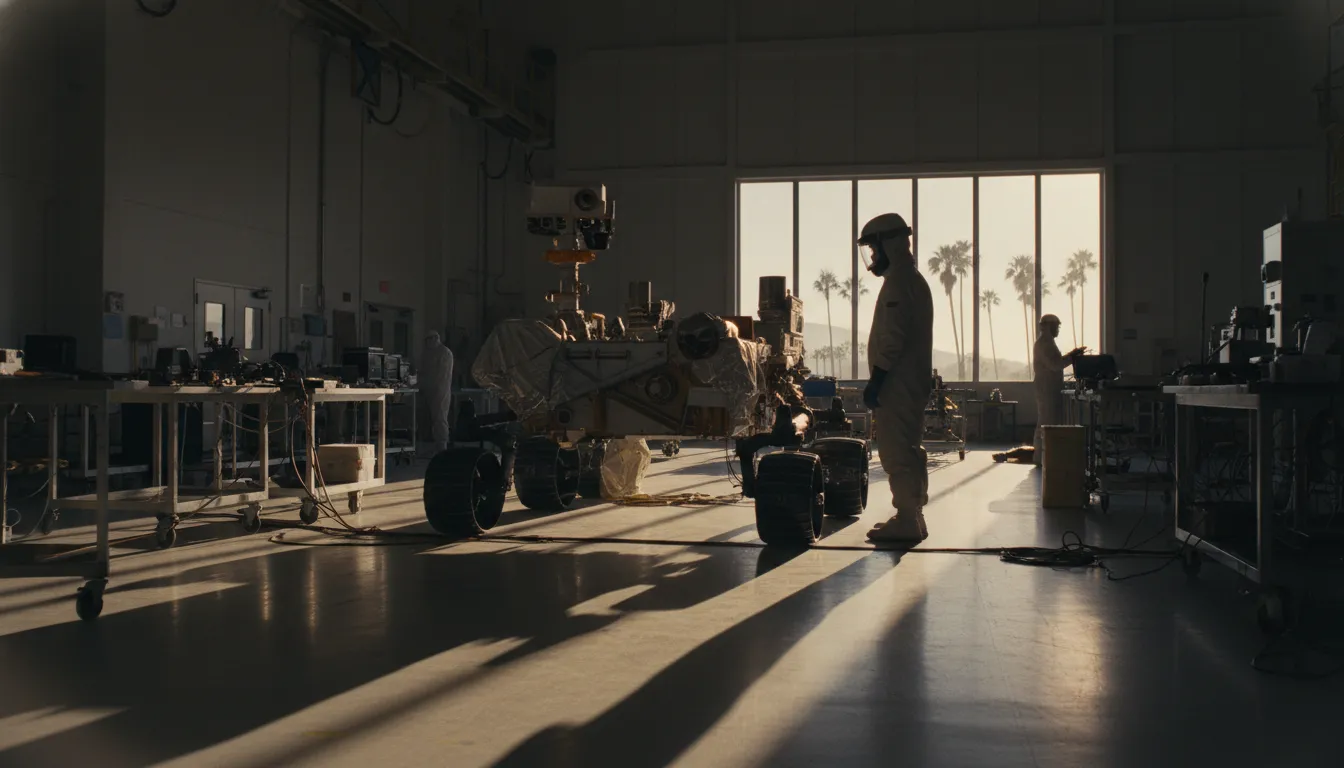
Somewhere on the dusty floor of Gale Crater, a robot the size of a small car is doing chemistry. NASA's Curiosity rover carries a suite of instruments collectively known as Sample Analysis at Mars (SAM)—a miniature laboratory capable of sniffing out the carbon-based molecules that scientists consider the building blocks of life. Understanding how rovers actually find these molecules reveals the ingenuity behind one of humanity's most ambitious scientific quests.
What Counts as an "Organic" Molecule?
In chemistry, organic does not mean "produced by a living thing." It simply refers to molecules built around carbon-carbon or carbon-hydrogen bonds. Meteorites deliver organic compounds to planetary surfaces all the time, and geological processes can create them without any biology involved. The challenge on Mars is not just finding organics—it is determining whether they formed through life, geology, or cosmic delivery.
That distinction matters enormously. Certain patterns—specific isotopic ratios, repeating molecular structures, or associations with particular minerals—could serve as biosignatures, evidence that life once existed. Rovers are designed to catalog these clues, even if a definitive answer remains elusive.
Step One: Drilling Into Rock
Detection begins with a drill mounted on the rover's robotic arm. Curiosity selects rock targets based on geological context—clay-bearing sediments deposited by ancient water are prime candidates. The drill pulverizes the rock into a fine powder, which is then funneled into SAM's internal chambers. The entire process must avoid contamination from Earth-origin chemicals carried aboard the rover, a constant engineering headache.
Step Two: Heating and Sniffing
SAM's standard method is pyrolysis—heating the powdered sample in a tiny oven to temperatures exceeding 800°C. As the rock bakes, trapped gases escape. These vapors pass through a gas chromatograph, a long coiled tube that separates the mixture into individual molecular components based on how quickly each moves through the column. The separated gases then enter a mass spectrometer, which identifies each molecule by its mass-to-charge ratio across a range of 2 to 535 daltons.
This technique, known as gas chromatography-mass spectrometry (GC-MS), is the workhorse of organic detection on Mars. It has confirmed the presence of chlorobenzene, thiophenes, and other small carbon compounds in Martian mudstone.
Step Three: Wet Chemistry—the Breakthrough
Some of the most interesting molecules—amino acids, fatty acids, and other large compounds central to biology—break apart or remain invisible at high temperatures. To catch them, SAM carries nine sealed cups of chemical solvent for a technique called wet chemistry.
In this approach, a rock sample is dropped into a cup containing tetramethylammonium hydroxide (TMAH) dissolved in methanol. The strongly alkaline reagent hydrolyzes the sample, snipping large molecules off mineral surfaces and breaking them into smaller, volatile fragments. The oven then heats the mixture to around 550°C, and the released gases flow into the same GC-MS pipeline for identification.
This method proved spectacularly successful. In results published in Nature Communications, Curiosity's first TMAH experiment detected more than 20 organic compounds in 3.5-billion-year-old sandstone, including seven never before seen on Mars. Among them were nitrogen-bearing heterocycles—ring-shaped molecules with structures similar to DNA precursors—and benzothiophene, the largest confirmed aromatic molecule identified as indigenous to the Red Planet.
Why It Matters
Each new detection expands the catalog of Martian chemistry and demonstrates that the planet's surface can preserve organic molecules over billions of years. That preservation is critical: if ancient life ever existed on Mars, its chemical fingerprints may still be readable in the rock record.
Future missions will push further. NASA's Perseverance rover is sealing rock samples in tubes for eventual return to Earth, where full-scale laboratories can apply techniques far beyond what any rover carries. The European Space Agency's Rosalind Franklin rover will drill up to two meters below the surface, reaching layers shielded from the harsh radiation that degrades organics at the top.
For now, the detective work continues one drill hole at a time—a robotic chemist patiently reading the molecular diary of a world that may not have always been dead.