How Sperm Whale Heads Work—and Why They're Extraordinary
The sperm whale's enormous head is a biological marvel housing the spermaceti organ, which powers echolocation, aids deep diving, and may serve as a battering ram in combat between males.
A Head Like No Other
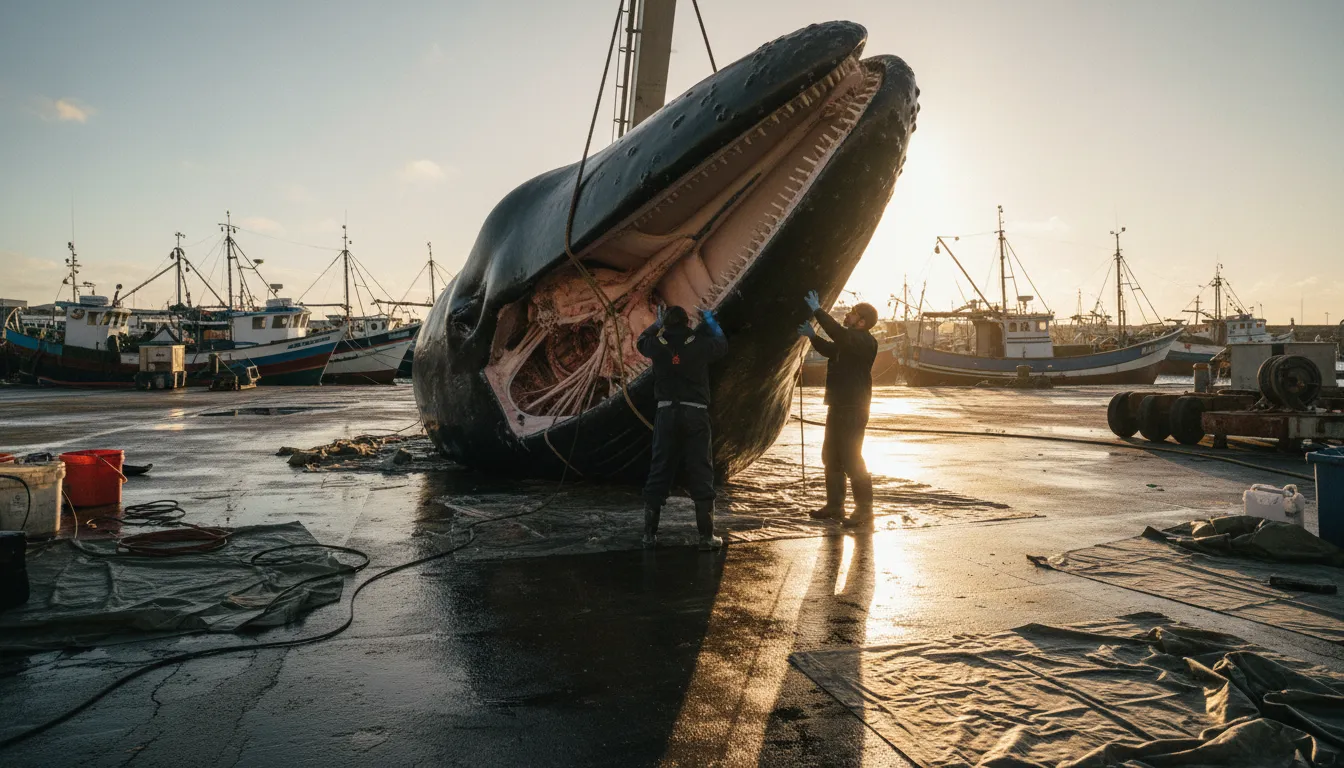
The sperm whale carries the largest head of any animal that has ever lived. Accounting for up to one-third of the creature's total body length, this block-shaped structure is far more than ballast. It houses a sophisticated biological system that enables the whale to hunt in pitch darkness, dive to crushing depths, and—scientists now believe—fight rivals head-on.
Inside that massive skull sits the spermaceti organ, a barrel-shaped reservoir that can hold up to 1,900 litres of a waxy, oily substance called spermaceti. Below it lies the junk (also called the melon), a layered arrangement of oil-filled compartments separated by walls of connective tissue and cartilage. Together, these two structures give the sperm whale capabilities unmatched in the animal kingdom.
A Biological Sonar System
Sperm whales are the loudest animals on Earth. Their echolocation clicks can exceed 230 decibels—louder than a jet engine at close range. The head is the engine behind this remarkable sonar.
When a sperm whale closes its blowhole and forces air through a pair of structures called phonic lips, it generates a powerful click. That sound pulse travels backward through the spermaceti organ, bounces off a reflective membrane called the frontal sac at the front of the skull, and redirects forward into the junk. The junk acts as an acoustic lens, focusing the click into a narrow, directional beam aimed into the deep ocean.
When echoes return from prey—usually squid—they travel through a fat-filled channel in the whale's lower jaw directly to the inner ear. This system lets sperm whales locate and track prey in total darkness at depths where sunlight never penetrates.
Built for the Abyss
Sperm whales routinely dive to 300–800 metres, and the deepest recorded dive reached approximately 2,250 metres—well over a mile below the surface. Dives can last up to two hours. The spermaceti organ may play a role in these feats.
One long-standing hypothesis holds that sperm whales regulate buoyancy by controlling the temperature of spermaceti oil. At normal body temperature (about 37 °C), the oil is liquid. By inhaling cold seawater through nasal passages running alongside the organ, the whale can cool the oil until it solidifies, increasing its density and helping the animal sink. To ascend, blood flow warms the wax back to liquid, restoring buoyancy. While this buoyancy-control hypothesis remains debated, it illustrates how finely tuned the whale's anatomy is for life in the deep.
A Built-In Battering Ram
In the 19th century, the whaling ship Essex was sunk by a sperm whale that rammed it head-first—the event that inspired Herman Melville's Moby-Dick. For decades, scientists wondered whether such ramming was intentional and whether the whale's head was adapted for it.
A 2016 study published in PeerJ used structural-engineering models to test the idea. The researchers found that the junk's internal partitions act like a shock-absorption system, distributing impact forces and protecting the skull during collisions. Scarring on adult males' heads is concentrated at the tip of the junk, suggesting whales instinctively avoid striking with the more delicate spermaceti organ. The conclusion: the forehead likely evolved, at least in part, as a weapon for male-male combat over mates.
In March 2026, drone footage published in Marine Mammal Science captured sperm whales headbutting each other for the first time on camera—finally confirming what whalers and scientists had long suspected.
The Biggest Brain on Earth
The sperm whale also possesses the largest brain of any animal, weighing roughly 9 kilograms—about six times heavier than a human brain. This enormous brain supports complex social structures, sophisticated vocal communication through distinctive click patterns called codas, and cooperative hunting and childcare behaviors observed across matrilineal family groups.
From sonar to shock absorber to deep-sea diving aid, the sperm whale's head is one of evolution's most extraordinary multi-tools—a single structure that solves half a dozen survival problems at once.