How Stellar Archaeology Works—and What Old Stars Reveal
Stellar archaeology uses spectroscopy and chemical analysis to read the composition of ancient stars, unlocking secrets about the earliest era of the universe that no telescope can directly observe.
Reading the Universe's Oldest Time Capsules
Somewhere in the Milky Way, a faint star burns with almost nothing but hydrogen and helium in its atmosphere. To most observers, it looks unremarkable. To a stellar archaeologist, it is a fossil from the dawn of the cosmos—a relic that preserves the chemistry of gas clouds that existed more than 13 billion years ago.
Stellar archaeology is the science of reconstructing the early history of the universe by studying the chemical fingerprints locked inside old stars. Because the first generations of stars formed from nearly pristine gas left over from the Big Bang, their surviving descendants carry an elemental record that no telescope peering into deep space can replicate. Understanding how this detective work is done reveals one of astronomy's most elegant methods.
Metallicity: A Star's Chemical Clock
In astronomy, every element heavier than helium is loosely called a "metal." Carbon, oxygen, iron—all metals by this definition. The fraction of metals in a star's atmosphere is its metallicity, and it serves as a rough clock.
The very first stars—the hypothetical Population III—formed from gas that contained virtually no metals, only hydrogen and helium forged in the Big Bang. When these massive stars exploded as supernovae, they seeded the surrounding gas with heavier elements. Each subsequent generation of stars incorporated more metals. Therefore, the lower a star's metallicity, the older its origin.
Metallicity is typically expressed as [Fe/H], a logarithmic ratio comparing a star's iron-to-hydrogen abundance against the Sun's. A star with [Fe/H] = −3 has one-thousandth the Sun's iron content—an extremely metal-poor star that likely formed within the first billion years after the Big Bang.
How Spectroscopy Unlocks the Record
The primary tool of stellar archaeology is spectroscopy. When starlight passes through a prism or diffraction grating, it spreads into a spectrum crossed by dark absorption lines. Each line corresponds to a specific element absorbing light at a characteristic wavelength.
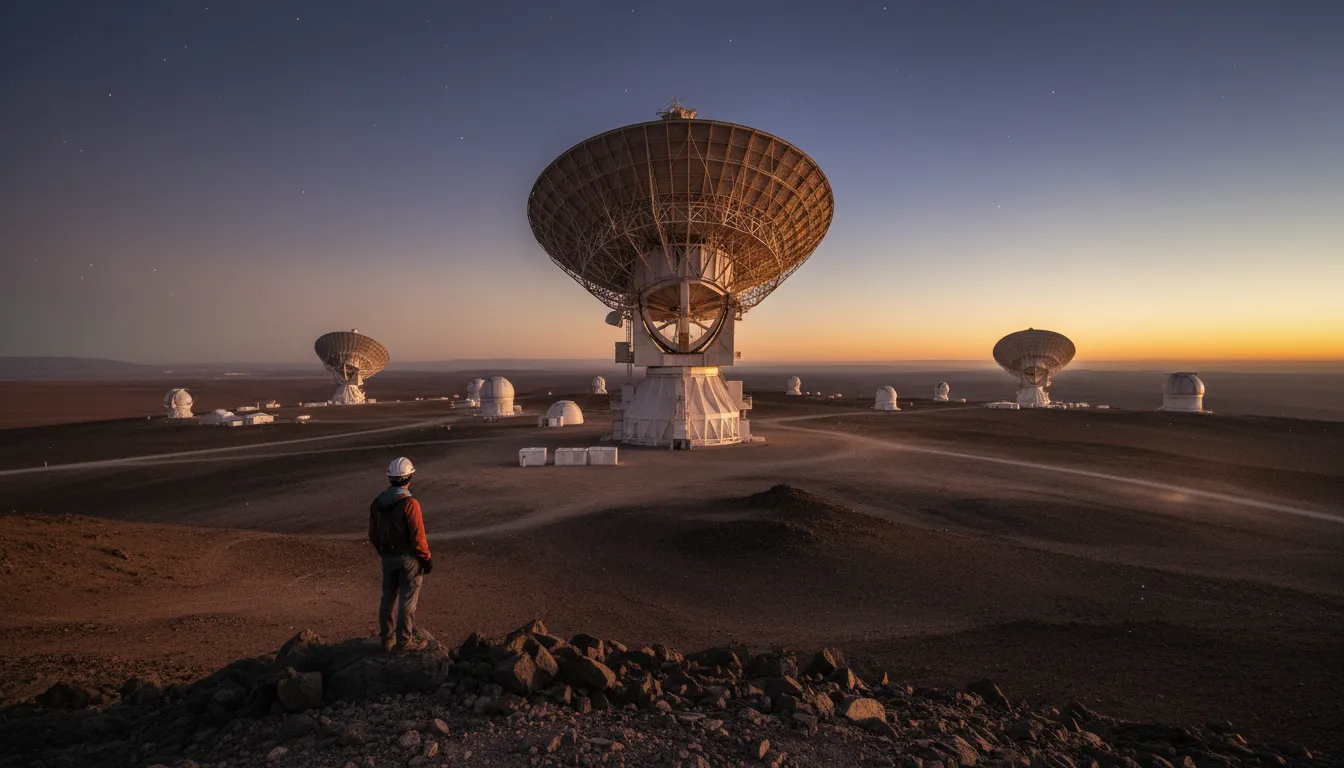
By measuring the depth and width of these lines, astronomers determine which elements are present and in what quantities. High-resolution spectrographs on telescopes like the Gemini Observatory or the European Southern Observatory's Very Large Telescope can detect dozens of elements in a single star, building a detailed chemical profile.
Large-scale surveys such as the Sloan Digital Sky Survey (SDSS) have catalogued hundreds of thousands of stellar spectra, enabling researchers to sift through vast datasets to find the rarest, most metal-poor stars. In a recent example, University of Chicago undergraduates identified one of the most chemically pristine stars ever found—a star with roughly half the heavy-element content of the previous record holder—by analysing SDSS data.
What Ancient Stars Tell Us
Each ultra-metal-poor star acts as a snapshot of the gas from which it formed. The relative ratios of different elements—not just iron, but carbon, magnesium, barium, and others—encode information about the type of supernova that enriched that gas. A star rich in carbon but poor in iron, for instance, may have formed from material ejected by a "faint" supernova that fell back into a black hole before dispersing its iron core.
These chemical patterns help astronomers answer fundamental questions:
- How massive were the first stars? Element ratios constrain whether Population III stars were tens or hundreds of times the Sun's mass.
- How did galaxies assemble? Ancient stars found in the Milky Way's halo sometimes originated in smaller dwarf galaxies that were later absorbed, traceable through their distinct chemical signatures.
- When did key elements appear? Elements essential for rocky planets and life—carbon, oxygen, silicon—had to be produced in sufficient quantities before Earth-like worlds could form.
The Search Continues
No confirmed Population III star has been observed directly; they likely burned out billions of years ago. But their chemical legacy survives in the most metal-poor stars that are still shining. Upcoming instruments, including next-generation spectrographs and NASA's James Webb Space Telescope, are pushing the search further—both by finding more metal-poor stars nearby and by looking for spectral signatures of pristine stellar populations in distant, early galaxies.
Stellar archaeology shows that the universe keeps its oldest records not in stone or ice, but in starlight. Reading those records requires patience, precision, and a spectrograph—but the payoff is a direct chemical connection to the very first chapter of cosmic history.