How Surface-to-Air Missiles Work—and Why They Matter
Surface-to-air missiles form the backbone of modern air defense, using radar, infrared, and command guidance to detect and destroy aerial threats. Here's how these systems work, from shoulder-fired weapons to strategic missile batteries.
From Ground to Sky in Seconds
A surface-to-air missile (SAM) is a weapon designed to be launched from the ground or sea to intercept and destroy aircraft, cruise missiles, or ballistic threats. Since the first systems were deployed in the 1950s, SAMs have reshaped modern warfare by challenging the dominance of air power and forcing pilots, planners, and engineers to constantly adapt.
Today, SAMs range from shoulder-fired weapons weighing less than 20 kilograms to massive strategic systems capable of engaging targets hundreds of kilometers away. Understanding how they work means understanding the invisible contest between those who control the sky and those who deny it.
Three Ways to Find a Target
Every SAM must solve the same problem: find a fast-moving object in a vast sky and steer an interceptor into it. There are three main guidance approaches.
Radar guidance is the most common for medium- and long-range systems. In semi-active radar homing (SARH), a ground-based radar illuminates the target, and a receiver in the missile follows the reflected signal. More advanced systems use active radar homing, where the missile carries its own onboard radar seeker—typically operating in the X-band—that locks onto the target independently after launch.
Infrared (IR) guidance dominates short-range and man-portable systems. These missiles passively detect the heat signature of an aircraft—engine exhaust, airframe friction, or auxiliary power units—and home in on it. Because IR missiles emit no signal of their own, they are extremely difficult for aircraft to detect before launch. Modern seekers can engage targets from any angle, not just from behind.
Command guidance is the oldest method. The SAM battery's ground radar tracks both the target and the missile, sending steering corrections via radio link. While less precise at extreme range, it remains effective and resistant to certain countermeasures.
Layered Defense: Small, Medium, and Large
Military planners organize SAMs into layers, each covering a different altitude and range band.
- Man-Portable Air Defense Systems (MANPADS) — Shoulder-fired missiles like the American FIM-92 Stinger or the Russian Igla. These weigh roughly 17–18 kg, have an engagement range of about 6 km, and are effective against helicopters and low-flying jets below about 6,000 meters. Their "fire and forget" IR guidance allows the operator to relocate immediately after shooting.
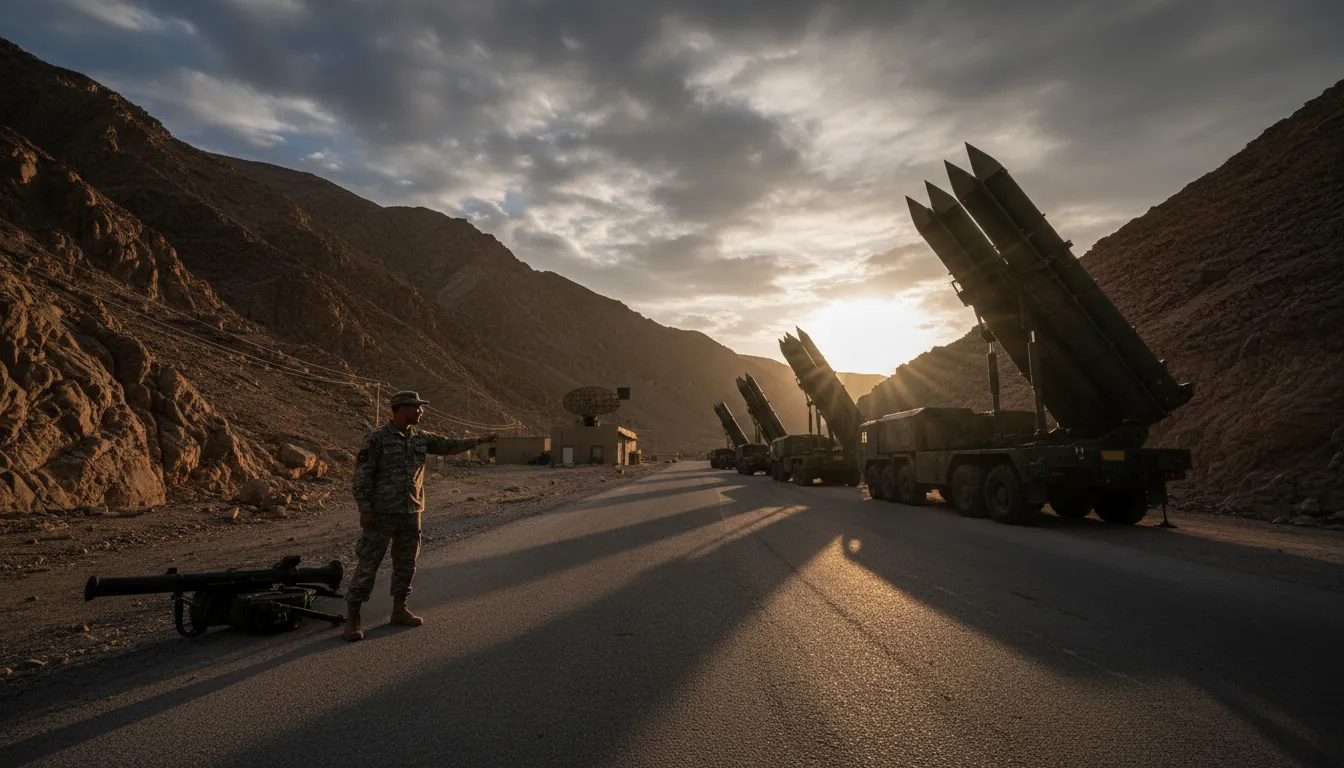
- Medium-range mobile systems — Vehicle-mounted batteries like NASAMS or the Buk series. These typically use radar guidance and can engage targets at distances of 30–50 km, providing coverage over a wide area while remaining mobile enough to avoid counterattack.
- Long-range strategic systems — Heavy batteries like Russia's S-400 Triumf or the American Patriot PAC-3. The S-400 can theoretically engage targets at ranges exceeding 380 km using multiple missile types. These systems anchor national air defenses and protect critical infrastructure.
Integrated Air Defense: The Network
A single SAM battery, no matter how advanced, has blind spots. That's why modern militaries build Integrated Air Defense Systems (IADS)—networks that link radars, missiles, electronic warfare units, and command centers into a unified system. According to the Mitchell Institute for Aerospace Studies, an IADS is "not a formal system in itself, but rather a distributed network of interconnected components."
Multiple radar types—long-range surveillance, engagement, and early warning—feed data into a central command post. Operators assign targets to the most appropriate weapon, avoiding redundancy and ensuring efficient use of interceptors. Electronic warfare adds another layer, jamming enemy radars and generating false targets.
The Cat-and-Mouse Game
Every advance in SAM technology triggers a countermeasure. Aircraft deploy chaff (metallic strips that confuse radar) and flares (heat sources that decoy IR missiles). Stealth aircraft reduce their radar cross-section to slip past detection. Electronic jamming can blind SAM radars entirely.
SAM designers fight back with frequency-hopping radars that resist jamming, dual-band IR seekers that distinguish flares from real engines, and networked sensors that fill each other's gaps. Russia's S-400, for instance, uses rapid frequency-hopping and agile beam-steering to maintain target lock in contested electronic environments.
This ongoing duel between offense and defense has driven some of the most expensive and secretive military research programs in history—and shows no sign of slowing down.
Why SAMs Shape Geopolitics
SAM systems are more than weapons; they are geopolitical tools. Turkey's purchase of Russia's S-400 strained its NATO alliance. Ukraine's effective use of Western-supplied air defenses changed the calculus of the conflict with Russia. The proliferation of MANPADS—produced by at least 25 countries, according to the Arms Control Association—poses a persistent threat to civilian aviation worldwide.
Whether protecting a capital city or giving a lone infantry squad the power to challenge a fighter jet, surface-to-air missiles remain one of the most consequential technologies in modern defense.