How Deep-Sea Mining Works—and Why Scientists Worry
Deep-sea mining targets potato-sized mineral nodules on the ocean floor rich in cobalt, nickel, and manganese. As regulators debate whether to allow commercial extraction, scientists warn that ecosystems destroyed by mining may take decades or longer to recover.
Trillions of Mineral Nodules on the Ocean Floor
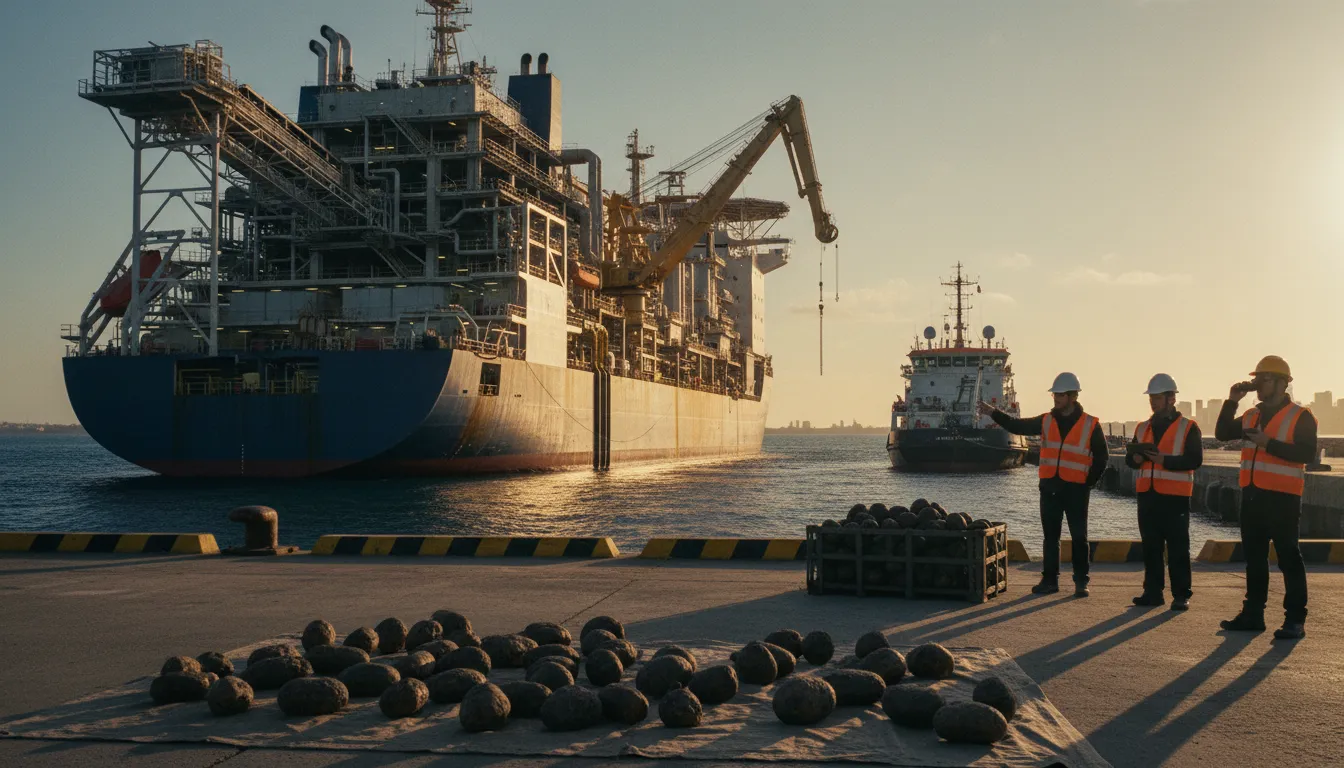
Scattered across the abyssal plains of the world's oceans, at depths of 4,000 to 6,000 metres, lie trillions of potato-sized rocks called polymetallic nodules. These dark, lumpy formations are rich in manganese, nickel, cobalt, copper, and rare earth elements — metals essential for batteries, electronics, and the green-energy transition. The nodules grow at an almost geological pace, accumulating just a few millimetres every million years.
The largest known deposit sits in the Clarion-Clipperton Zone (CCZ), a 4.5-million-square-kilometre stretch of the Pacific Ocean between Hawaii and Mexico. As land-based mineral reserves face growing demand, the CCZ has become the focal point of a global debate: should humanity mine the deep sea?
How the Mining Would Work
No commercial deep-sea mining operation has begun yet, but the proposed technology follows a three-step process. First, tractor-sized collector vehicles crawl across the seabed, vacuuming up nodules along with the top layer of sediment. The material is then pumped through a riser pipe — sometimes several kilometres long — to a surface support vessel. On board, the nodules are separated from sediment, and the waste slurry is piped back down and discharged into the water column.
Proponents, including companies like The Metals Company, argue that nodule mining has a smaller land footprint than terrestrial mining, produces no toxic tailings ponds, and could supply critical minerals without deforestation or displacement of communities.
What Lives Where Miners Want to Dig
The CCZ is far from lifeless. Scientists have catalogued more than 400 species there, and researchers at the Natural History Museum in London estimate that 88 to 92 percent of species in the zone remain undescribed. In March 2026, a team announced the discovery of 24 new amphipod species in the CCZ, including an entirely new superfamily — a rare find that highlights how little we know about life in this region.
The nodules themselves are not just rocks. They serve as the only hard substrate on an otherwise soft, muddy seabed, providing attachment points for sponges, corals, and other sessile organisms. A 2021 study in Scientific Reports found that removing nodules disrupts local food webs far beyond the organisms directly attached to them.
Damage That Lasts Decades
A landmark 2025 study published in Nature examined a site in the CCZ where a test mining machine operated in the 1970s. Forty-four years later, the eight-metre-wide mining tracks were still clearly visible, and the seabed remained stripped of nodules. Some mobile organisms — sediment-dwelling worms and deposit feeders — had recolonised the tracks to near-normal levels. But sessile fauna that depend on nodules as habitat had not recovered, and the overall community composition remained altered.
The study's lead authors concluded that mining impacts in the abyssal ocean persist over at least decadal timeframes, with communities in directly disturbed areas remaining fundamentally changed. Since nodules take millions of years to regrow, the habitat loss is effectively permanent on any human timescale.
Who Decides — and When
Because the CCZ lies in international waters, mining there falls under the jurisdiction of the International Seabed Authority (ISA), a United Nations body based in Jamaica. The ISA has issued 31 exploration contracts covering over 1.5 million square kilometres of seabed, but none yet permits commercial extraction.
The ISA has been drafting a regulatory framework — known as the Mining Code — for years. Negotiations on the draft exploitation regulations continued through July 2025 without reaching consensus, and discussions are set to resume in 2026. Meanwhile, more than 30 countries have called for a moratorium or precautionary pause on deep-sea mining, citing the scale of scientific uncertainty.
The Core Tension
Deep-sea mining sits at the intersection of two urgent priorities. The world needs vast quantities of cobalt, nickel, and manganese to build batteries for electric vehicles and grid storage. But extracting those metals from a poorly understood ecosystem risks causing irreversible harm to some of the most ancient and least-explored habitats on Earth. How regulators resolve that tension will shape both the ocean floor and the energy transition for generations to come.