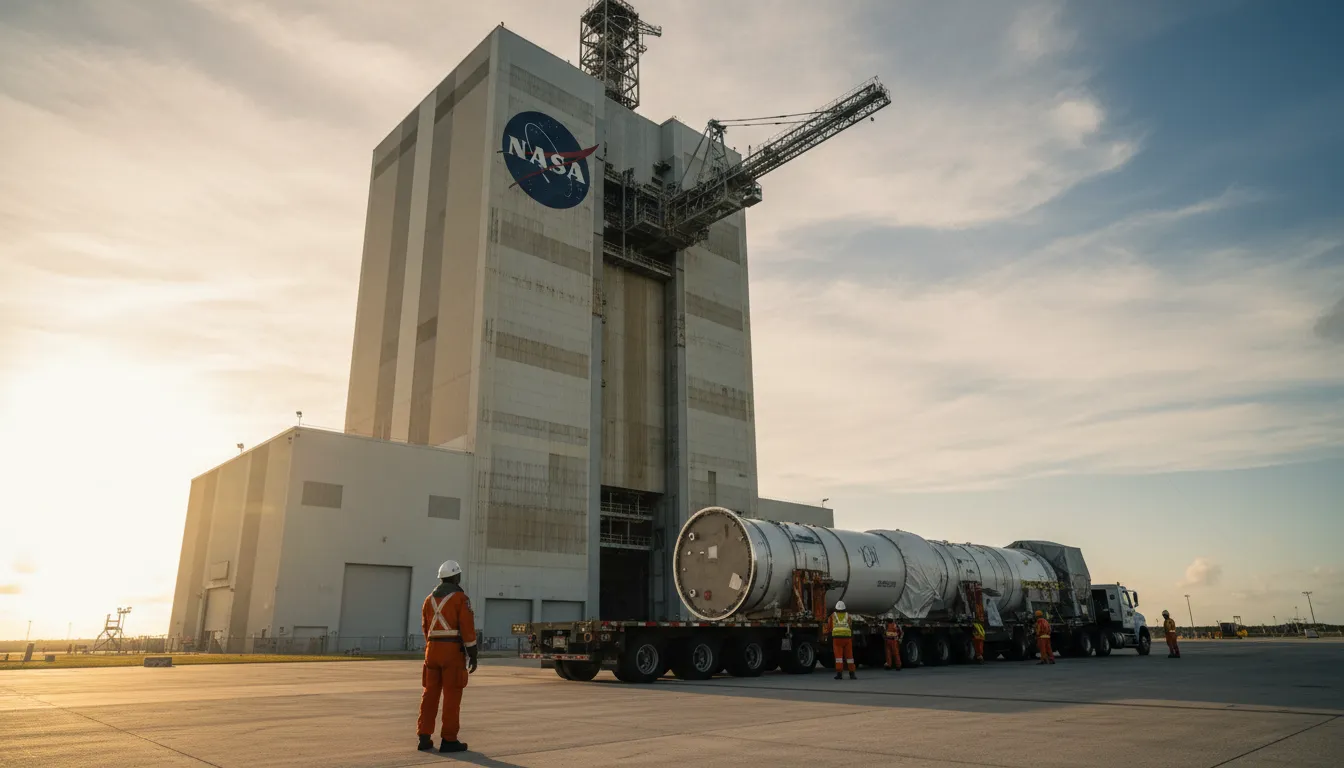
How NASA's Artemis Program Works—Moon to Mars
NASA's Artemis program aims to return humans to the Moon and eventually reach Mars, using the powerful SLS rocket and Orion spacecraft. Here's how the missions, hardware, and trajectory design work together.
Returning to the Moon After Half a Century
For the first time since Apollo 17 in 1972, humans are traveling beyond low Earth orbit. NASA's Artemis program is the multi-mission effort designed to establish a sustained human presence on and around the Moon—and ultimately use it as a proving ground for crewed missions to Mars.
The program involves new spacecraft, new rockets, new international partnerships, and a fundamentally different approach from Apollo. Where Apollo aimed to land, plant a flag, and leave, Artemis is designed for long-term exploration.
The Hardware: SLS and Orion
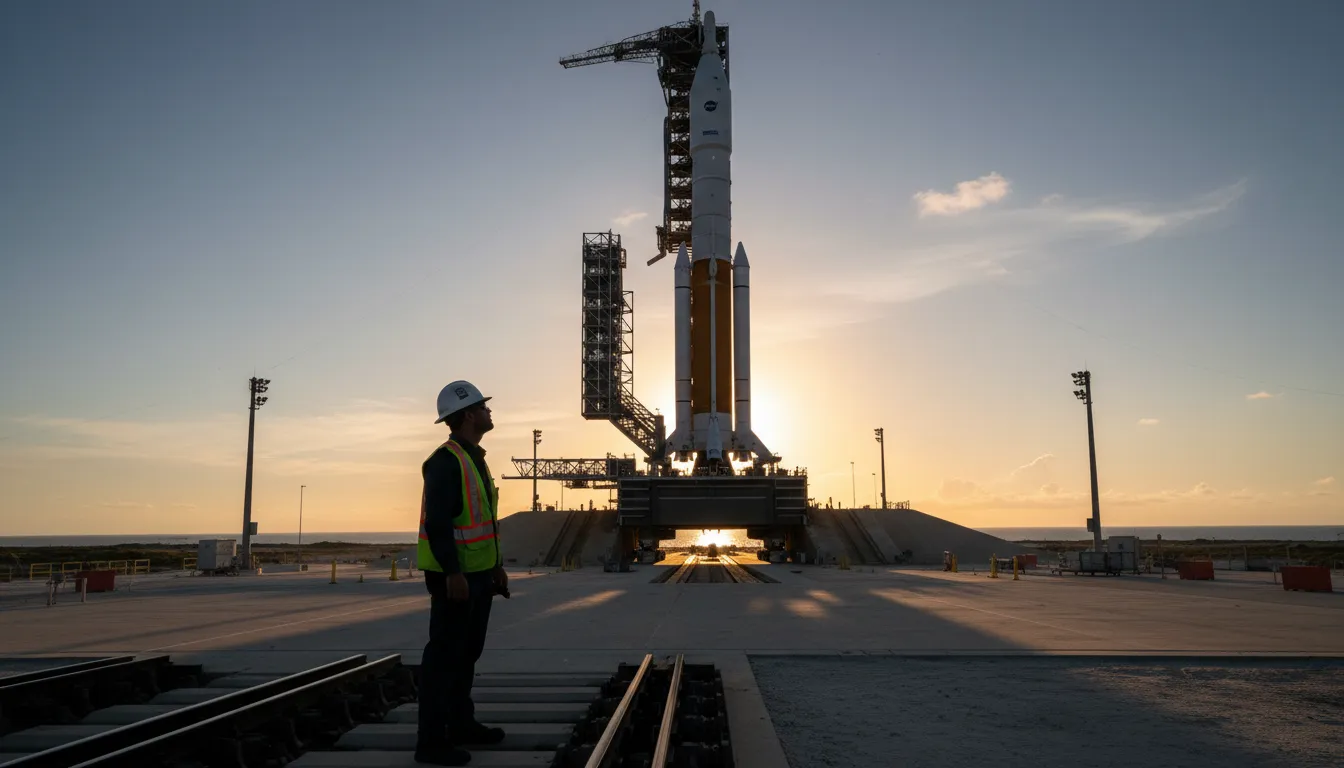
Two pieces of engineering make Artemis possible: the Space Launch System (SLS) rocket and the Orion spacecraft.
SLS is the most powerful rocket NASA has ever built. Its core stage stands 212 feet tall and is powered by four RS-25 engines—upgraded versions of the engines that flew on the Space Shuttle. These engines burn liquid hydrogen and liquid oxygen, producing over two million pounds of thrust in just four seconds. Two five-segment solid rocket boosters, also derived from Shuttle hardware, flank the core stage. Together, SLS generates 8.8 million pounds of thrust at liftoff—about 15 percent more than the Saturn V that carried Apollo astronauts.
Sitting atop SLS is Orion, built by Lockheed Martin with a European Service Module provided by the European Space Agency. Orion carries up to four crew members and is equipped with an Environmental Control and Life Support System (ECLSS) that maintains breathable air, stable temperature, and drinkable water. Carbon dioxide is scrubbed using regenerative amine swing beds, while the cabin stays at a comfortable 21–24°C even during the extreme heat of atmospheric re-entry.
The Free-Return Trajectory
Artemis missions to the Moon rely on a clever piece of orbital mechanics called a free-return trajectory. Once the spacecraft is placed on this figure-eight path between Earth and the Moon, gravity does most of the work. The Moon's gravitational pull bends the spacecraft's path around its far side and sends it back toward Earth—no additional engine burns required.
This design is fundamentally about safety. If a critical system fails en route, the crew can coast home without firing a single thruster. The concept proved its value during Apollo 13 in 1970, when an oxygen tank explosion forced the crew to abandon their planned lunar orbit and rely on a free-return path to survive. Artemis II, which flew in April 2026, used the same principle, sending four astronauts around the Moon and back on a ten-day mission covering over one million kilometers.
The Mission Sequence
The Artemis program is structured as a series of progressively ambitious missions:
- Artemis I (2022) — Uncrewed test flight. Orion orbited the Moon for 25 days, testing heat shield performance during re-entry at over 40,000 km/h.
- Artemis II (2026) — First crewed flight. Four astronauts flew a free-return trajectory around the Moon, testing life support, navigation, and communication systems in deep space.
- Artemis III (planned 2027) — Intended to test a Human Landing System (HLS) in Earth orbit, developed by SpaceX using a variant of its Starship vehicle.
- Artemis IV (targeted 2028) — The first planned crewed lunar landing since 1972, delivering astronauts to the Moon's south pole, where water ice may exist in permanently shadowed craters.
Why the South Pole?
Unlike Apollo, which landed near the lunar equator, Artemis targets the Moon's south polar region. Scientists believe permanently shadowed craters there contain water ice deposited by comets over billions of years. If confirmed and extractable, this ice could be converted into drinking water, breathable oxygen, and even rocket propellant—dramatically reducing the cost and complexity of future missions.
An International Stepping Stone
Artemis is not a solo American effort. The European Space Agency builds Orion's service module, the Canadian Space Agency contributed astronaut Jeremy Hansen to the Artemis II crew, and Japan's JAXA and other partners are involved in the planned Lunar Gateway, a small space station that will orbit the Moon and serve as a staging point for surface missions.
NASA frames everything through the lens of its Moon to Mars architecture. The technologies tested on the Moon—life support, radiation shielding, in-situ resource utilization—are the same ones crews will need for the six-to-nine-month journey to Mars. The Moon, in this view, is not the destination. It is the rehearsal.