How Textile Recycling Works—and Why It's So Hard
The fashion industry generates 92 million tonnes of textile waste every year, yet less than 15% is recycled. Here's why recycling clothes is so technically challenging—and what new science is doing to change that.
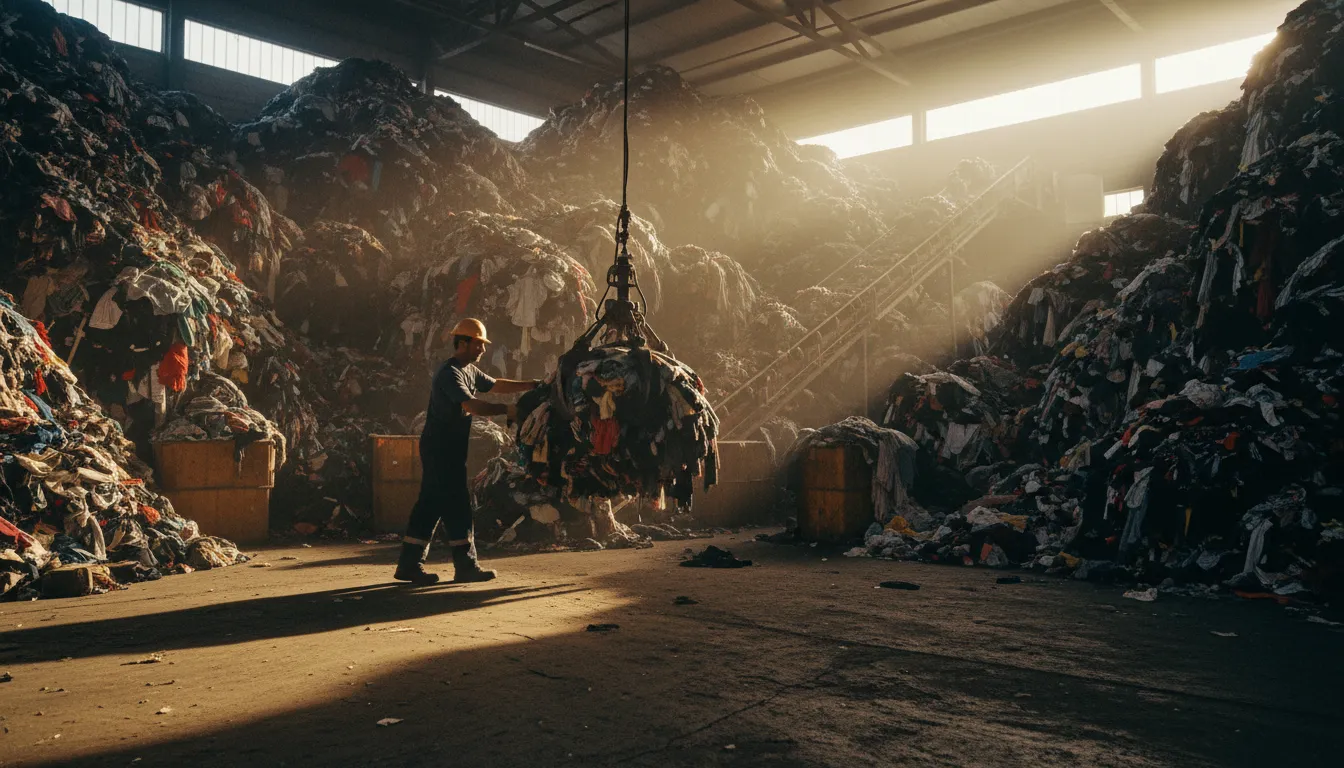
The Scale of Fashion's Waste Problem
Every second, the equivalent of a rubbish truck full of clothes is dumped in a landfill or incinerated somewhere in the world. The global fashion industry generates roughly 92 million tonnes of textile waste annually, according to data cited by the U.S. Government Accountability Office and environmental researchers. In the United States alone, 66% of discarded textiles end up in landfill. Globally, less than 15% of post-consumer clothing is recycled in any meaningful way.
The numbers are staggering, but the reasons recycling rates remain so low are rooted in genuine technical difficulty—not just a lack of will. Understanding why requires a look at how clothes are actually made, and what it takes to unmake them.
Why Clothes Are So Hard to Recycle
The central problem is blended fabrics. The majority of modern garments are not made from a single material. A typical T-shirt might be 60% cotton and 40% polyester. Sportswear commonly adds elastane (spandex) into the mix. These blends are engineered for performance—softness, stretch, moisture-wicking—but they are a nightmare for recyclers.
Cotton is a natural cellulose fiber; polyester is a synthetic plastic polymer. They require completely different processes to recycle, yet in a blended fabric they are woven together at a microscopic level. Sorting them by hand is impractical at scale, and most recycling machinery cannot distinguish between fiber types automatically. The result: most textile waste is treated as unsortable and sent to landfill.
Mechanical Recycling: The Old Way
The most widely used method today is mechanical recycling. Garments are shredded into shorter fibers, carded (combed and aligned), and spun back into yarn. The process is simple and cheap, but it has a critical flaw: shredding shortens fibers, weakening the resulting material. Mechanically recycled fibers typically must be blended with virgin (new) fibers to produce yarn of usable quality. The process degrades material with each cycle, and it cannot handle mixed-fiber textiles at all.
According to the U.S. GAO's Science & Tech Spotlight on Textile Recycling, sorting and fiber identification in most facilities is still performed primarily by hand—a bottleneck that prevents the industry from scaling.
Chemical Recycling: The Promising Alternative
Chemical recycling takes a more radical approach: it breaks textiles all the way down to their molecular building blocks, then rebuilds them into new fibers. Unlike mechanical recycling, this process can produce fibers of similar quality to virgin material—and can handle blended fabrics.
For polyester, chemical recycling uses processes like glycolysis or hydrolysis to depolymerize the plastic into its constituent monomers—ethylene glycol and terephthalic acid—which are then re-polymerized into new polyester. Dyes and contaminants are stripped out during depolymerization, meaning the output is genuinely clean material.
For cotton-polyester blends, researchers have developed acid hydrolysis methods using concentrated hydrochloric acid to dissolve the cotton fraction into glucose, leaving solid polyester behind. A 2025 study published in Nature Communications demonstrated a 75% glucose recovery rate from cotton and 78% monomer recovery from polyester in blended fabrics—a significant step toward viable industrial separation.
Emerging Technologies
Beyond acid hydrolysis, several other approaches are advancing rapidly:
- Enzymatic recycling: Enzyme cocktails selectively break down cellulose in cotton while leaving polyester intact, separating the blend without harsh chemicals.
- Hydrothermal treatment: Heating fabrics in water to 220–230°C for ten minutes can dissolve cotton while preserving the shape and integrity of polyester fibers.
- Solvent-based dissolution: Specialized solvents selectively dissolve one fiber type, allowing physical separation of the two materials.
None of these technologies has yet reached full industrial scale, but investment is accelerating as regulatory pressure mounts.
New Rules Are Forcing Change
The European Union is reshaping the economics of textile waste through legislation. The revised EU Waste Framework Directive, which entered into force in October 2025, mandates Extended Producer Responsibility (EPR) for textiles for the first time. Under EPR rules, fashion brands will be required to fund the collection, sorting, and recycling of post-consumer clothing. Member states have until 2028 to establish national EPR schemes.
Crucially, financial contributions will be eco-modulated—brands that design products that are easier to recycle will pay lower fees. This creates a direct financial incentive to move away from hard-to-separate blends.
Why It Matters
Textile production accounts for an estimated 10% of global carbon emissions and is a major source of microplastic pollution. The U.S. GAO has called for greater federal coordination on textile waste reduction, noting that fast fashion's accelerating production cycle—consumers buying more clothing but wearing each piece fewer times—is outpacing any current recycling infrastructure.
Closing the loop on fashion waste requires both technological breakthroughs and policy pressure working together. The chemistry is catching up. Whether the industry moves fast enough remains the harder question.