How the Northern Lights Form and Why They Glow
The aurora borealis is one of Earth's most spectacular natural phenomena — but the physics behind those shimmering curtains of color is equally remarkable. Here's how it all works.
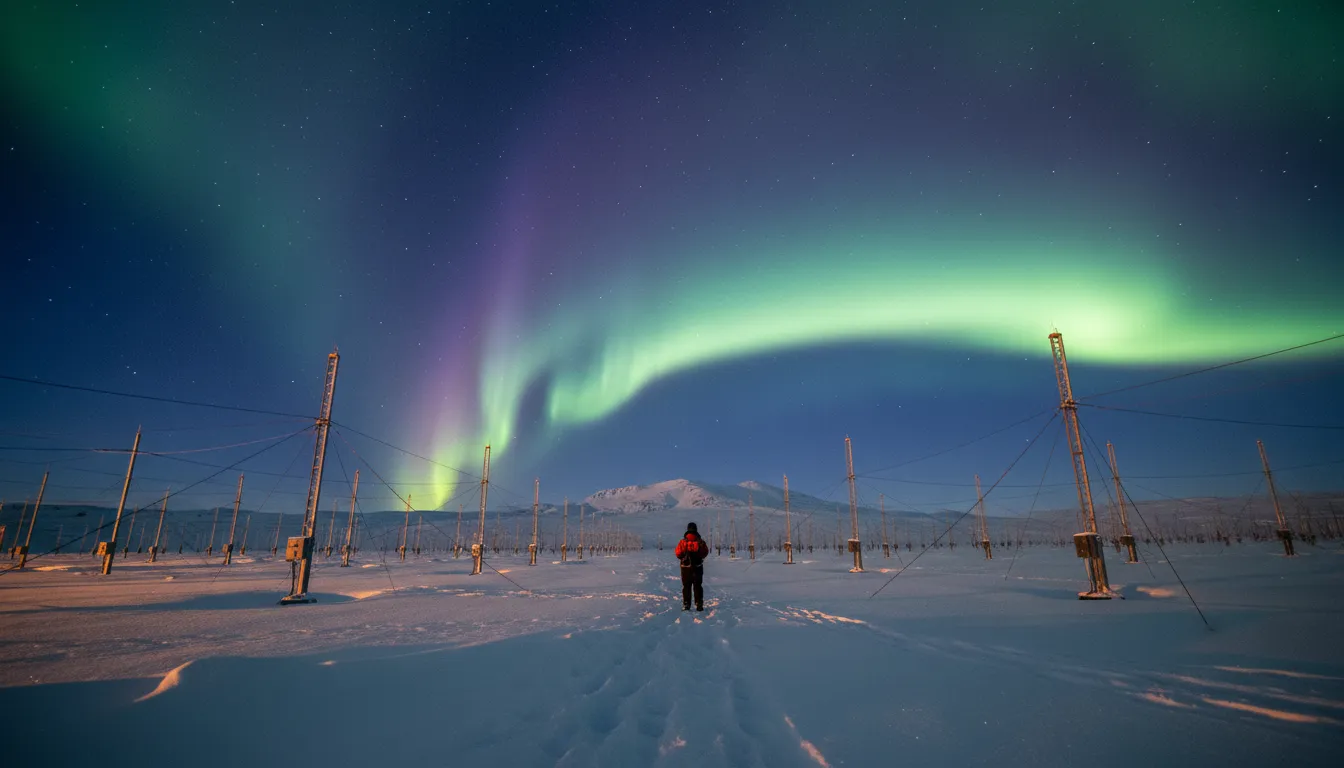
A Light Show Powered by the Sun
Few natural spectacles rival the aurora borealis — those sweeping curtains of green, red, and violet light that ripple across polar skies on clear nights. Yet the northern lights are not magic: they are the visible signature of a continuous, planet-scale interaction between our Sun, Earth's magnetic shield, and the gases in our upper atmosphere.
It Starts With the Solar Wind
The Sun does not simply shine — it constantly exhales. Every second, it releases billions of tonnes of charged particles (mainly electrons and protons) into space in a stream known as the solar wind. This stream travels at roughly 400–800 kilometres per second and reaches Earth in one to three days, according to NASA's aurora science page.
In addition to the steady solar wind, the Sun periodically ejects massive bursts of plasma called coronal mass ejections (CMEs). When a CME hits Earth, it dramatically amplifies auroral activity — often making the lights visible far beyond the polar regions.
Earth's Magnetic Shield — and Its Weak Spots
Earth is surrounded by a vast magnetic field called the magnetosphere, generated by the churning molten iron in its outer core. This invisible shield deflects the vast majority of the solar wind, protecting the planet's surface from harmful radiation.
Near the magnetic poles, however, the field lines converge and dip back into the planet, creating funnel-like openings. Charged particles can follow these lines down into the upper atmosphere — a region roughly 100 to 300 kilometres above the surface. This is where the real light show begins.
Collisions That Make Light
When energetic electrons from the solar wind plunge into the atmosphere, they collide with atoms of oxygen and nitrogen. Each collision gives the atom a burst of energy, briefly exciting it to a higher energy state. As the atom returns to its normal state, it releases that energy as a photon — a tiny packet of light. Millions of these collisions per second, spread across hundreds of kilometres, produce the luminous curtains we see from the ground.
As the Royal Museums Greenwich explains, the process is essentially the same physics behind a neon sign: excite a gas, watch it glow.
Why So Many Colors?
The aurora's palette is not random — it is a direct readout of atmospheric chemistry and altitude. According to the Natural History Museum:
- Green — the most common colour, produced by oxygen atoms at altitudes of roughly 100–300 km
- Red — a rarer, higher-altitude glow from oxygen above 300 km, where the atmosphere is so thin that excited atoms take longer to release their energy
- Blue and purple — produced by nitrogen molecules, often visible at the lower edges of aurora displays
- Pink fringes — a mix of red and blue, caused by nitrogen at the very lowest auroral altitudes
The speed and energy of the incoming electrons also influence the exact shade, meaning each display is subtly unique.
The 11-Year Solar Cycle
Aurora activity is not constant — it rises and falls with the Sun's own magnetic cycle. Roughly every 11 years, the Sun swings between a quiet period (solar minimum) and a peak of intense activity (solar maximum), when sunspots, flares, and CMEs are far more frequent. Near solar maximum, auroras are brighter, more frequent, and visible at lower latitudes than usual.
Solar Cycle 25 — the current cycle — reached its maximum around 2024–2025, according to NOAA's Space Weather Prediction Center. Although the peak has passed, solar activity remains elevated well beyond the official maximum, and strong flares and CMEs continue to trigger impressive displays.
Not Just in the North
The aurora borealis has a southern mirror image: the aurora australis, visible from Antarctica, southern Chile, New Zealand, and Tasmania. Both are driven by identical physics — the name simply changes with hemisphere. Auroras also appear on other planets with strong magnetic fields, including Jupiter and Saturn, where the Hubble Space Telescope has captured vivid ultraviolet aurora rings around the poles.
Why It Matters Beyond Beauty
Strong geomagnetic storms that produce vivid auroras can also disrupt satellites, GPS systems, radio communications, and even power grids on the ground. The most powerful aurora event in recorded history — the Carrington Event of 1859 — knocked out telegraph systems across North America and Europe. Today, space weather forecasting, led by agencies like NOAA and ESA, monitors solar activity continuously to give early warning of potentially disruptive storms.
The northern lights are, in this sense, both one of nature's most breathtaking spectacles and a vivid reminder that Earth is not isolated in space — it is constantly shaped by the star at the centre of our solar system.


