How Venezuela's Oil Wealth Turned Into a Crisis
Venezuela sits atop the world's largest oil reserves, yet suffered one of history's worst peacetime economic collapses. Here is how a petrostate squandered its riches — and what lessons it holds for resource-dependent economies.
The Richest Country That Became the Poorest
Few economic stories are as striking as Venezuela's. By 1970, the country was the wealthiest nation in Latin America, its oil fields pumping nearly four million barrels a day. Half a century later, living standards had fallen by 74 percent between 2013 and 2023 — a collapse that economists at the London School of Economics describe as the largest outside of wartime in modern history. How did a country with the world's largest proven oil reserves end up in such ruins?
A Nation Built on Black Gold
Venezuela's story begins with petroleum. Major oil discoveries in the early 20th century transformed the country almost overnight. By mid-century, Venezuela was supplying a significant portion of US oil imports and using the revenues to build roads, schools, and a modern capital in Caracas. The state oil company, PDVSA, founded in 1976 after nationalization, became one of the most professionally run energy companies in the developing world, pumping 3.5 million barrels per day at its late-1990s peak.
Yet this dependence planted the seeds of future crisis. Economists call it Dutch disease — when a natural resource windfall crowds out other industries, leaving the economy dangerously reliant on a single export whose price swings with global markets.
Chávez, Bolivarianism, and the PDVSA Purge
Hugo Chávez won the presidency in 1998 on a wave of anger at inequality and corruption. His Bolivarian Revolution redirected oil revenues toward ambitious social programs — called misiones — that reduced poverty, expanded health clinics, and boosted literacy. By some measures, the early years were a success.
But after a failed coup attempt in 2002, Chávez moved decisively against PDVSA's professional management, purging thousands of experienced engineers and executives and replacing them with political loyalists. According to the Council on Foreign Relations, oil investment collapsed by more than 80 percent from 2003 onward. The company that had been Venezuela's engine became a tool for political patronage.
Maduro Inherits a Broken Machine
When Chávez died of cancer in 2013 and Nicolás Maduro took power, global oil prices were still above $100 a barrel — masking PDVSA's deterioration. Then, in 2014, prices crashed. By January 2015, oil had dropped below $50. Venezuela, which funded nearly 95 percent of its foreign exchange earnings through oil exports, had no buffer.
What followed was catastrophic. The government printed money to cover deficits, triggering hyperinflation that at its peak in 2018 exceeded one million percent annually, according to the International Monetary Fund. Supermarket shelves emptied. Hospitals ran out of basic medicines. More than seven million Venezuelans — roughly a quarter of the population — fled the country in what the UN called one of the largest displacement crises in the Western Hemisphere.
The Role of US Sanctions
Beginning in 2017 and escalating sharply in 2019, the United States imposed sweeping economic sanctions targeting Venezuela's oil sector, PDVSA, and its access to US financial markets. The impact is fiercely debated. A report by the Washington Office on Latin America found that sanctions significantly deepened the crisis by cutting off oil revenues. The US Government Accountability Office concluded in 2021 that sanctions "likely contributed" to the economic decline.
However, many economists — including those at the Economics Observatory — note that Venezuela's collapse was already well underway before the harshest sanctions took effect. Hyperinflation, food shortages, and emigration all predated the 2019 oil embargo. Most analysts see sanctions as an accelerant to a crisis whose roots lay in two decades of mismanagement and corruption.
A Petrostate's Cautionary Tale
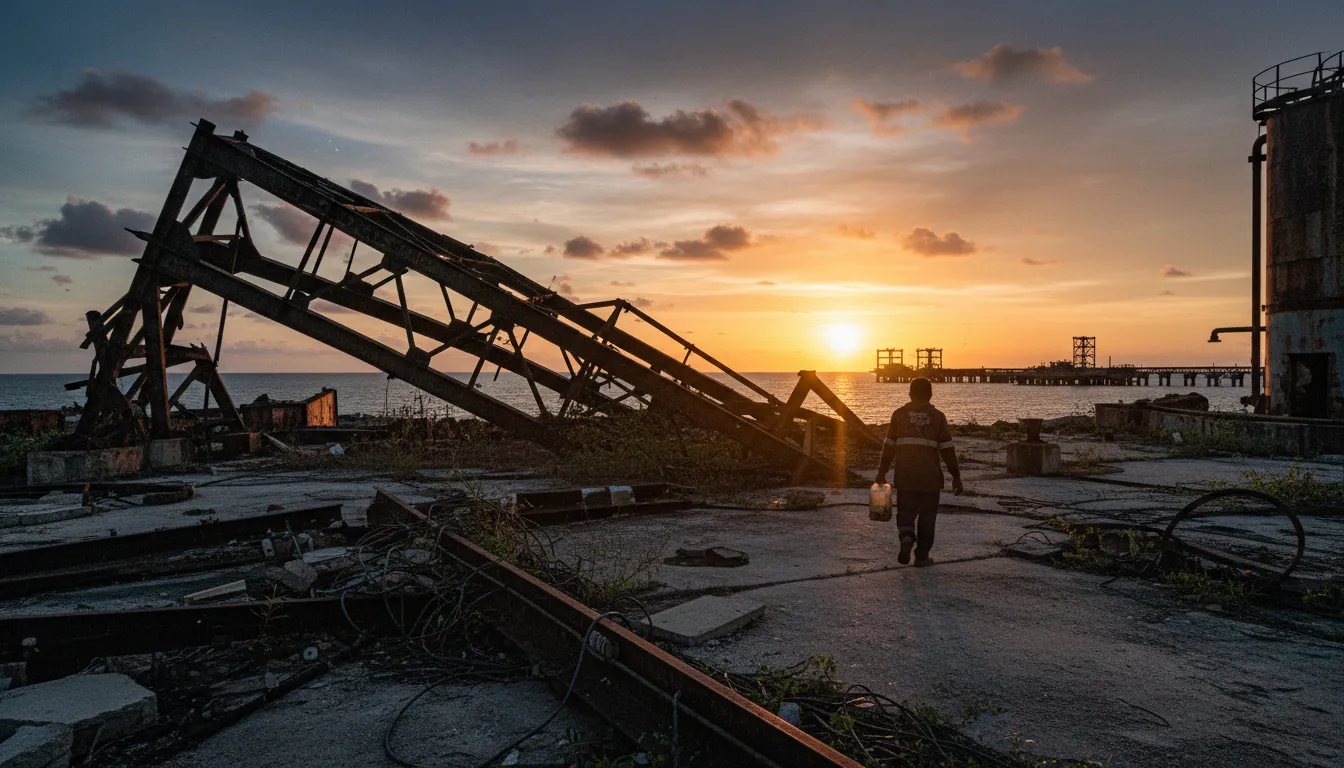
Venezuela's decline offers a textbook lesson in the dangers of resource dependency. PDVSA's oil production, once 3.5 million barrels per day, had fallen to roughly 735,000 barrels per day by 2023, according to the US Energy Information Administration. The country holds around 303 billion barrels of proven reserves — nearly a fifth of the global total — yet lacks the capital, expertise, and institutional capacity to extract them profitably.
Resource wealth, economists warn, is neither a guarantee of prosperity nor a shield against failure. Without strong institutions, diversified economies, and transparent governance, even the world's richest oil fields can become a curse. Venezuela's trajectory stands as one of the starkest illustrations of that principle in modern history.