What Are Zombie Fires and Why They Threaten the Climate
Underground peat fires can smolder invisibly for months, re-igniting across entire seasons and releasing carbon stored for thousands of years — creating a dangerous feedback loop that accelerates global warming.
Fires That Never Die
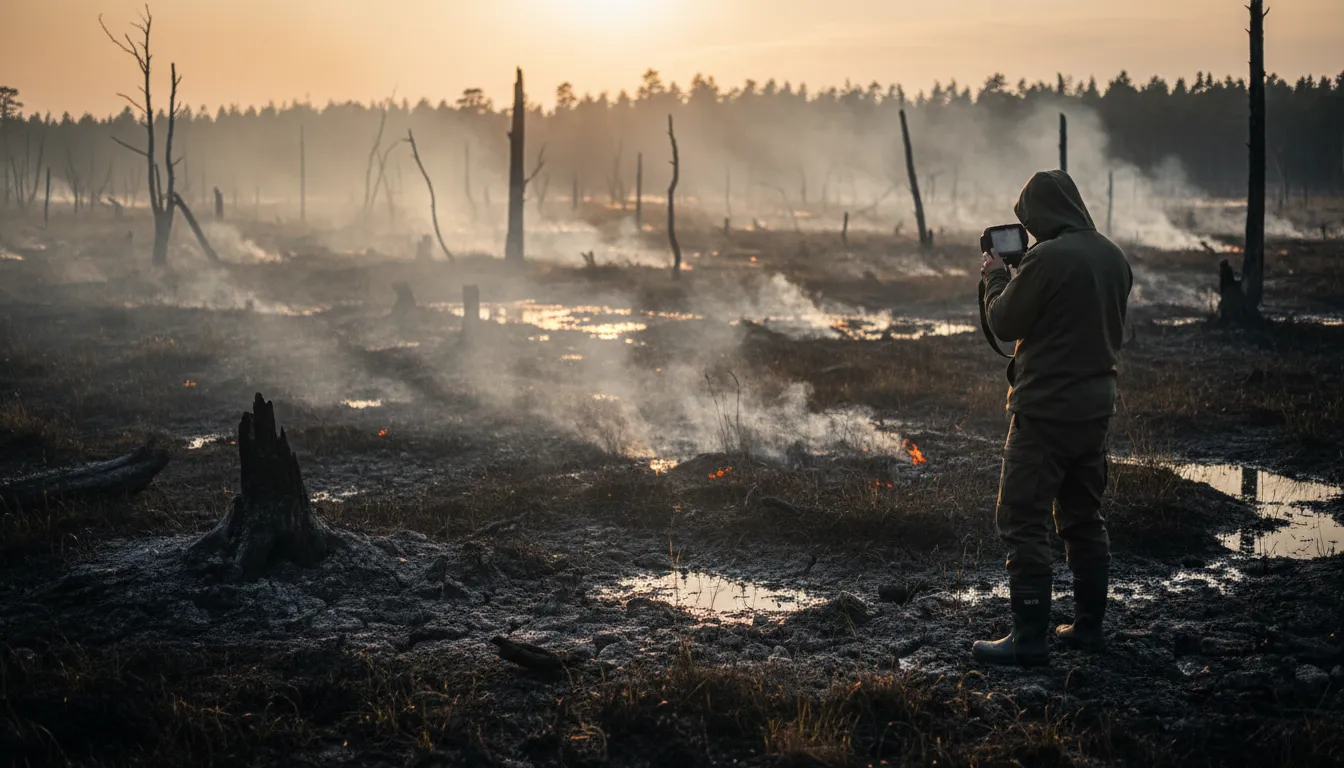
In the vast boreal forests of Canada, Siberia, and Alaska, a peculiar kind of wildfire defies the seasons. Covered by snow and invisible from the air, these fires burn slowly underground through winter — only to re-emerge in spring, sometimes kilometres from where they first appeared. Scientists call them zombie fires, and they represent one of the more unsettling climate phenomena of our era.
New research published in early 2026 by the University of Alberta confirms that burned permafrost peatlands can continue releasing carbon for years after a fire has officially been declared out. Understanding why requires a short journey into the strange, ancient world of peat.
What Is Peat — and Why Is It So Carbon-Rich?
Peat is partially decomposed plant matter — mosses, sedges, and other wetland vegetation — that has accumulated over centuries or millennia in cold, waterlogged conditions. Because the northern climate is too cold and wet for organic material to break down fully, dead plants pile up layer upon layer, locking away enormous quantities of carbon that would otherwise return to the atmosphere.
The scale of this storage is staggering. According to the Proceedings of the National Academy of Sciences, northern hemisphere peatlands hold roughly 550 gigatons of carbon — comparable to all the carbon in the world's living forests. Boreal peatlands alone account for an estimated 20–40% of Earth's entire terrestrial carbon stock, according to the Natural Resources Canada.
Much of this peat sits atop or within permafrost — ground that remains frozen year-round. Permafrost acts as a deep freezer, preserving organic carbon that died off as long ago as the last Ice Age.
How Zombie Fires Burn
A typical forest fire burns fast and hot across the surface. A peat fire is its opposite: slow, cool, and persistent. When surface vegetation ignites and dries out the upper layers of peat, the fire can burrow downward into the soil. There, starved of oxygen, it smolders rather than flames — a process called smoldering combustion.
When the first snows arrive, the surface fire is extinguished — but the underground embers continue to burn, fed by the peat itself. Months later, as snow melts and oxygen returns, the fire resurfaces. According to National Geographic, research has confirmed these zombie fires account for a meaningful share of early-season boreal wildfires, skipping the need for a lightning strike or any other ignition event.
Why the Carbon Release Is So Dangerous
Surface wildfires burn recently living biomass — carbon that was in the atmosphere just decades ago. Peat fires are fundamentally different: they combust carbon that has been sequestered for hundreds to thousands of years. The Bulletin of the Atomic Scientists notes that underground peat fires can release up to 100 times more carbon per unit area than a surface wildfire.
The damage does not end with the flames. Research published in Geophysical Research Letters shows that burned permafrost peatlands keep emitting carbon during the recovery process — as the disrupted soil structure exposes previously frozen organic layers to microbial decomposition for years afterward.
A Climate Feedback Loop
What makes zombie fires so alarming from a climate perspective is the feedback loop they create. Warmer temperatures dry out peatlands and increase the frequency of lightning ignitions. More fires release more carbon, which warms the atmosphere further, thaws more permafrost, and makes new peat fires more likely. According to researchers at the Woodwell Climate Research Center, this cycle risks turning boreal peatlands from carbon sinks — which they have been for millennia — into carbon sources.
The 2023 Canadian wildfire season offered a stark preview: Canada's boreal fires that year released roughly three times the country's annual total greenhouse gas emissions, a record that alarmed climate scientists worldwide.
What Can Be Done?
Protecting peatlands from drainage and development is the most effective intervention. Rewetting degraded peatlands — a practice known as paludiculture — can restore their water table and dramatically slow carbon loss. Early-detection systems using satellite infrared imaging are also being developed to spot underground smoldering before zombie fires can resurface.
But experts are clear: the most powerful lever remains reducing fossil fuel emissions to limit the warming that is drying and igniting these ancient landscapes in the first place. Zombie fires are, in the end, a symptom of a larger fire we have yet to put out.