Iran Nears China Missile Deal, Threatening U.S. Navy
Iran is close to finalizing a deal to buy supersonic CM-302 anti-ship cruise missiles from China, a move experts call a 'complete gamechanger' that could threaten American aircraft carriers in the Persian Gulf.
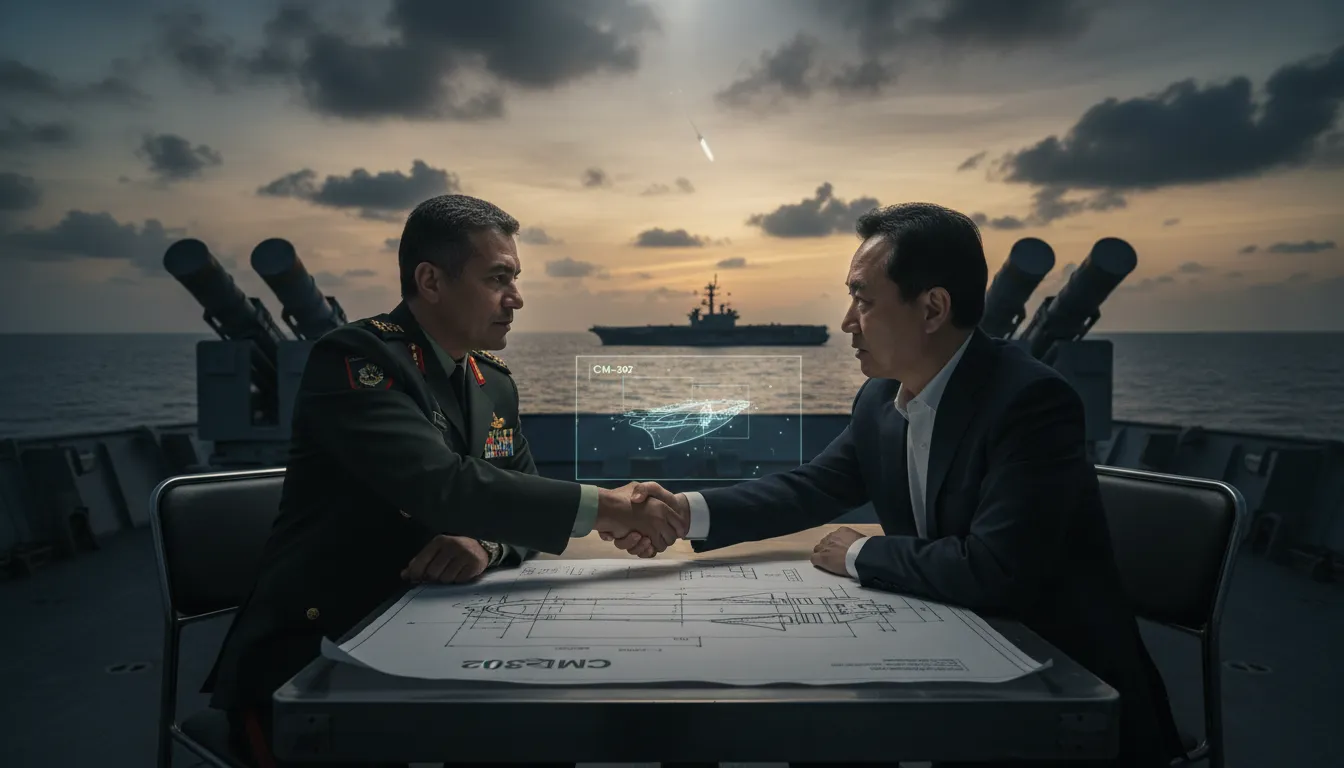
A Deal That Could Reshape the Persian Gulf
Iran is on the verge of acquiring one of China's most formidable naval weapons — the CM-302 supersonic anti-ship cruise missile — in a deal that military analysts warn could dramatically tilt the balance of power in the Persian Gulf against the United States Navy. Reuters cited six people familiar with the negotiations, calling the agreement near-complete, though no delivery date has yet been set.
What Makes the CM-302 a 'Gamechanger'
The CM-302 is an export variant of China's domestically fielded YJ-12 anti-ship missile — engineered specifically to defeat modern naval air-defense systems. Its technical profile is formidable: a range of approximately 290 kilometers, a 250-kilogram warhead, and a top speed exceeding Mach 2, with some estimates placing it as high as Mach 4. Crucially, the missile sea-skims at low altitude during approach and executes evasive spiral maneuvers in its terminal phase, drastically compressing defenders' reaction time.
An Israeli security expert quoted by the Times of Israel was blunt:
"It's a complete gamechanger if Iran has supersonic capability to attack ships in the area. These missiles are very difficult to intercept."
Unlike subsonic weapons that current U.S. naval defense systems are well-calibrated to defeat, a supersonic sea-skimmer gives defending ships only seconds to respond — and Iran's doctrine of saturation attacks, flooding defenses with multiple simultaneous threats, amplifies that danger significantly.
Timing: Two Carrier Groups, Rising Tensions
The reported negotiations come at a moment of acute regional tension. Since late January 2026, the United States has deployed its largest naval presence in the Middle East since the 2003 Iraq invasion: two carrier strike groups — the USS Abraham Lincoln and the USS Gerald R. Ford — together carrying over 5,000 personnel and around 150 aircraft. The deployment was designed to deter Iran amid ongoing nuclear standoff pressure from the Trump administration.
According to Army Recognition, the talks accelerated after a 12-day conflict between Israel and Iran that strained Tehran's conventional missile arsenal and exposed critical gaps in its ability to project naval deterrence. Acquiring the CM-302 would directly address that vulnerability.
China's Calculated Risk
For Beijing, the deal is a geopolitical double-edged sword. Iran settles much of its Chinese trade in oil — approximately 90% of Iranian crude exports flow to China — giving the relationship deep economic roots. But finalizing the transfer would represent one of the most advanced Chinese weapons systems ever sold to Tehran, inevitably drawing U.S. sanctions scrutiny and complicating preparations for a high-stakes Trump-Xi summit tentatively planned for April 2026.
Analysts at the Middle East Eye note that the deal reflects deepening Iran-China security convergence shaped by years of Western sanctions — a structural shift that extends well beyond any single weapons transfer.
Pentagon on Alert
U.S. officials are reportedly preparing contingency options. Military planners face a difficult calculus: intercepting CM-302 missiles in the constrained waters of the Strait of Hormuz is significantly harder than in open ocean, and Iran's geography — with dispersed coastal launch sites across hundreds of kilometers of shoreline — makes preemptive strikes costly and uncertain. The Pentagon has not officially commented on the reported deal.
Whether China ultimately proceeds remains uncertain. But the signal alone — that Tehran is this close to supersonic anti-ship capability — is already reshaping strategic calculations on all sides.