Meta's $100B AMD Deal Challenges Nvidia's AI Chip Grip
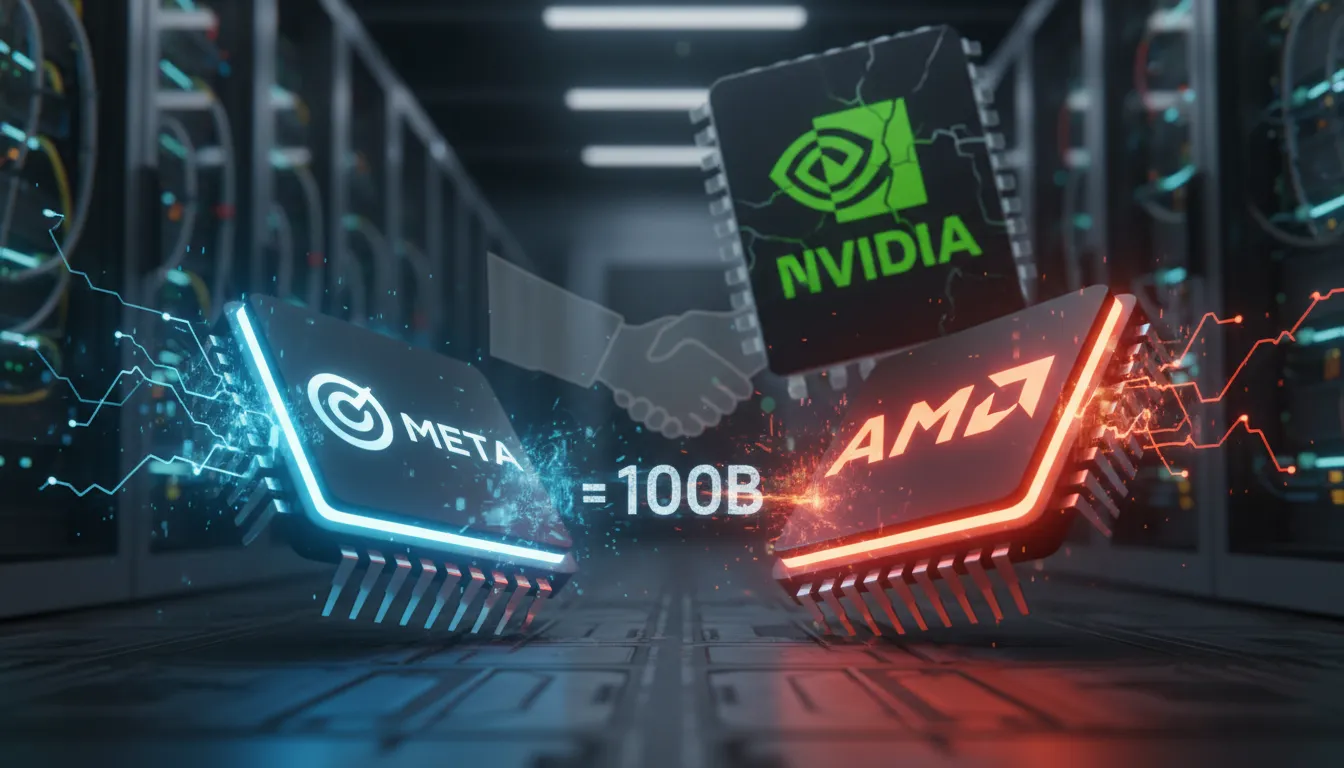
Meta Platforms has struck a deal worth up to $100 billion with AMD for AI chips, including an option to acquire a 10% stake in the chipmaker — a bold bid to diversify away from Nvidia's near-monopoly on AI accelerators.
A $100 Billion Bet Against Nvidia
Meta Platforms has signed one of the largest AI infrastructure deals in history, agreeing to purchase up to $100 billion worth of chips from AMD over multiple years in a move that directly challenges Nvidia's near-total dominance of the AI accelerator market. Announced on February 24, the partnership also grants Meta the option to acquire up to 10% of AMD — a strategic equity stake that binds the two companies' futures far beyond a standard supply agreement.
What the Deal Covers
At the core of the agreement is the deployment of up to six gigawatts of AMD Instinct GPUs — enough raw computing power to run enormous AI training and inference workloads simultaneously. The first tranche, one gigawatt of capacity, is scheduled to come online in the second half of 2026, powered by AMD's custom MI450-based GPUs and sixth-generation EPYC server processors, delivered through AMD's integrated Helios rack-scale architecture.
The equity component is particularly striking. AMD issued Meta a performance-based warrant for up to 160 million shares — roughly 10% of the chipmaker — at just $0.01 per share. The shares vest in stages as Meta hits cumulative deployment milestones on the path to the full six-gigawatt target, aligning both companies' incentives over the long term.
Breaking Nvidia's Lock
For years, Nvidia has commanded an estimated 80–90% share of the AI chip market, leaving rivals and customers with few viable alternatives. Meta's AMD deal — announced just days after a separate agreement to also expand its Nvidia GPU deployments — signals a deliberate supply-chain diversification strategy. "This is an important step to diversify our compute and build a more resilient and flexible infrastructure," Meta said in an official statement.
Mark Zuckerberg framed the partnership around an ambitious corporate vision. "We're excited to form a long-term partnership with AMD to deploy efficient inference compute and deliver personal superintelligence," the CEO said — a phrase that marks a notable escalation of Meta's declared AI ambitions, suggesting systems capable of acting as individualized cognitive companions rather than simple productivity tools.
AMD's Largest Win in the AI Era
For AMD, the deal is a watershed moment. The company commands less than 10% of the AI accelerator market today, and the Meta agreement is its largest single customer win since the AI boom began. AMD shares surged 8.8% on the announcement, reflecting investor conviction that the partnership could meaningfully shift competitive dynamics in a market long defined by Nvidia's H100 and B200 chips.
The Bigger Picture
Meta's willingness to make a decade-scale, nine-figure commitment to AMD signals that the AI arms race is no longer winner-take-all for any single chip vendor. As companies race to build infrastructure for the next generation of AI — from large language models to real-time inference deployed across billions of devices — supply-chain resilience has become as strategic as raw performance.
The deal also underscores how capital-intensive AI has become. Six gigawatts of GPU compute represents roughly three times Meta's current AI infrastructure, according to Data Center Knowledge — a figure that illustrates just how dramatically the company is scaling its ambitions. With Microsoft, Google, and Amazon similarly committing hundreds of billions to AI buildouts, 2026 is shaping up as the year the AI infrastructure race truly went industrial.