Iran Strikes US Bases Across Five Gulf States
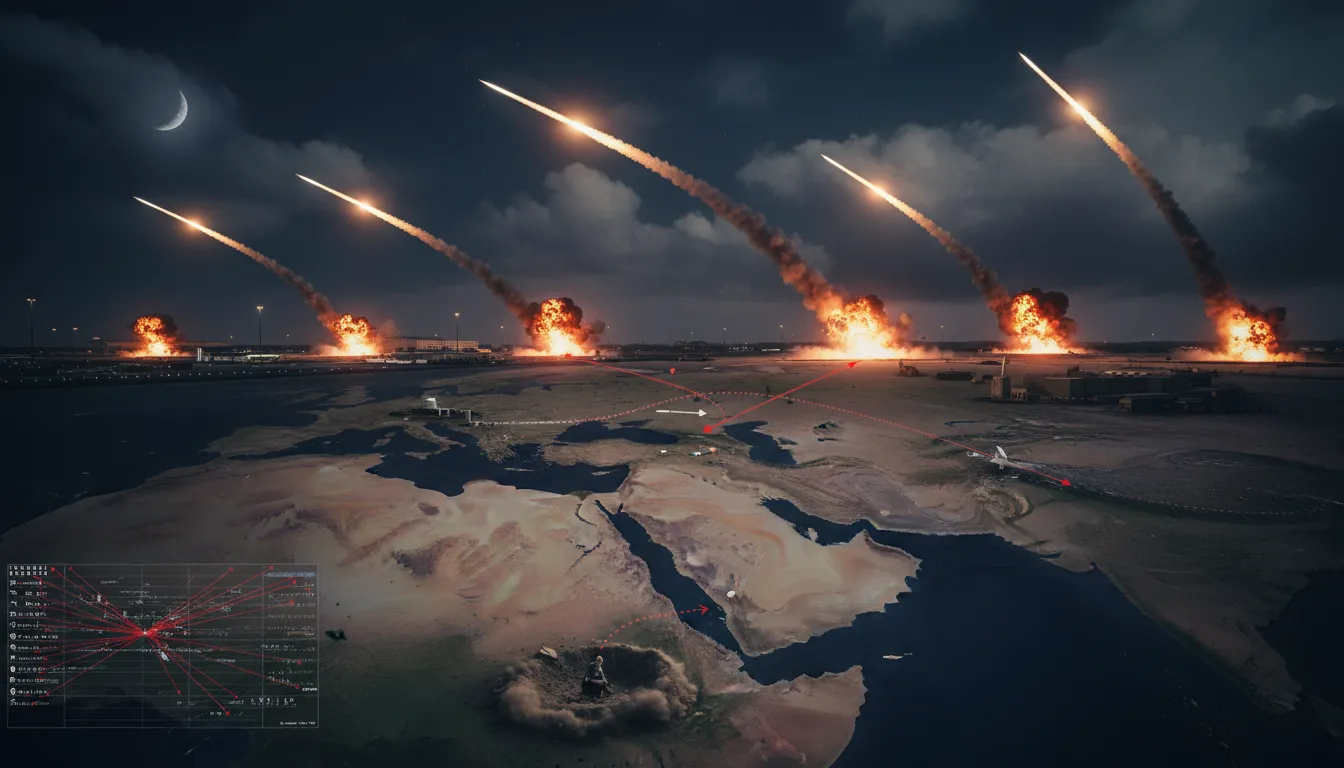
In an unprecedented move, Iran launched coordinated ballistic missile barrages at US military installations across Bahrain, Qatar, Kuwait, the UAE, and Saudi Arabia, killing at least one person and triggering airspace closures across the Gulf — marking the first time Tehran has targeted all American military bases in the region simultaneously.
A Historic Escalation
In the hours following a massive joint US-Israeli airstrike campaign on Iranian territory, Tehran struck back with a sweeping missile barrage targeting American military installations spread across five Gulf Arab states — marking what analysts and officials describe as an unprecedented escalation in Middle Eastern warfare. For the first time ever, Iran launched coordinated attacks on all US military bases in the Gulf region simultaneously, a threshold it had carefully avoided crossing in previous confrontations.
The Targets: America's Gulf Footprint Under Fire
Iran's Islamic Revolutionary Guard Corps (IRGC) confirmed that its missiles targeted a string of critical US installations, including:
- Al Udeid Air Base, Qatar — the largest US air base in the Middle East, serving as the regional hub for US Air Forces Central Command
- US Navy Fifth Fleet headquarters, Bahrain — Bahrain confirmed the base was struck, representing a direct hit on America's naval command center for the entire Gulf
- Al-Salem Air Base, Kuwait — Kuwait's Defence Ministry said all incoming ballistic missiles were intercepted by air defense systems
- Al-Dhafra Air Base, UAE — explosions were reported in Abu Dhabi and footage showed impacts near the Dubai Marina
Iraq's Erbil airport was also struck twice, while Syria's Suwayda province reported four killed in an industrial zone hit by Iranian fire.
Casualties and Air Defenses
At least one person was killed in Abu Dhabi after Iranian ballistic missiles were intercepted over UAE territory, according to the country's state news agency WAM. Qatar's Defence Ministry stated that all missiles targeting Qatari soil were intercepted before reaching their destinations. Kuwait reported similar results, with its air defenses engaging multiple ballistic missiles.
Despite largely successful interceptions, the sheer volume and geographic breadth of the strike caused immediate panic across the region, with multiple countries temporarily closing or restricting their airspace as a precautionary measure.
Tehran's Declaration
The IRGC issued a stark statement following the missile salvos, claiming that "all Israeli and US military targets in the Middle East have been struck by the powerful blows of Iranian missiles." The corps added: "This operation will continue relentlessly until the enemy is decisively defeated," and designated all US military assets across the region as legitimate targets. Iran's decision to act was framed as an existential response — analysts noted the strikes bore none of the prior warnings or deliberate restraint that had characterized Iran's previous retaliatory actions, suggesting Tehran viewed the situation as a fundamental threat to the Islamic Republic's survival.
Gulf Reactions: Condemnation and Alarm
Saudi Arabia issued one of the sharpest condemnations, calling the attacks "blatant Iranian aggression and a flagrant violation of sovereignty" of the UAE, Bahrain, Qatar, Kuwait, and Jordan. All targeted states lodged formal protests. Notably, Oman — which had been actively brokering peace negotiations between the US and Iran just hours before the fighting erupted — was not struck, a calculated signal that Tehran was preserving a back-channel even while unleashing its most expansive military response yet.
A New and Dangerous Phase
The strikes dramatically widen the geographic boundaries of the Iran conflict, pulling Arab states that had long sought to remain neutral directly into the crossfire. With US military assets distributed across partner nations now treated as legitimate targets by Iran, the Gulf's careful balance between alignment with Washington and economic ties to Tehran has been shattered. Oil markets, regional aviation, and diplomatic channels all face severe disruption as a conflict that began over Iran's nuclear program spirals toward a full regional war.