MWC 2026: Real AI Devices Arrive, Europe Falls Behind
At Mobile World Congress 2026 in Barcelona, over 109,000 attendees witnessed Honor's robotic phone, AMD's first AI desktop chips, and Nvidia's 6G commitments — while Europe's fragmented telecom market drew stark warnings from industry leaders.
Barcelona Enters the IQ Era
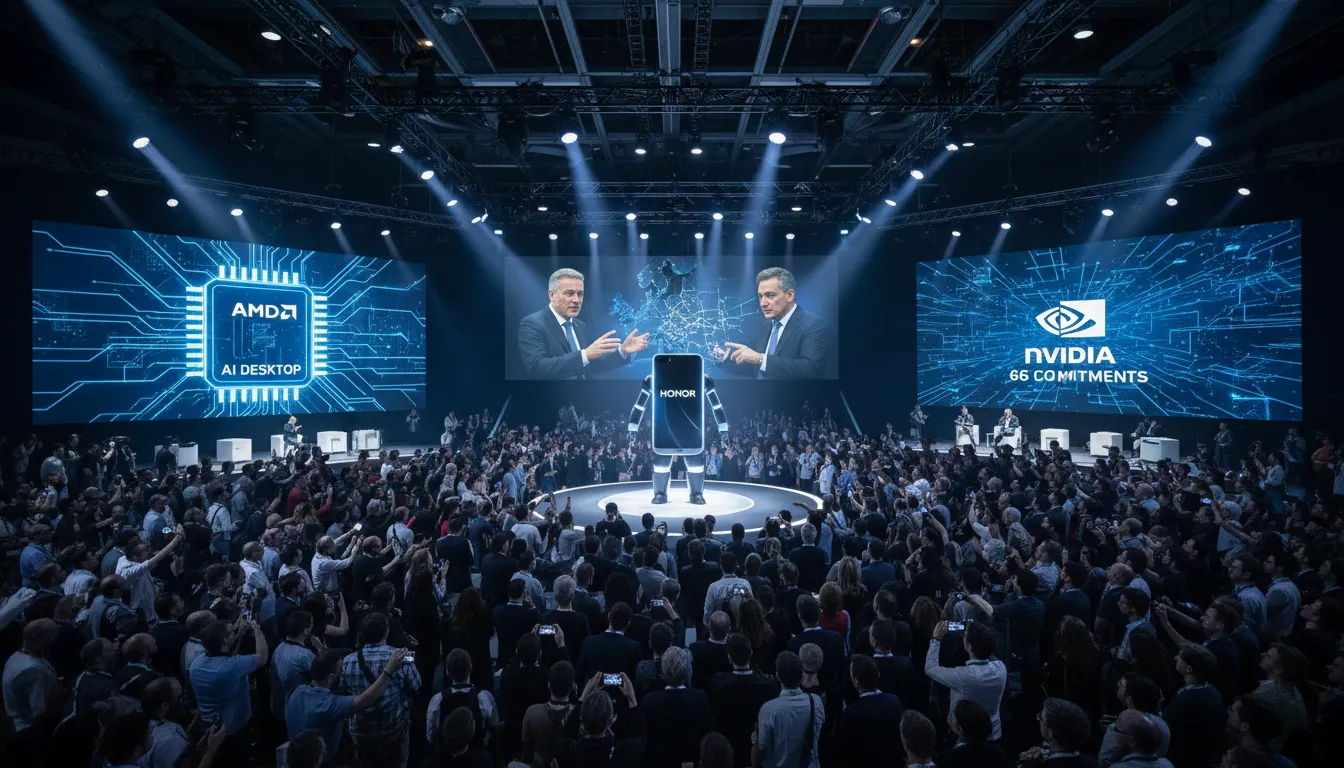
Mobile World Congress 2026 opened on March 2 in Barcelona, marking the event's 20th anniversary in the Catalan capital. Under the theme "The IQ Era", roughly 109,000 professionals and nearly 2,900 exhibitors from over 100 countries gathered at Fira Gran Via to signal a decisive industry shift: artificial intelligence is no longer a feature layered onto devices — it is becoming the device itself.
GSMA Director General Vivek Badrinath set the tone in his opening remarks, calling for "joint efforts to deepen 5G deployment, address AI-related challenges and strengthen digital security." The mood throughout the halls was one of urgency, not mere excitement.
Honor's Robot Phone: A New Species of Smartphone
The single most striking product on the show floor came from Chinese manufacturer Honor, which unveiled its Robot Phone — a device it describes as "a new species of smartphone" built around embodied intelligence. The handset features a camera mounted on a small robotic arm that extends from the body, tracks faces and objects in real time, nods in acknowledgment, and even dances to music rhythm.
"The camera can respond with a yes or no answer by nodding," Honor said, noting that the assistant carries what the company calls a "personality." Alongside the Robot Phone, Honor previewed its first humanoid robot, intended for three scenarios: shopping assistance, workplace inspections, and companionship. No production timeline or pricing was disclosed, but the message was clear — the smartphone's evolution toward physical, embodied AI has begun.
AMD Brings AI Acceleration to the Desktop
On the silicon side, AMD announced the Ryzen AI 400 and Ryzen AI PRO 400 series at MWC — the world's first desktop processors certified for Microsoft's Copilot+ PC standard. Until now, Copilot+ certification was the exclusive domain of laptops. AMD's Jack Huynh described the chips as "the world's first designed to power new Copilot+ experiences on the desktop," with the top-end Ryzen AI 9 HX PRO 475 delivering up to 60 TOPS of local AI processing — well above the 40 TOPS threshold required for certification. OEM partners including HP and Lenovo plan to ship systems in Q2 2026.
Nvidia and the Open Road to 6G
Ahead of the congress, Nvidia committed to backing open, AI-native platforms as the foundation for future 6G networks. The company argues that the explosion of autonomous AI agents will create network demands that only software-defined, programmable infrastructure can handle. The current phase — 5G Advanced — is positioned as the critical bridge before 6G arrives, with operators able to tune it via software-defined networking tools.
Europe's Uncomfortable Truth
Beneath the product launches ran a sobering current. GSMA's Badrinath warned bluntly that Europe risks being "out of the game" if it fails to accelerate 5G Standalone deployment, currently sitting at a mere 3 percent across the continent — compared to far higher rollout rates in the US and China. The structural cause is stark: Europe has roughly 200 fragmented operators averaging 5 million customers each, while US and Chinese counterparts each serve between 150 and 450 million subscribers, enabling dramatically higher R&D and infrastructure spending.
With EU commissioners attending, MWC 2026 also served as an informal lobbying stage for the bloc's Digital Network Act reforms, as telcos pushed for regulatory changes they argue are essential to close the gap.
The Verdict
MWC 2026 drew a clear line between hype and hardware. Robot phones, AI desktop chips, and open 6G commitments signal that the industry has moved past proof-of-concept. The harder question — who will lead the commercialization of this new era — remains very much open, and for Europe, the clock is ticking.