New Mars Mineral Found in Ancient Sulfur Deposits
Scientists have identified ferric hydroxysulfate, a potentially brand-new mineral, in ancient sulfate-rich sediments on Mars. The discovery, published in Nature Communications, suggests the Red Planet was far more chemically and thermally active in its recent geological past than previously believed.
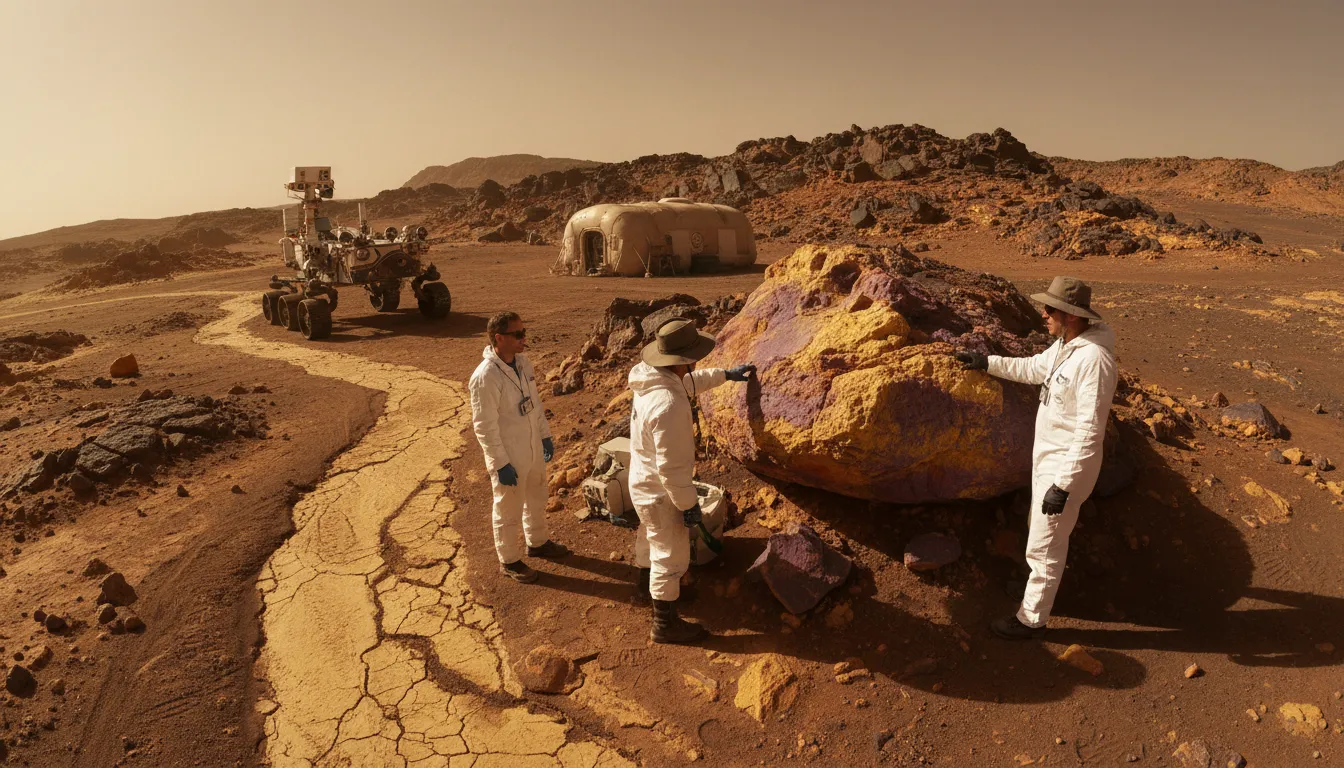
A Mineral Unlike Any Known on Earth
Scientists studying data from Mars have identified what may be a brand-new mineral — a ferric hydroxysulfate previously unknown to planetary science. The discovery, published in Nature Communications and led by Dr. Janice Bishop of the SETI Institute and NASA's Ames Research Center, was made by combining detailed laboratory experiments with spectroscopic data captured by the CRISM instrument aboard NASA's Mars Reconnaissance Orbiter.
For nearly two decades, researchers noticed puzzling spectral signatures in Mars' iron sulfate deposits that did not match any known mineral. Only now has a systematic investigation cracked the mystery. The mineral — ferric hydroxysulfate — is rare even on Mars, appearing in just a handful of small, localized zones near the planet's massive canyon system.
Heat, Water, and Chemistry
The story of this mineral's formation is also the story of Mars losing its water. Ancient sulfate-rich brines once pooled across vast lowland regions. As those waters gradually evaporated, they left behind layered deposits of hydrated iron sulfates. Then, volcanic eruptions and geothermal activity heated the dried sediments to temperatures exceeding 100°C — and in the presence of atmospheric oxygen, the chemistry shifted, producing ferric hydroxysulfate.
"This ferric hydroxysulfate only forms when hydrated ferrous sulfates are heated in the presence of oxygen," explained postdoctoral researcher Dr. Johannes Meusburger, one of the study's co-authors. Lab experiments confirmed the transformation sequence: polyhydrated sulfates first lose water molecules at around 50°C, and above 100°C the chemical structure fundamentally reorganizes into the new compound.
Two key Martian sites bear the mineral's fingerprint. At Juventae Chasma, ancient water channels crisscross the terrain alongside volcanic features — signs of lava or ash that could have provided the necessary heat. At Aram Chaos, the chaotic, broken landscape records a history of catastrophic flooding and subsequent geothermal warmth from the planet's interior.
A More Dynamic Mars Than Expected
The implications go well beyond mineralogy. The findings indicate that Mars remained chemically and thermally active far more recently than scientists had assumed — potentially within the last 3 billion years. That timeline matters enormously for questions about habitability, as geothermal heat and liquid water are among the key ingredients that could support microbial life.
"These minerals survive for billions of years on Mars' dry surface, preserving valuable evidence about the planet's early conditions," Bishop's team noted. Because Mars lacks tectonic recycling, its ancient geological record remains largely intact — a library that Earth has largely destroyed through plate motion and erosion.
Significance for Future Missions
The discovery carries direct relevance for upcoming NASA and ESA missions focused on the search for biosignatures. Locations where volcanic heat once interacted with standing water — exactly the environments where ferric hydroxysulfate forms — are the kinds of niches that astrobiologists consider most promising for preserving traces of ancient life.
There is also a scientific caveat worth noting: before ferric hydroxysulfate can be formally recognized as a new mineral species, it must first be confirmed in a terrestrial sample. Nature's classification rules require a physical specimen, not just a spectral match. That hunt on Earth is now underway.
The research adds yet another layer of complexity to our understanding of the Red Planet — one that increasingly resembles a world that was, in the distant past, far more dynamic, wet, and potentially life-friendly than its cold and barren present would suggest.