Oil Edges Toward $100 as Iran Strikes Shock Markets
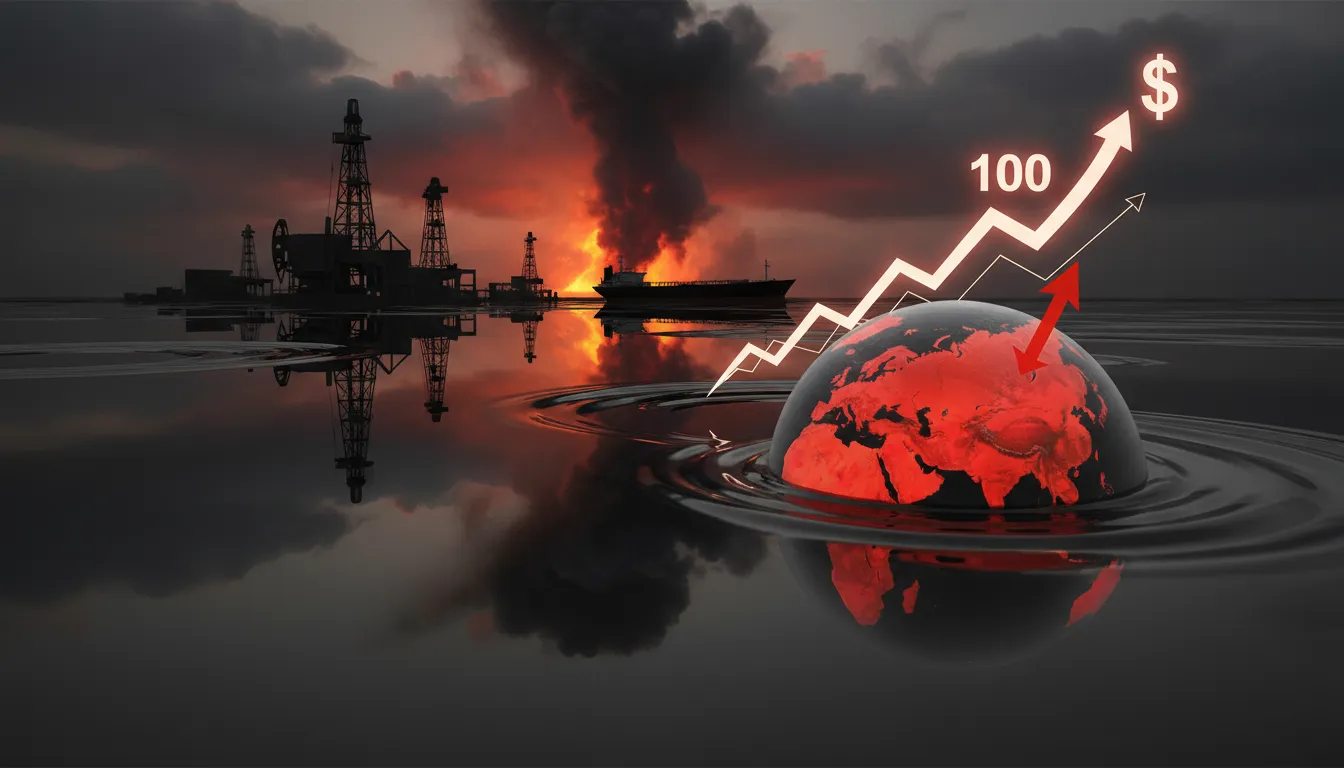
Joint US-Israeli strikes on Iran sent Brent crude surging to $72.48 a barrel, with Barclays warning prices could hit $100 if Iran moves to restrict the Strait of Hormuz — the chokepoint for a third of the world's seaborne oil trade.
Markets in Shock as Strikes Hit Iran
The joint US-Israeli military operation targeting sites across Iran sent immediate shockwaves through global energy markets on Friday. Brent crude settled at $72.48 a barrel — up $1.73, or 2.45% on the day — while US West Texas Intermediate rose 2.78% to $67.02. Both benchmarks had been creeping higher for weeks in anticipation of military action, but the confirmation of strikes triggered a sharper, fear-driven jump.
Barclays was among the fastest to revise its outlook, raising its Brent forecast to around $100 a barrel — up from an earlier estimate of $80 — citing the possibility of sustained supply disruption. The bank's upward revision reflects a scenario in which fighting drags on or Iran retaliates in ways that meaningfully restrict oil flows out of the Persian Gulf.
The Hormuz Chokepoint
At the center of market anxiety sits the Strait of Hormuz, the narrow waterway between Iran and Oman through which more than 14 million barrels of oil flow every day — roughly one-third of all seaborne crude exports, according to Bloomberg. About three-quarters of that volume is destined for China, India, Japan and South Korea, making any disruption a direct threat to the economies of Asia's largest energy consumers.
In the immediate aftermath of the strikes, semiofficial Iranian media described the strait as effectively shut. Vessels in the region reported receiving VHF radio messages purportedly from the Iranian Revolutionary Guards announcing that no ships were permitted to pass. Tehran did not formally confirm a closure order, but the threat alone rattled tanker markets. Iran possesses large stockpiles of mines and short-range missiles capable of seriously disrupting commercial traffic through the waterway — and even a partial, insurance-driven rerouting of tankers could push Brent well above $100, analysts warned.
Iran's Oil Footprint — and Its Limits
Despite years of Western sanctions, Iran currently exports roughly 1.9 million barrels a day, most of it reaching China through a network of so-called shadow ships designed to evade detection. Losing Iranian supply would tighten markets but would not by itself critically disrupt global flows, according to NPR's energy analysts — China maintains substantial strategic reserves and alternative supply lines.
The far larger fear is collateral damage. Iranian retaliation against Gulf producer infrastructure in Saudi Arabia, Kuwait, the UAE or Qatar could knock out far more barrels than Iran itself exports. A worst-case scenario involving wider regional escalation could take roughly 20% of global supply offline, some analysts estimated — a level not seen since the oil shocks of the 1970s.
OPEC+ and the Inflation Threat
OPEC+ convened an emergency meeting on Sunday to assess the situation. The group was already considering a modest production increase of 137,000 barrels per day for April; a prolonged conflict could accelerate those discussions. Yet spare capacity — concentrated mostly in Saudi Arabia and the UAE — may not be easily deployed if fighting spreads across the region.
The macroeconomic stakes extend well beyond energy traders. A sustained disruption to Hormuz traffic could add 0.6 to 0.7 percentage points to global inflation, according to projections cited by CNBC — unwelcome pressure for central banks already navigating stubborn price growth. If sustained, such a shock could tip the global economy into recession.
What Happens Next
The immediate trajectory depends heavily on whether Iran formalizes its Hormuz restrictions and how quickly diplomatic channels can contain the conflict. A swift, contained exchange ending in negotiated de-escalation could allow Brent to drift back toward $70 in a fundamentally oversupplied global market. But if the strikes prompt a prolonged confrontation, energy markets — and the global economy — face a reckoning without recent precedent.