Paralympics Boycott Grows Over Russia's Flag Return
The 2026 Winter Paralympics opens 6 March in Italy amid a boycott by eight European nations and the EU Commission, after the IPC allowed Russia and Belarus to compete under their national flags — a stark contrast to the neutrality imposed at the recent Winter Olympics.
A Divided Stage in Italy
The 2026 Winter Paralympic Games open on 6 March in Milan and Cortina d'Ampezzo, Italy, bringing together around 665 para-athletes to compete across 79 medal events in six sports over ten days. But what should be a celebration of human resilience is instead being overshadowed by a widening diplomatic dispute over Russia and Belarus — and whether they belong on the podium, flags and all.
A Break from Olympic Rules
At the Winter Olympic Games held in the same Italian venues just weeks earlier, Russian and Belarusian athletes were permitted only a marginal presence — competing as "Individual Neutral Athletes," designated by the French acronym AIN, without national flags, uniforms bearing national insignia, or anthems. The International Olympic Committee maintained its sanctions against both countries following Russia's full-scale invasion of Ukraine in 2022.
The International Paralympic Committee has taken a strikingly different path. Following a vote by its General Assembly in September 2025, the IPC restored full membership rights to the Russian and Belarusian Paralympic Committees. Ten athletes — six Russian, four Belarusian — will now compete under their respective flags and anthems. Should a Russian athlete win gold, it would mark the first time the Russian national anthem has been played at a major international sporting event since the 2014 Winter Games in Sochi. Russia has been allocated six slots across alpine skiing, cross-country skiing, and snowboard; Belarus has four in cross-country skiing.
Eight Nations and the EU Say No
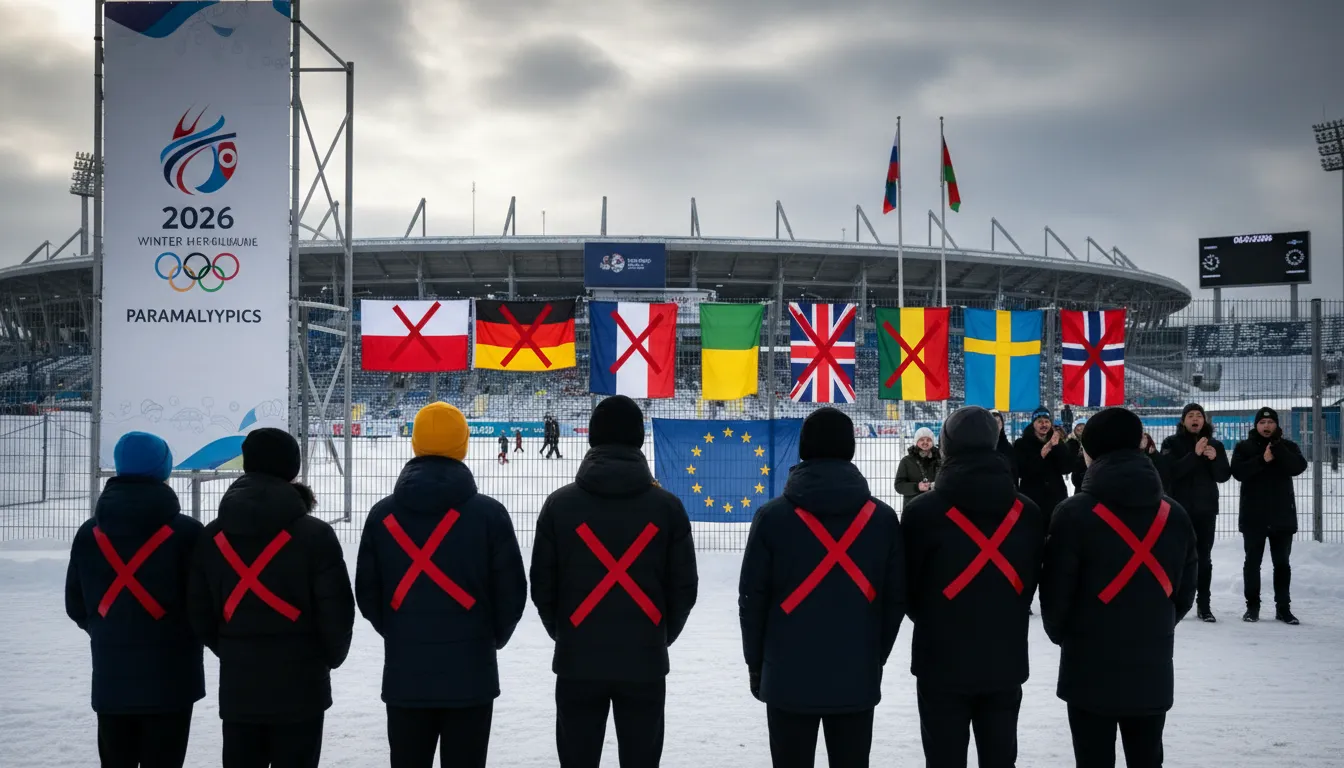
The backlash was swift and significant. By late February, at least eight countries — Ukraine, Poland, Finland, Latvia, Estonia, Lithuania, the Netherlands, and the Czech Republic — announced they would boycott the opening ceremony at the Arena di Verona. The European Commission joined them. EU Commissioner for Sport Glenn Micallef was unequivocal:
"While Russia's war of aggression against Ukraine continues, I cannot support the reinstatement of national symbols."
Even Italy, the Games' host nation, urged the IPC to reconsider. Britain's culture secretary Lisa Nandy described the ruling as "completely the wrong decision." The breadth of opposition — spanning governments, the EU executive, and athletes' advocates — reflects deep frustration over what many regard as a rehabilitation of a country still engaged in active military aggression against a neighbouring state.
Ukraine's Painful Compromise
For Ukraine, the situation is agonising. Ukrainian para-athletes — many of them veterans injured during the war — will still compete in Milan and Cortina. But no Ukrainian officials will attend any events. Sports Minister Matvii Bidnyi called the IPC's decision "disappointing and outrageous," while President Volodymyr Zelenskyy expressed anger at what he described as international legitimisation of Russia. Ukraine's foreign minister instructed ambassadors in boycotting countries to push collectively for the ruling to be reversed. It was not.
IPC Holds the Line
IPC President Andrew Parsons has made clear the General Assembly's vote is legally binding and cannot be overturned by the governing board or by himself alone. "The decision cannot be overturned," Parsons stated, acknowledging a "difficult situation" while standing firm on process and institutional procedure. The IPC argues that sport must remain politically neutral — a principle critics say rings hollow when one competing nation is actively bombing another.
With the opening ceremony days away and boycotts locked in, the 2026 Winter Paralympics faces a conflict it cannot resolve — one that reflects a deeper question the global sporting community has yet to answer: when does political neutrality become moral indifference?