EU Freezes US Trade Deal After Trump's 15% Tariff
The European Parliament has suspended ratification of its landmark trade agreement with Washington after President Trump imposed a new 15% global tariff — defying a Supreme Court ruling and plunging transatlantic trade relations into fresh crisis.
A Deal in Jeopardy
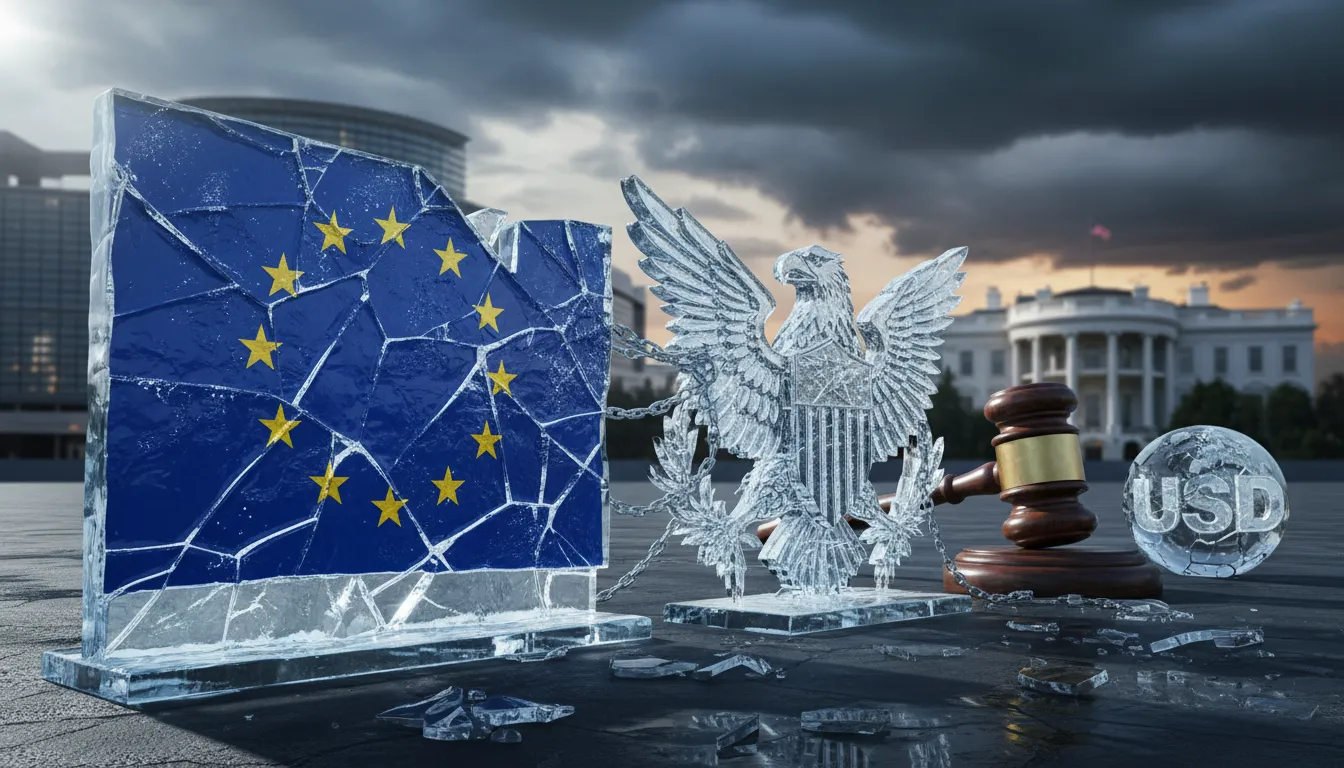
The transatlantic trading relationship lurched into fresh crisis last week when the European Parliament suspended ratification of a landmark trade agreement with the United States. The trigger: President Donald Trump's decision to impose a blanket 15% tariff on all global imports, an aggressive move that directly contradicts the terms of a deal the two sides had celebrated just months earlier.
Court Loss, Tariff Rebound
The crisis began on February 21 when the US Supreme Court struck down Trump's sweeping global tariff regime, which had roiled global markets since its introduction in spring 2025. Rather than accept the ruling, Trump moved immediately to reimpose duties through an alternative legal framework. He first announced a 10% universal import levy, then raised it to 15% — the statutory ceiling that can remain in place for up to 150 days without congressional approval.
The maneuver stunned European capitals. The trade deal negotiated last July between Trump and European Commission President Ursula von der Leyen had been designed around a stable tariff framework: it would have capped most US tariffs on EU goods at 15% and eliminated duties on aircraft, pharmaceuticals, semiconductors, and certain agricultural products. With Trump now unilaterally imposing that same 15% rate outside the agreement's structure, the deal's rationale collapsed almost overnight.
Brussels Hits Pause
The European Parliament's trade committee convened an emergency meeting in Brussels on February 23 before suspending the ratification vote. Committee chair Bernd Lange was blunt in his assessment, telling CNBC: "The US has breached the terms of its deal. The bloc is ready to retaliate if necessary." He added that "nobody knows what will happen" next from Washington, making it impossible for lawmakers to commit to an agreement they could not trust the other side to honour.
The European Commission echoed the frustration. "A deal is a deal," spokesman Olof Gill told reporters, demanding that Washington show clearly "what path it is taking to honor the agreement." Trump responded characteristically, warning via social media that any country trying to "play games" with the Supreme Court decision could face "a much higher tariff."
Retaliation Options
European officials are now weighing a range of countermeasures. The most powerful tool available is the EU's Anti-Coercion Instrument (ACI), a rarely invoked mechanism that would allow Brussels to restrict American companies' access to EU markets, exclude US firms from public procurement, and impose limits on investment flows. France has reportedly pushed hardest for its deployment.
The economic stakes are substantial. According to IMF analysis, a universal 10% US tariff accompanied by retaliatory measures from the EU and China could reduce US GDP by roughly 1% and trim global output by around 0.5% through 2026. US exports represent approximately 2.1% of EU GDP, meaning even a moderate tariff regime could subtract 0.4 percentage points from European growth.
Markets Rattled
Financial markets registered the alarm swiftly. The Dow Jones Industrial Average fell more than 820 points — a drop of 1.66% — on the day the EU announced its pause, while the S&P 500 shed 1.04% and the Nasdaq lost 1.13%. European indices also declined. Separately, Indian trade negotiators cancelled planned talks with Washington over a separate bilateral deal, suggesting the damage to US trade diplomacy is spreading beyond Europe.
A Pattern of Escalation
The standoff illustrates a recurring dynamic of Trump's second term: using tariff threats as coercive leverage, then reescalating when checked by legal or diplomatic constraints. For the EU, the immediate question is whether the transatlantic trade deal can be salvaged — or whether Brussels must now treat it as effectively dead and pivot fully toward retaliation. Either path carries significant costs for consumers, businesses, and the broader global economy.