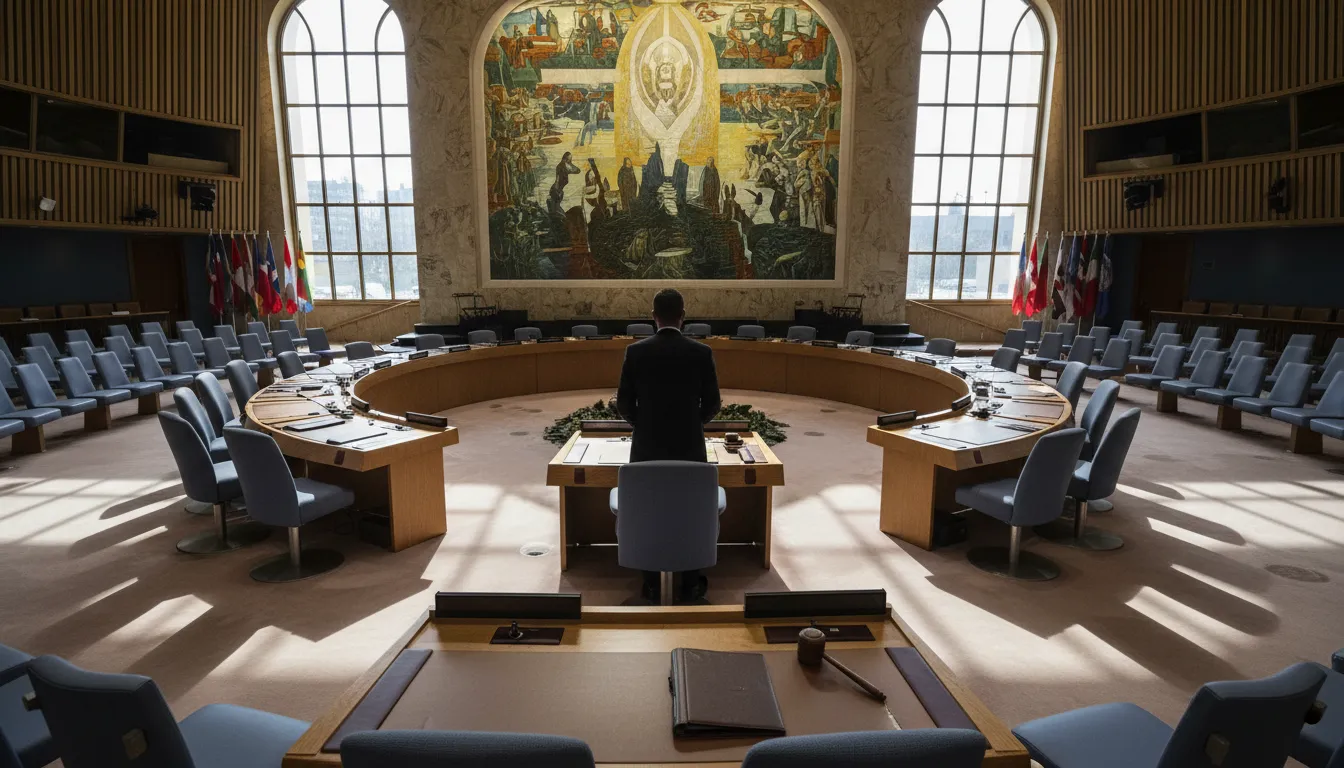
Trump Imposes 15% Global Tariff After Supreme Court Defeat
The U.S. Supreme Court struck down Trump's IEEPA tariffs in a 6-3 ruling, prompting the president to immediately pivot to a 15% universal import duty under a 1974 trade law, sending shockwaves through global markets and trade agreements.

A Landmark Ruling Reshapes U.S. Trade Policy
In a historic 6-3 ruling on February 20, 2026, the U.S. Supreme Court invalidated the sweeping tariffs President Donald Trump had imposed under the International Emergency Economic Powers Act (IEEPA), dealing the administration one of its most significant legal defeats. Chief Justice John Roberts, writing for the majority, held that IEEPA's references to "regulate" and "importation" were insufficient to grant the executive branch the power to levy tariffs — a power the Constitution explicitly reserves to Congress.
Roberts was joined by Justices Gorsuch and Barrett, along with the Court's three liberal justices — Sotomayor, Kagan, and Jackson — in a rare cross-ideological coalition. Justices Thomas, Kavanaugh, and Alito dissented. Kavanaugh's dissent warned that the ruling could force the government to refund more than $200 billion in tariffs already collected from U.S. importers.
Trump's Immediate Pivot: A New Legal Weapon
Within hours of the ruling, Trump did not back down. He signed an executive order imposing a new 10% universal import tariff, citing Section 122 of the Trade Act of 1974 — a provision that allows the president to declare a "temporary import surcharge" of up to 15% for up to 150 days when large balance-of-payments deficits are found. By Saturday morning, he had already escalated it to the statutory maximum of 15%.
"The biggest trade cheat in history just got caught by a rigged court — so we'll do it legally," Trump wrote on social media, signaling no intention to accept the Court's limits on his trade agenda.
The White House published a fact sheet framing the surcharge as a response to "fundamental international payment problems." U.S. Trade Representative Jamieson Greer confirmed the administration would simultaneously launch accelerated Section 301 investigations against most major trading partners, laying the groundwork to potentially reimpose higher tariffs under yet another legal authority once the 150-day window closes.
Global Markets and Alliances Rocked
The rapid sequence of legal defeat and policy escalation sent reverberations across the globe. For many countries, the shift from IEEPA's variable "reciprocal" rates to a flat 15% is a net reduction — but the uncertainty is proving more damaging than the rate itself.
The European Union found itself in an ambiguous position. ECB President Christine Lagarde warned that the new tariff "puts at risk the terms negotiated" in a fragile EU-US trade framework. German Chancellor Friedrich Merz called persistent tariff uncertainty "poison" for European economies. The European Parliament's trade committee was set to vote on the EU-US deal on the very day the new tariff took effect.
China, which previously faced cumulative tariffs exceeding 35%, saw the IEEPA component replaced by the universal 15% rate. Beijing called tariffs harmful to both nations but notably avoided making prior concessions, leaving it in a stronger negotiating position than countries that had already signed bilateral deals.
South Korea announced it would review a November 2025 agreement that had reduced U.S. tariffs from 25% to 15%, now questioning whether the new universal baseline changes its terms. India, similarly, postponed a trade delegation that had been finalizing a separate arrangement.
A 150-Day Clock — and What Comes After
The core tension in Trump's pivot is temporal. Section 122 is explicitly designed as an emergency measure, not a permanent fixture. When the 150-day clock expires — likely in late July 2026 — the administration will need congressional approval to extend it or pursue yet another legal mechanism.
Legal scholars and trade analysts broadly agree the Supreme Court's ruling represents a structural constraint on executive trade power. But Trump's ability to rapidly cycle between legal authorities demonstrates that the president retains considerable leverage — enough to sustain a trade war even without IEEPA, at least for now.