U.S. Masses 150 Warplanes Near Iran in Nuclear Standoff
The United States has repositioned more than 150 military aircraft and two carrier strike groups to the Middle East as nuclear talks with Iran stall, marking the largest regional buildup since the 2003 Iraq War.
The Largest Military Buildup in Decades
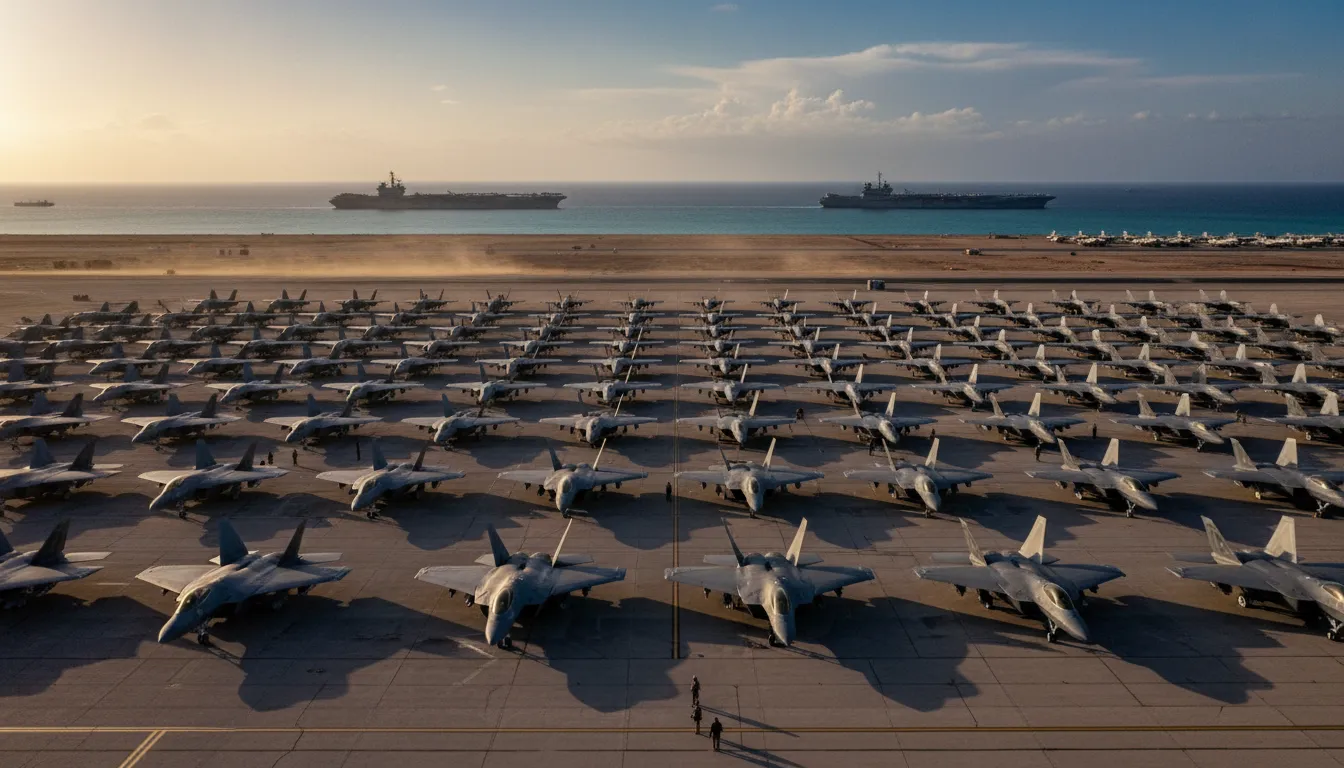
The United States has rapidly repositioned more than 150 military aircraft to bases across Europe and the Middle East, assembling a force not seen in the region since the 2003 invasion of Iraq. The deployment — which includes F-35 stealth fighters, F-22 air superiority jets, E-3 Sentry early-warning aircraft, and dozens of aerial refueling tankers — follows the breakdown of a second round of nuclear negotiations with Iran on February 17.
Alongside the airpower, the Pentagon has deployed two aircraft carrier strike groups to the region. The USS Abraham Lincoln, stationed roughly 200 miles off the coast of Oman, has been in the Arabian Sea since January. The USS Gerald R. Ford — the world's largest aircraft carrier — is steaming through the Mediterranean en route to join it. Fourteen warships in total now operate in the theater, supported by approximately 10,700 additional service members.
Trump's Ultimatum and the Diplomatic Clock
The military surge is the backdrop to an escalating diplomatic confrontation. President Donald Trump has given Iran "10 to 15 days at most" to agree to sweeping restrictions on its nuclear program and ballistic missile arsenal. "Otherwise bad things happen," Trump warned. A fresh round of U.S.-Iranian talks is scheduled for Geneva on February 26, though little optimism surrounds the session.
Iranian Foreign Minister Abbas Araghchi has said Tehran is "prepared for peace," calling a diplomatic solution "within reach." But Iran has simultaneously labelled the U.S. military buildup "unnecessary and unhelpful," signaling that the dual pressure of warplanes and negotiations is straining any remaining goodwill.
A Shadow of Operation Midnight Hammer
The context is especially fraught given recent history. In June 2025, the United States and Israel jointly struck Iranian nuclear facilities in what became known as Operation Midnight Hammer. The bases now receiving the latest wave of aircraft — including installations in the Azores and on Crete — were central to that campaign. Analysts who reviewed the deployments told The Washington Post that the current scale and composition surpass last year's pre-strike buildup, and appear consistent with planning for a sustained, multi-day air campaign rather than a single surgical strike.
Ali Vaez of the International Crisis Group warned that circumstances have shifted considerably: "It will be very hard for the Trump administration to do a one-and-done kind of attack in Iran this time around." An Iranian retaliation could draw in regional proxies and risk a far broader conflagration than the June strikes produced.
A High-Stakes Gamble
The buildup represents one of the sharpest tests of Trump's maximum-pressure doctrine. The administration appears to be wagering that an overwhelming show of force will drive Tehran toward concessions it has repeatedly refused. With the Geneva talks hours away and the military machinery already in place, the window for diplomacy is narrowing fast — and the consequences of its failure could reshape the Middle East for a generation.