Brazil's Amazon Nears Historic Deforestation Record Low
Satellite data shows Amazon deforestation in Brazil fell to its lowest level since 2014, with Environment Minister Marina Silva predicting 2026 could deliver an all-time record low if current enforcement trends hold.
A Forest Fighting Back
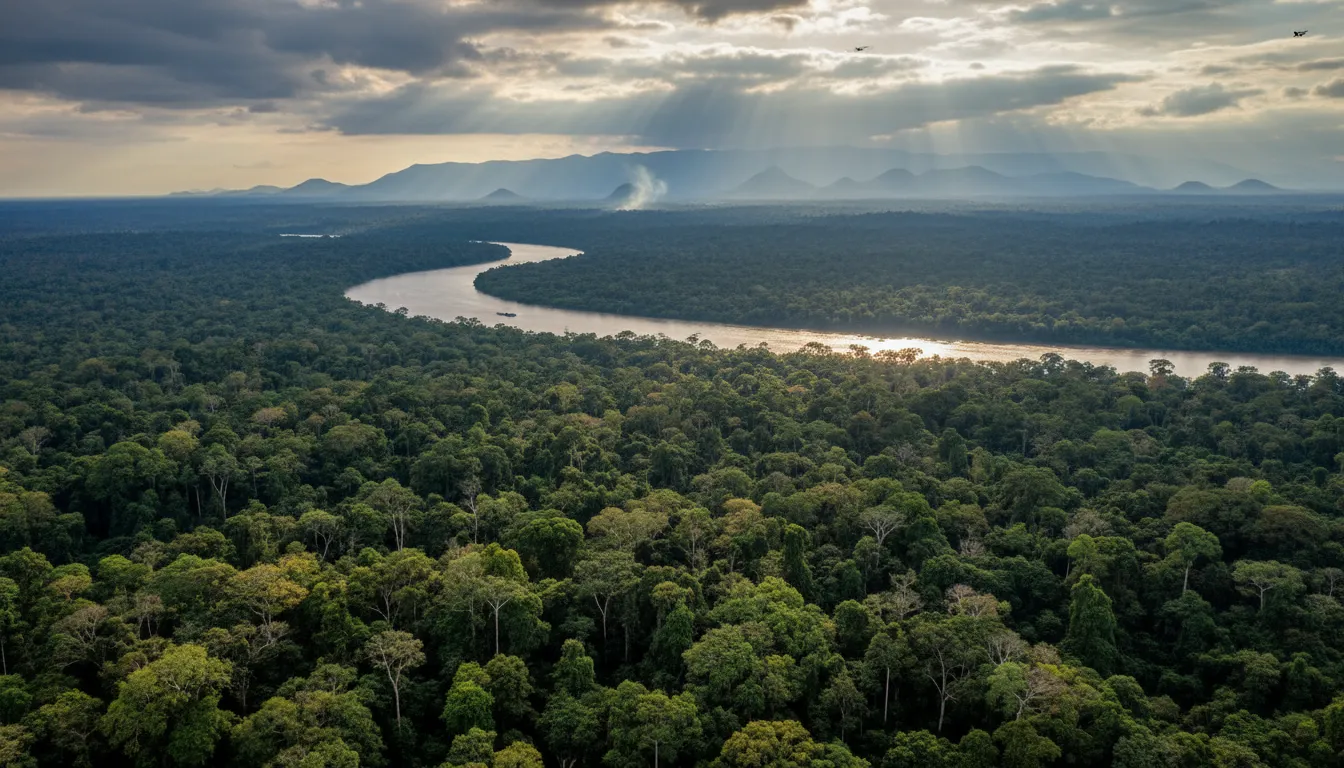
For decades, the Amazon rainforest was synonymous with one of humanity's most urgent ecological failures — a colossal natural system being dismembered at industrial scale. Now, fresh satellite data is telling a strikingly different story. Forest clearing in the Brazilian Amazon between August 2025 and January 2026 totalled just 1,325 square kilometres, the lowest figure for that six-month window since 2014, according to monitoring by Brazil's National Institute for Space Research (INPE) and independent nonprofit Imazon.
The figure represents a 35 percent drop compared with the same period a year earlier, when 2,050 square kilometres were cleared. For the full deforestation year running August 2024 through July 2025, Brazil recorded 5,796 square kilometres of loss — an 11 percent decline and the lowest annual total in eleven years, as reported by ESG News.
A Minister's Milestone Prediction
Environment Minister Marina Silva, the architect of Brazil's conservation push, has gone further than the numbers alone. "There is an expectation that we will reach, in 2026, the lowest deforestation rate in the historical series in the Amazon if we continue with these efforts," she said, according to Mongabay. If confirmed at year's end, it would surpass previous low-water marks going back to the beginning of systematic satellite monitoring.
Silva credited a coordinated government effort: of the 81 Brazilian municipalities historically responsible for the highest deforestation rates, 70 have now joined a federal initiative called "Union with Municipalities," committing local authorities to anti-clearing programmes backed by resources from Brazil's Amazon Fund.
The Lula Effect
The transformation is closely tied to President Luiz Inácio Lula da Silva, who returned to office in January 2023 after the permissive Bolsonaro years, when illegal loggers, ranchers, and miners operated with near-impunity. Since Lula took office, Amazon deforestation rates have more than halved. Strengthened enforcement operations, increased federal prosecutions, and reinstated environmental oversight agencies have reshaped conditions on the ground.
The downstream effect has been measurable at a macro level. Brazil's greenhouse gas emissions dropped by their biggest margin since 2009 in the previous year, a shift driven overwhelmingly by the forest gains, according to Yale Environment 360.
Why the Amazon's Recovery Matters Globally
The stakes extend far beyond Brazil's borders. Research shows that deforested patches of the Amazon experience average dry-season temperatures roughly 3°C higher than intact forest areas, and receive about 25 percent less rainfall — feedback loops that threaten regional agriculture. Scientists estimate the Amazon's rainfall contribution alone is worth approximately $20 billion annually to the farmers and communities that depend on its water cycle.
The Amazon also functions as one of Earth's most critical carbon sinks. When trees are cleared and burned, they release centuries of stored carbon dioxide in a matter of hours. Protecting that store has become a cornerstone of global climate strategy.
The COP30 Backdrop
The timing is politically charged. Brazil is set to host COP30, the UN's annual climate summit, later in 2026 — and the deforestation figures give Brasília tangible evidence to present to world leaders. The milestone also arrives as environmental funding mechanisms face pressure globally, making Brazil's domestic policy success all the more notable.
Challenges remain: the Cerrado savanna, Brazil's second major biome, still faces clearing pressure, and enforcement capacity is uneven across remote frontier regions. But for now, the data from the world's largest rainforest points unmistakably in the right direction.