Ukraine Peace Talks Near Breaking Point Over Donbas
Russia is threatening to abandon US-brokered peace negotiations unless Ukraine cedes its remaining territory in the Donetsk region, pushing talks to a critical juncture ahead of a new round expected in Abu Dhabi in early March.
A Make-or-Break Moment
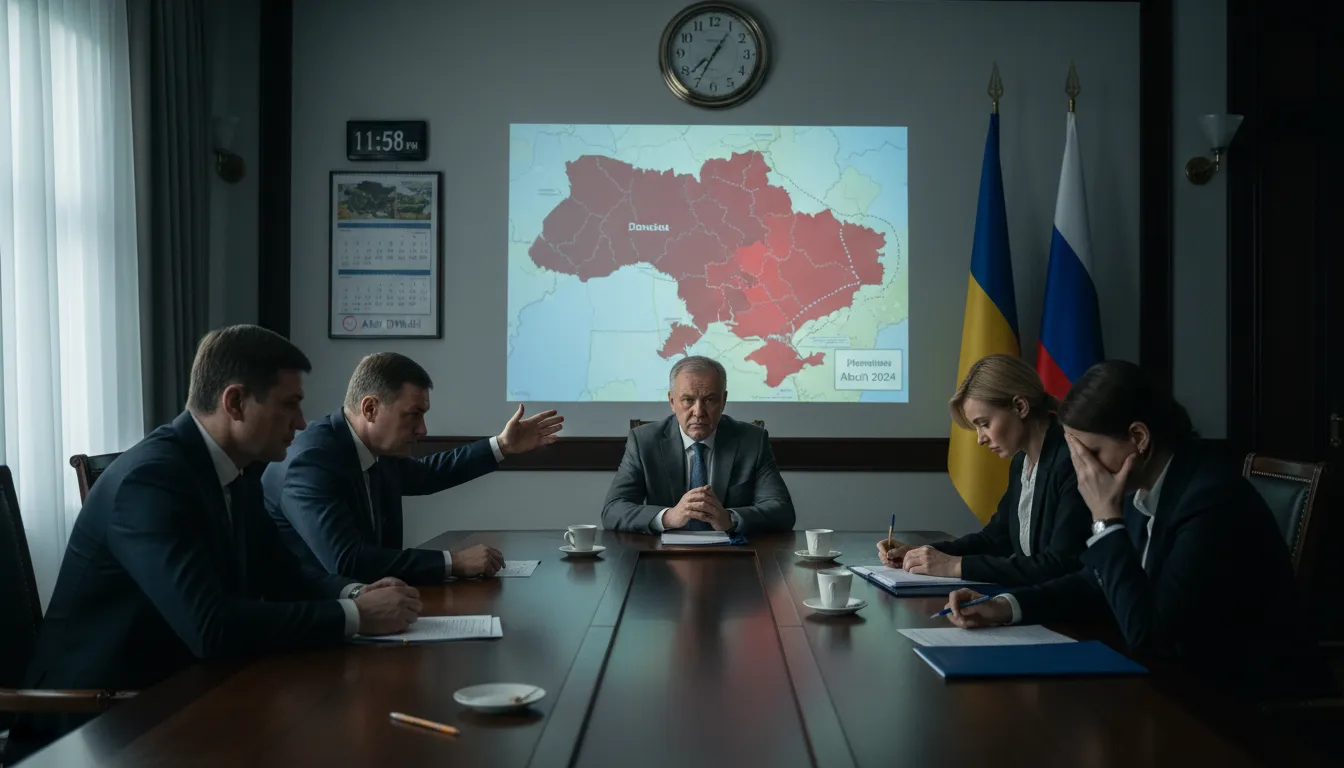
Russia has signalled it may walk away from US-brokered peace negotiations with Ukraine unless Kyiv agrees to surrender its remaining foothold in the eastern Donetsk region — a demand Ukraine has categorically rejected and one that threatens to collapse the most serious diplomatic effort to end nearly four years of war.
According to Bloomberg, people close to the Kremlin have indicated that Moscow sees little point in continuing trilateral talks with the United States and Ukraine if Kyiv refuses to make territorial concessions. The next round of negotiations, expected in Abu Dhabi around March 4–5, is widely described as a last opportunity to prevent the process from unravelling entirely.
The Donetsk Ultimatum
At the heart of the standoff is what analysts have dubbed the "Anchorage formula": Russia demands that Ukraine withdraw from the portions of Donetsk it still controls in exchange for Moscow freezing the front lines elsewhere. Ukraine's position, articulated repeatedly by President Volodymyr Zelenskyy, is equally firm — the fortified urban areas of Donetsk remaining under Ukrainian control are critical buffers against any future Russian advance, and Kyiv will not recognise Moscow's illegal occupation of any Ukrainian territory.
The Kremlin has sweetened its offer with potential concessions: withdrawing troops from northeastern Sumy, Kharkiv, and Dnipropetrovsk regions; abandoning demands for additional territory in Kherson and Zaporizhzhia; and dropping earlier insistence on limiting the size of the Ukrainian army. Russia has also signalled openness to a three-way power-sharing arrangement at the Zaporizhzhia nuclear power plant.
Washington's June Ultimatum
The Trump administration is applying pressure from the opposite direction. Zelenskyy told reporters in February that Washington had set a June 2026 deadline for a peace agreement, with the Americans prepared to pressure both sides to meet it. Trump himself publicly told Ukraine to "come to the table, fast," a comment Kyiv viewed as unfairly favouring Russian positions.
The US has proposed converting the contested Donbas into a free economic zone as a creative compromise, but neither side has embraced the idea. On ceasefire monitoring, Washington has confirmed it would play a supervisory role — though Russia has refused to accept foreign troops on Ukrainian soil.
A Pattern of Failure
Previous rounds of talks have produced little beyond a prisoner exchange of 314 individuals. When negotiations convened in Geneva in late February, the second day ended after barely two hours, with Zelenskyy accusing Russia of deliberate stalling. Throughout the talks, Russia continued military operations unabated — launching 521 drones and missiles at Ukrainian infrastructure on February 3, the same day negotiations were scheduled in Abu Dhabi, according to The Conversation.
Analysts note that Russia's intransigence is bolstered by renewed Chinese diplomatic support and stalled US Congressional pressure on sanctions — factors that reduce Moscow's incentive to compromise.
What Comes Next
With the June US deadline looming and battlefield losses mounting on both sides, the Abu Dhabi talks represent a defining test for the peace process. Zelenskyy has said any deal must be followed by a presidential summit between Putin, Trump, and himself to give any agreement durable weight. Whether Russia will turn up to Abu Dhabi — and whether it will negotiate in good faith if it does — remains the question hanging over a war that has already claimed hundreds of thousands of lives.