Ukraine Peace Talks Split: Military Progress, Political Stall
Three-way US-Russia-Ukraine talks in Geneva yielded technical military progress on ceasefire monitoring but ended without a political breakthrough, as Russia's maximalist territorial demands continue to block a deal before Washington's June deadline.
Geneva Talks End in Mixed Results
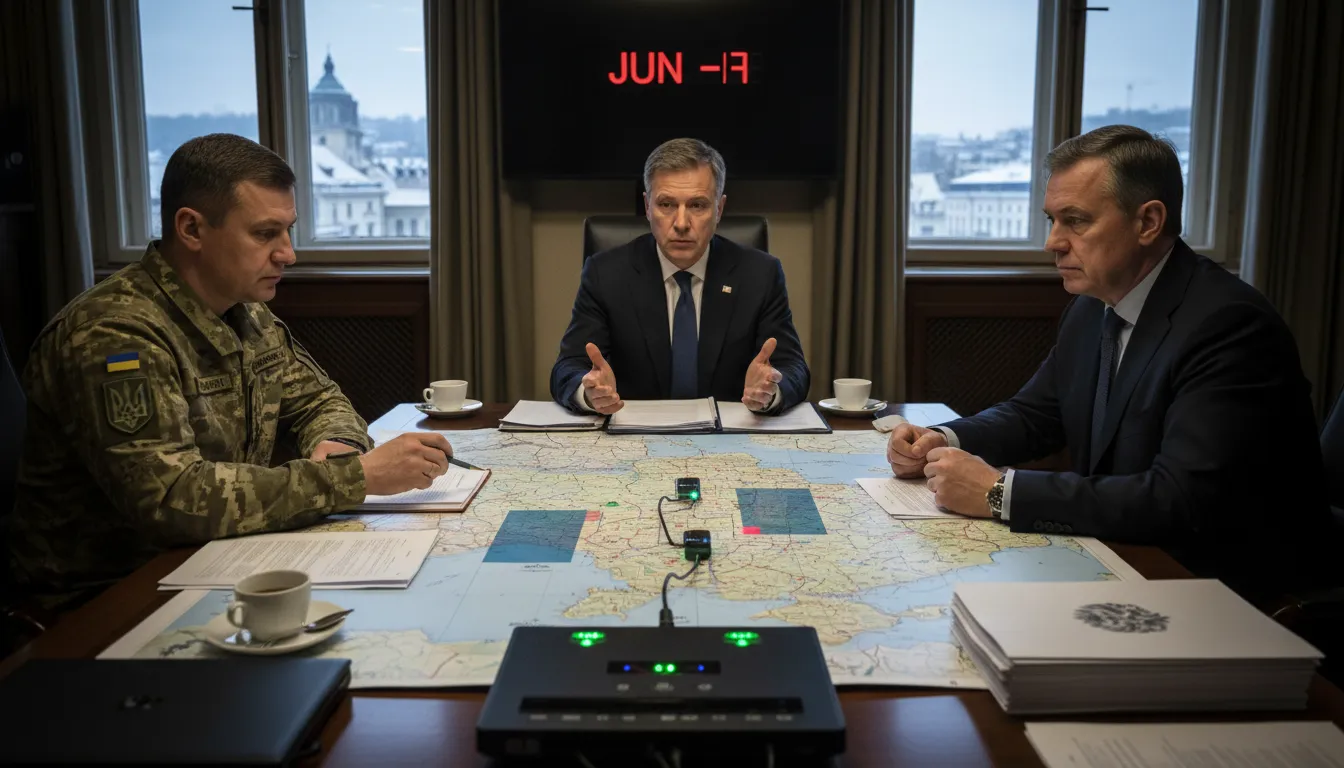
Two days of US-brokered trilateral negotiations in Geneva between Russia, Ukraine, and the United States concluded on February 18 without a political breakthrough, even as negotiators claimed "meaningful progress" on the military track. The talks — the third round in a series launched by the Trump administration, following two previous sessions in Abu Dhabi — broke off abruptly on Wednesday after Kyiv accused Moscow of stalling.
US Special Envoy Steve Witkoff, who led the American delegation alongside Jared Kushner, described the military discussions as a qualified success. The parties, he said, now broadly understand how to monitor a ceasefire and structure the technical architecture of a potential armistice. Russia's chief negotiator, Vladimir Medinsky, called the sessions "difficult, but practical" and said further talks would resume "soon" — without specifying a date.
Two Tracks, Two Realities
The Geneva negotiations exposed a structural divide in the peace process. On the military track — covering ceasefire monitoring, front-line verification, and energy-site truces — delegations made genuine technical headway. According to a Ukrainian diplomatic source cited by the Kyiv Independent, all three sides were constructive, reaching preliminary agreement on how monitoring would work and confirming that the American side would be directly involved in any oversight mechanism.
The political track was a different story entirely. Russia entered the talks demanding that Ukraine formally withdraw its forces from the entire Donbas region, including areas still under Kyiv's control. Moscow controls nearly all of Luhansk and roughly 80 percent of Donetsk, yet Putin insists Ukraine cede even territory his forces have not captured. Kyiv categorically refuses and insists instead on a ceasefire that freezes the current front lines — the only position it deems realistic.
Russia has also ruled out any Western troop presence on Ukrainian soil as part of a post-deal security guarantee, leaving perhaps the most fundamental question — what protects Ukraine from a future attack — entirely unresolved.
A June Deadline and a Fragile Framework
The talks are running under significant time pressure. President Volodymyr Zelenskyy confirmed in early February that Washington had set a June 2026 deadline for a peace agreement. A revised 28-point framework reportedly circulating among negotiators would see Ukraine formally relinquish Luhansk and Donetsk — including areas its forces still hold — in exchange for security guarantees and a demilitarized "special economic" buffer zone in contested areas. Kyiv has not accepted the proposal.
Without movement on Russia's core territorial demands, analysts widely doubt the June timeline is achievable. The Soufan Center has warned that Moscow appears to be using the talks primarily as a pressure campaign, banking on Western fatigue rather than seeking a genuine compromise.
Board of Peace Adds a Complication
As Geneva stalled, Washington convened the inaugural summit of Trump's "Board of Peace" on February 19 — a new multilateral body intended to anchor US-led diplomacy across multiple conflicts. Ukraine, alongside France, Germany, and the United Kingdom, declined its invitation. Zelenskyy has stated that Ukraine cannot sit at the same table as Russia while the war continues. The collective refusal underscores the difficulty the Trump administration faces in building a unified diplomatic coalition — let alone delivering a durable peace deal by summer.