What Are Mars Boxwork Formations and Why They Matter
NASA's Curiosity rover has been exploring eerie spider-web-like rock structures on Mars called boxwork formations. Here's what they are, how they formed, and what they reveal about Mars's ancient watery past.
Giant Webs Frozen in Rock
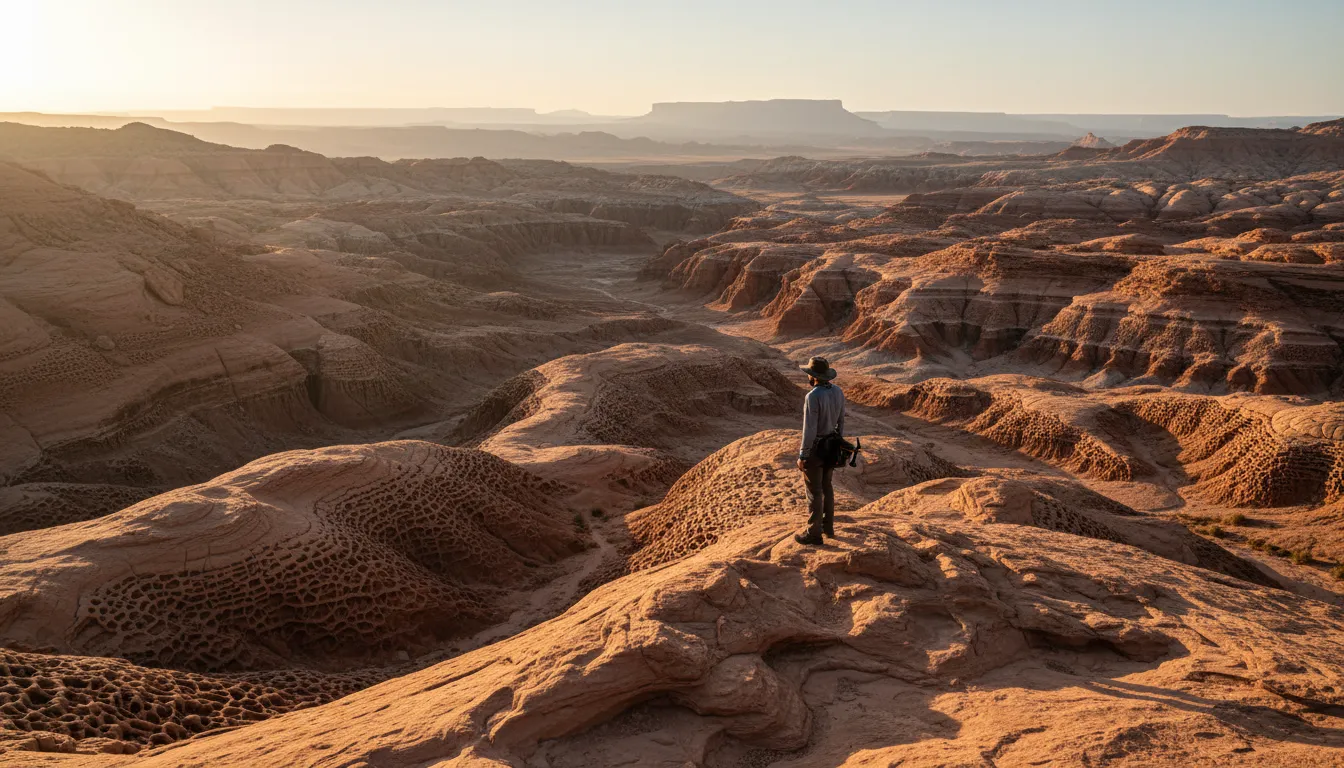
From orbit, they look like enormous spider webs etched into the surface of Mars—grid-like networks of ridges stretching for miles across the slopes of Mount Sharp. Up close, NASA's Curiosity rover has found something even more scientifically remarkable: boxwork formations, a rare geological feature that preserves a record of ancient groundwater activity billions of years old.
Scientists are excited because these structures are not just visually striking. They are mineralogical time capsules, locking in chemical clues about when Mars had liquid water—and possibly conditions suitable for microbial life.
What Is Boxwork?
Boxwork is a geological term for a pattern of intersecting mineral ridges with hollows in between, forming a honeycomb or lattice structure. On Earth, the phenomenon is best known from Wind Cave National Park in South Dakota, which contains roughly 95% of all known boxwork on the planet. There, thin blades of calcite crystallized inside cracks in surrounding limestone; over millions of years, the softer rock eroded away, leaving the harder mineral lattice standing proud.
On Mars, the process was driven not by cave chemistry but by groundwater moving through fractured bedrock. As mineral-rich water percolated through cracks, it deposited compounds that hardened those zones. Wind erosion then stripped away the weaker surrounding rock over billions of years, exposing the tougher ridges in the distinctive web-like pattern visible today.
The Martian version dwarfs its Earth counterpart. Where Wind Cave boxwork is typically just centimeters thick, the ridges on Mount Sharp stand 1 to 2 meters (3 to 6 feet) tall and extend across kilometers of terrain.
What Curiosity Found Inside
After first spotting the formations from orbit, Curiosity spent months navigating the treacherous terrain—ridges barely wider than the rover itself, with sand-filled hollows that risk wheel slippage—to analyze the structures up close. The findings were significant.
- Clay minerals were detected at the tops of ridges, a strong indicator of sustained water interaction with rock.
- Carbonate minerals appeared in the sandy hollows between ridges, forming when water reacts with rock and atmospheric carbon dioxide.
- Nodules—pea-sized mineral bumps—were found not just at the central fractures where groundwater likely entered, but also along ridge walls and in the hollows, suggesting a more complex and prolonged hydrological history than a single event.
- Perhaps most intriguingly, Curiosity's chemistry lab detected long-chain hydrocarbon molecules—the largest organic compounds ever found on Mars—in boxwork samples, compounds whose origin scientists have not yet fully explained.
A Higher, Longer-Lasting Water Table
The location of these formations matters as much as their composition. Mount Sharp, formally known as Aeolis Mons, rises about 5 kilometers above the floor of Gale Crater. The fact that boxwork ridges appear high up on the mountain's slopes rather than just at its base carries a striking implication.
"Seeing boxwork this far up the mountain suggests the groundwater table had to be pretty high. And that means the water needed for sustaining life could have lasted much longer than we thought." — Tina Seeger, mission scientist, Rice University
Each geological layer of Mount Sharp represents a different era in Mars's history. Finding groundwater signatures at higher elevations pushes the timeline forward: liquid water may have persisted on Mars later into the planet's drying phase than orbital data alone suggested.
Why It Matters for Astrobiology
Life as we know it requires liquid water, chemical energy, and time. Boxwork formations suggest Mars had all three in regions that were once thought too dry and too late in geological history. The clay and carbonate minerals found in the ridges indicate water with relatively neutral chemistry—conditions that, on Earth, tend to be hospitable to microbial life.
The long-chain organic molecules add a further dimension. While their presence does not confirm biology, scientists note they are inconsistent with several known abiotic sources, making them a priority target for future analysis.
What Comes Next
Curiosity has collected four drill samples from the boxwork region, with the most recent undergoing the rover's advanced wet chemistry analysis. Results will help determine whether the organic compounds are remnants of ancient chemistry—biological or otherwise—or the product of purely geological processes.
The broader lesson from Mars's spiderweb rocks is geological humility: features that appear simple from space often encode a planet's deepest secrets. The more Curiosity reads these mineral lattices, the more complex—and habitable—ancient Mars appears to have been.