What Is a Gravity Hole? Antarctica's Weak Spot Explained
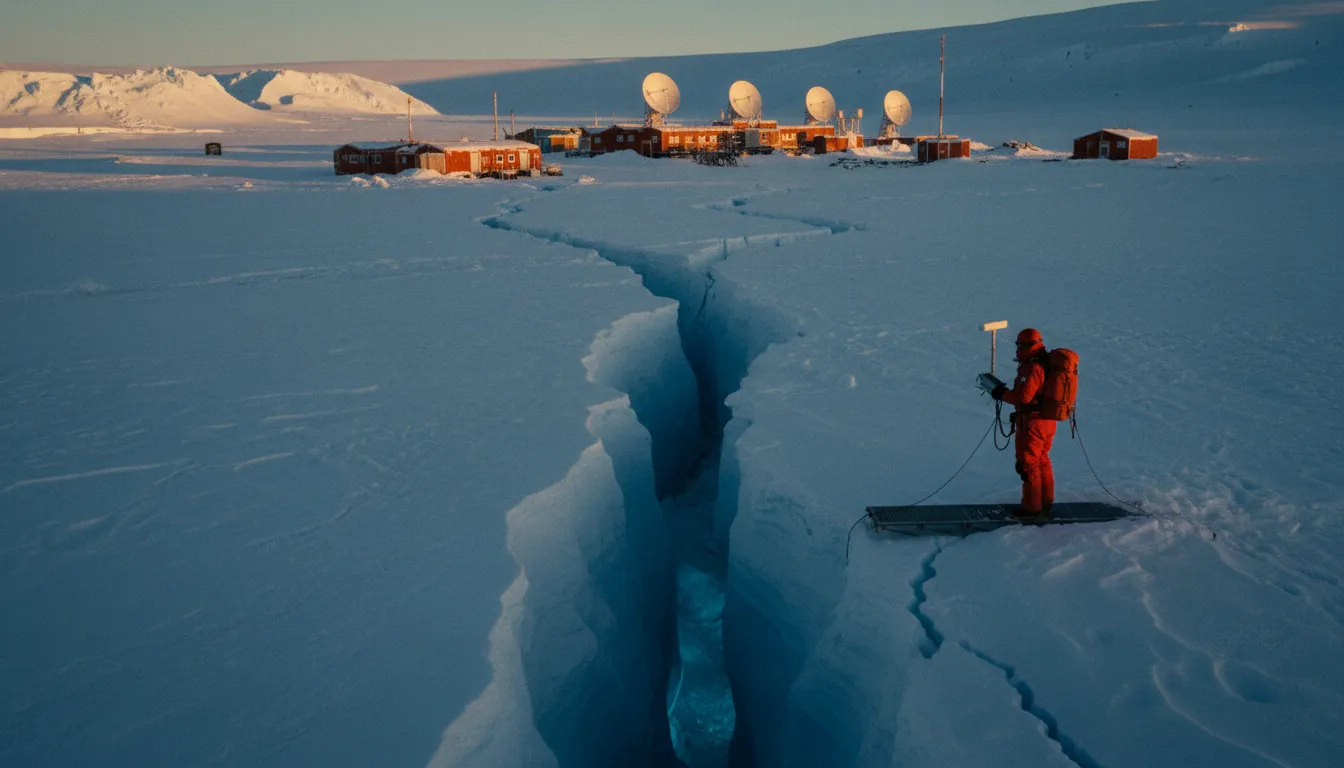
Antarctica sits above Earth's strongest 'gravity hole'—a region where gravitational pull is measurably weaker than the global average. Scientists have finally traced its origins to slow churning movements deep within the planet's mantle, with surprising implications for how the frozen continent came to be.
Earth's Gravity Is Not a Constant
Most of us were taught that gravity is a steady, uniform force pulling everything toward the ground. In reality, it varies across the planet's surface. Where rock beneath the crust is dense, gravity pulls slightly harder. Where it is lighter or absent, gravity weakens. Scientists call these variations gravity anomalies, and the most extreme example on Earth sits directly beneath Antarctica.
What Is a Gravity Hole?
A gravity hole—formally called a geoid low—is a region where Earth's gravitational pull is measurably weaker than the global average. To understand it, you need to know what the geoid is: the shape that the ocean's surface would take if winds, tides, and currents were completely removed. Because gravity is slightly stronger where dense rock concentrates beneath the seafloor, water is pulled toward those areas, making the ocean surface bulge. Where rock is lighter, water flows away and the surface dips.
Antarctica sits above the strongest such dip on the planet—the Antarctic Geoid Low. The ocean surface around the continent sits roughly 50–60 meters lower than the global geoid average, because water is effectively pulled away toward regions with stronger gravitational attraction. Satellites first detected this anomaly in the early 2000s, noticing that the Southern Ocean was measurably shallower near Antarctica than models predicted.
Why Is Gravity Weaker Beneath Antarctica?
The answer lies hundreds of kilometers underground, in a process called mantle convection. Earth's mantle—the thick layer of semi-molten rock between the crust and the outer core—is never fully still. Over millions of years, hot rock rises while cool, dense rock sinks, driven by heat escaping from the planet's interior in vast, sluggish currents.
Beneath Antarctica, this process created a specific combination. Cold, dense slabs of ancient tectonic plates sank into the deep mantle along the continent's Pacific and South Atlantic margins. At the same time, a broad upwelling of hot, buoyant rock rose beneath the Ross Sea region. Dense material creates stronger gravity; hot, light material creates weaker gravity. The net result is a significant mass deficit beneath the continent—and therefore a gravity hole above it.
Researchers from the University of Florida and the Institut de Physique du Globe de Paris recently reconstructed the full history of this anomaly using seismic tomography—essentially performing a CT scan of the planet's interior using earthquake waves. Their study, published in Scientific Reports, traced the gravity hole back at least 70 million years and found it strengthened dramatically between 50 and 30 million years ago.
How Scientists Measure It
For decades, gravity anomalies were mapped using sensitive gravimeters carried on ships and aircraft. The field was transformed in 2002 when NASA launched the GRACE mission (Gravity Recovery and Climate Experiment)—twin satellites that detected tiny gravitational variations from orbit by measuring the changing distance between themselves as they flew over regions of differing mass. GRACE produced the most detailed gravity maps of Earth ever made, clearly revealing the Antarctic Geoid Low's full extent and confirming it as the planet's strongest gravity depression.
Did the Gravity Hole Help Freeze Antarctica?
One of the most striking implications of recent research is a possible connection between the deepening gravity hole and the formation of Antarctica's ice sheets. Antarctica's glaciation began around 34 million years ago—precisely when the gravity anomaly was strengthening most rapidly.
The proposed mechanism is elegant: as the gravity low deepened, it pulled ocean water away from Antarctica, effectively lowering local sea levels relative to the land. In glaciology, lower sea levels allow ice sheets to anchor themselves firmly on the continental shelf rather than floating and breaking apart. By lowering the local "waterline," the churning mantle may have provided conditions that let Antarctica's nascent glaciers stabilize and grow into the vast frozen continent that exists today.
Why This Matters Now
Understanding Antarctica's gravity hole is not purely academic. As climate change accelerates ice loss across the continent, the removal of that enormous ice mass allows the land beneath to slowly rebound—a process called glacial isostatic adjustment. This rebound changes the mass distribution in the mantle, which in turn affects the gravity field itself. Scientists note that the anomaly appears to be gradually strengthening as ice is lost, creating a feedback loop that is only beginning to be understood.
Accurate gravity maps are also essential for modeling global sea-level rise. Because the Antarctic Geoid Low influences how meltwater redistributes itself across the world's oceans, any change in its strength ripples through sea-level projections for coastlines thousands of kilometers away. The weakest gravity on Earth, it turns out, has consequences that reach far beyond the frozen south.