What Is Antimatter and Why Is It So Hard to Move?
Antimatter is the mirror image of ordinary matter and annihilates on contact with it, making it the most expensive and volatile substance on Earth. Here is how scientists create, trap, and now transport it.
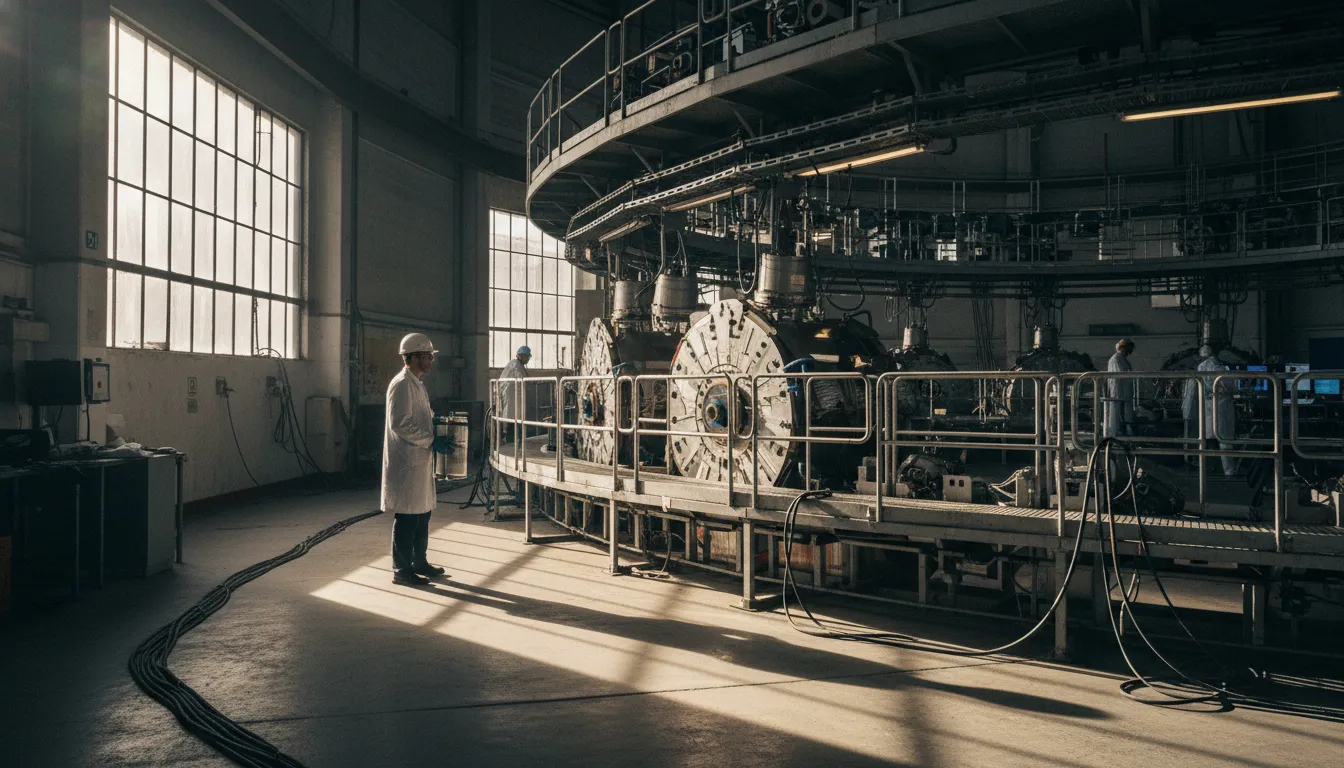
The Mirror Image of Everything
For every particle of matter in the universe, there exists a corresponding antiparticle—identical in mass but opposite in charge. An electron has the positron; a proton has the antiproton. When a particle meets its antiparticle, both vanish in a flash of pure energy. This is antimatter, and it is simultaneously one of the most fascinating and frustrating substances in physics.
Antimatter was first predicted by physicist Paul Dirac in 1928 and confirmed experimentally in 1932, when Carl Anderson detected a positron in cosmic rays. Since then, scientists have learned to produce, trap, and study it—but moving it from one place to another remains an extraordinary challenge.
How Antimatter Is Made
Antimatter does not exist naturally in significant quantities. At CERN's Antimatter Factory near Geneva, Switzerland, scientists create antiprotons by firing a beam of protons from the Proton Synchrotron into a metal target. The violent collisions produce a spray of secondary particles, including antiprotons, which are then captured and slowed down by the Antiproton Decelerator.
The process is spectacularly inefficient. CERN's entire antimatter output over decades amounts to roughly 20 nanograms—nowhere near enough to fill a teaspoon. Estimates put the cost of antihydrogen at around $62.5 trillion per gram, making it the most expensive substance on Earth by a wide margin.
Why Containment Is So Difficult
The fundamental problem is simple: antimatter annihilates the instant it touches ordinary matter. A container made of steel, glass, or any physical material would destroy its contents on contact. Scientists must therefore use electromagnetic traps—devices that suspend charged antiparticles in a vacuum using carefully shaped magnetic and electric fields.
The most common design is the Penning trap, which combines a strong magnetic field with an electric quadrupole field to confine charged particles in a small volume. Keeping the trap operational requires cryogenic cooling, often to temperatures below −265 °C, to maintain the superconducting magnets that generate the fields.
Even under ideal laboratory conditions, maintaining a stable antimatter sample demands constant monitoring. Any vibration, power fluctuation, or thermal drift can destabilize the trap and cause the antiparticles to touch the container walls—resulting in instant annihilation.
The Challenge of Transport
Until recently, antimatter experiments could only happen where antimatter was produced—essentially, at CERN. Transporting antiparticles to other laboratories would allow physicists to conduct measurements in quieter, lower-noise environments, potentially achieving far greater precision.
The BASE experiment at CERN developed a solution called BASE-STEP: a portable cryogenic Penning trap weighing about 1,000 kilograms, compact enough to fit through standard laboratory doors and load onto a truck. The system uses a superconducting magnet cooled with liquid helium, an ultra-high vacuum chamber, and battery-powered electronics—all designed to keep antiprotons stable while on the move.
The device can sustain trapped antiprotons for roughly four hours without external power, setting a hard limit on travel distance. A trip from CERN to Heinrich Heine University Düsseldorf—one of the team's target destinations—takes about eight hours by road, meaning engineers must extend the trap's autonomy before long-distance deliveries become routine.
Why Antimatter Matters
Antimatter research is not merely academic. Positron emission tomography (PET) scans, one of the most powerful diagnostic imaging tools in modern medicine, already rely on antimatter: the scanner detects gamma rays produced when positrons emitted by a radioactive tracer annihilate with electrons in the body.
At the frontier of physics, antimatter holds the key to one of science's deepest mysteries: why does the universe exist at all? The Big Bang should have produced equal amounts of matter and antimatter, which would have annihilated each other completely. The fact that matter survived—and we are here—means something tipped the balance. Studying antiprotons and antihydrogen with extreme precision could reveal subtle differences between matter and antimatter that explain this cosmic asymmetry.
Further afield, antimatter's energy density—roughly 10 billion times greater than chemical combustion—makes it a theoretical candidate for interstellar propulsion, though producing enough fuel remains far beyond current technology.
From Lab Curiosity to Portable Science
The ability to move antimatter safely opens a new chapter in fundamental physics. Instead of being confined to a single facility, antimatter experiments could spread across universities and research centers worldwide. For a substance that vanishes the instant it touches anything, learning to carry it gently down the road is a remarkable achievement—and a first step toward answering why the universe is made of matter at all.


