What Is Homo habilis and How Did It Shape Human Evolution
Homo habilis—'handy man'—is one of the oldest known members of the human genus, living roughly 2.4 to 1.65 million years ago. Combining ape-like body proportions with a significantly larger brain and early stone tools, it occupies a pivotal place in the story of how humans came to be.
A Species That Rewrote Prehistory
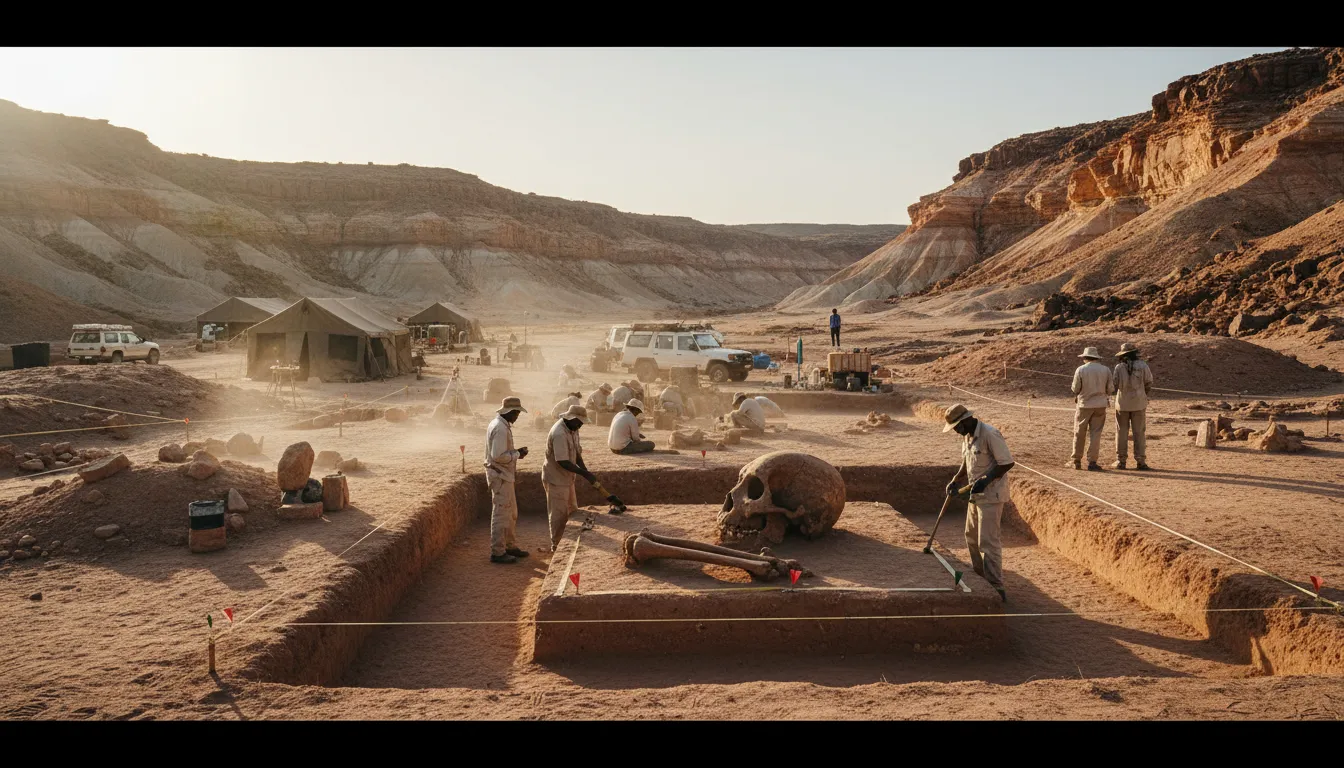
When paleoanthropologists Louis and Mary Leakey uncovered strange fossilized bones at Olduvai Gorge in Tanzania between 1960 and 1963, they knew immediately that they had found something unusual. The skull was more rounded than any australopithecine they had seen, the braincase bigger, the teeth slightly smaller. In 1964, together with scientists Philip Tobias and John Napier, they formally announced a new human species: Homo habilis—Latin for "handy man."
The name reflected a crucial suspicion: that this slightly bigger-brained early human was responsible for the thousands of stone tools scattered across the same ancient lakebed. The announcement was controversial, but H. habilis has since become one of the most studied and debated species in the entire human family tree.
When and Where It Lived
Homo habilis inhabited East and South Africa from approximately 2.4 million to 1.65 million years ago, during a period known as the Early Pleistocene. Fossils have been found in Tanzania, Kenya, Ethiopia, and South Africa—regions that were then a mosaic of grasslands, woodlands, and lakes teeming with large mammals.
According to the Smithsonian Institution's Human Origins Program, H. habilis is currently the earliest well-documented member of the genus Homo, though the boundary between it and its australopithecine predecessors remains a subject of active scientific debate.
What It Looked Like
Think of Homo habilis as a transitional creature caught between two worlds. It walked upright on two legs like a modern human, but its body proportions still echoed those of much older ancestors. As the Natural History Museum explains, it had short legs, long arms, and a relatively small body—features more reminiscent of the earlier Australopithecus than of later Homo erectus.
The most recent and most complete skeleton ever found—designated KNM-ER 64061 and analyzed in 2026—confirmed this mosaic nature in striking detail. Dated to between 2.02 and 2.06 million years ago, the specimen shows an estimated stature of about 160 cm but a body mass of only 30–33 kilograms. Its forearm-to-upper-arm proportions were strikingly similar to Australopithecus afarensis, the species that includes the famous fossil "Lucy," suggesting that H. habilis had not yet shed its capacity for tree climbing, even as it increasingly walked the open savanna.
The Brain That Changed Everything
What most sharply distinguishes H. habilis from its predecessors is cranial capacity. While australopithecines averaged around 430–450 cubic centimeters of brain volume, H. habilis ranged from roughly 500 to 800 cubic centimeters—a significant leap. According to Encyclopædia Britannica, this expansion represents the beginning of the long trend of brain enlargement that ultimately produced anatomically modern humans.
Larger brains demand more calories, and researchers believe this partly explains why H. habilis became so closely associated with butchering and consuming meat from large animals—a dietary shift that may have helped fuel further cognitive development across subsequent generations.
Oldowan Tools: The First Technology
The stone tools linked to H. habilis belong to what archaeologists call the Oldowan industry, named after Olduvai Gorge. These are among the simplest tools ever made—rough flakes knocked off river cobbles to create sharp cutting edges—yet they marked a revolutionary moment. For the first time, a hominin was deliberately shaping raw material to serve a purpose.
Oldowan tools appear in the fossil record from about 2.6 million years ago and were used to process meat, crack bones for marrow, and cut plant material. While it was once assumed that only H. habilis made them, more recent research has shown that some australopithecines may also have produced stone tools, complicating the picture of who deserves credit for the world's first technology.
Where It Fits in the Family Tree
One of the most surprising findings in recent decades is that Homo habilis and Homo erectus—long thought to be ancestor and descendant in a neat linear sequence—actually co-existed in East Africa for roughly half a million years. This discovery, supported by fossil evidence from northern Kenya, suggests that human evolution was far more branching and complex than a simple ladder from primitive to advanced.
As the Live Science report on the KNM-ER 64061 analysis notes, the new skeleton reinforces the view that early members of the genus Homo were a diverse, varied group—not a single, steadily improving lineage marching toward modernity.
Why Homo habilis Still Matters
More than six decades after its discovery, Homo habilis remains central to our understanding of what it means to be human. It embodies the moment when a lineage of tree-dwelling, small-brained primates began investing in bigger brains, more sophisticated diets, and the deliberate reshaping of the physical world. Every smartphone, skyscraper, and scientific paper traces an unbroken line back to those first crude flakes of stone chipped in the shadow of an African gorge.