What Is Nanotyrannus—and Why It's Not a Baby T. Rex
For decades, paleontologists argued whether small tyrannosaur fossils belonged to juvenile T. rex or a separate species. Multiple studies now confirm Nanotyrannus was its own dinosaur—reshaping what we know about Late Cretaceous ecosystems.
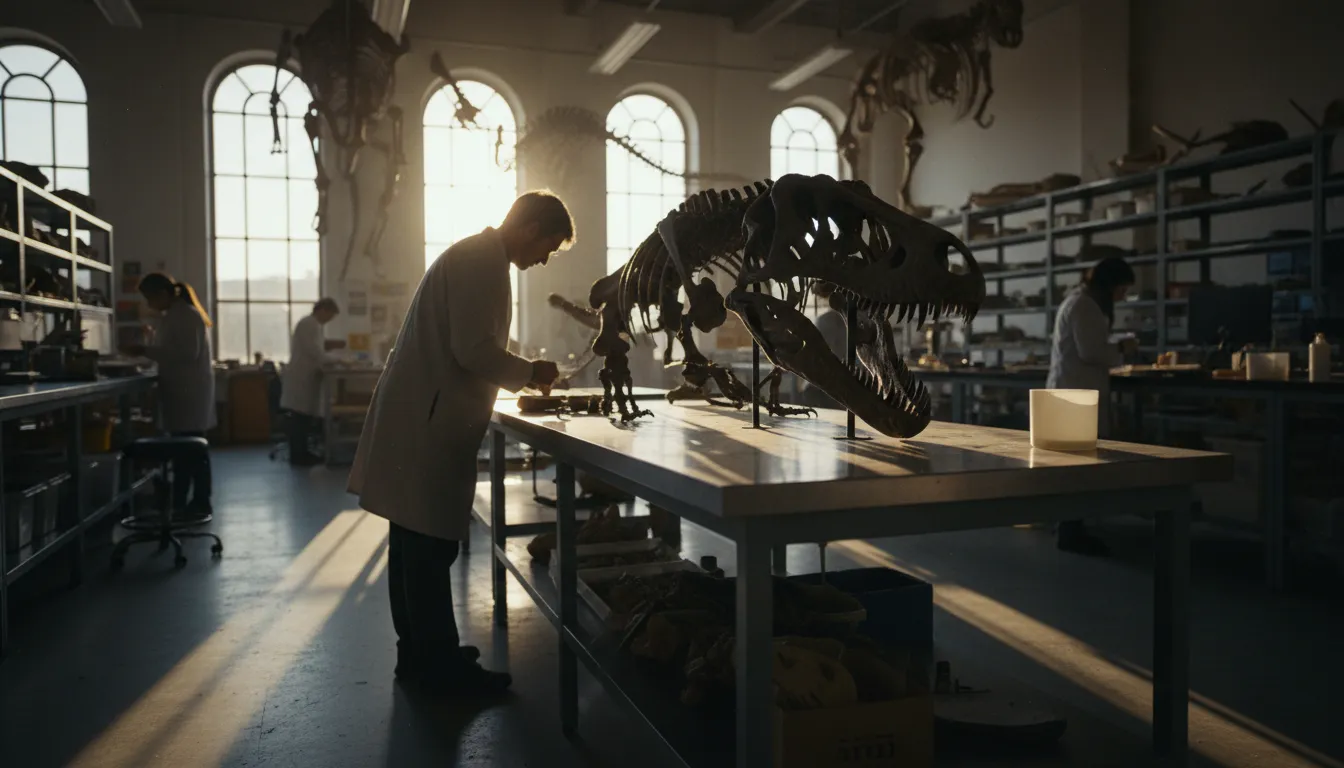
A Fossil Mystery Decades in the Making
In 1942, a curious small tyrannosaur skull surfaced in Montana's Hell Creek Formation. Initially classified as Gorgosaurus, it was reclassified in 1988 as Nanotyrannus lancensis—literally "tiny tyrant." But rather than settling anything, the new name ignited one of paleontology's longest-running feuds: was Nanotyrannus a real species, or simply a teenage Tyrannosaurus rex?
For most of the past four decades, the majority of researchers leaned toward the juvenile hypothesis. The fossils were smaller, slimmer, and seemingly fit what a growing T. rex might look like. Textbooks and museum exhibits reflected that consensus. But a cascade of studies from 2025 and 2026 has upended the debate—and Nanotyrannus is back, this time for good.
The Evidence That Changed Everything
The Dueling Dinosaurs
The pivotal specimen is the famous "Dueling Dinosaurs"—a remarkably complete Triceratops and a small tyrannosaur locked together in what appears to be a predator-prey encounter, discovered in Montana's Hell Creek Formation. Now housed at the North Carolina Museum of Natural Sciences, this fossil provided researchers with the most complete small tyrannosaur skeleton ever found.
A team led by Lindsay Zanno of NC State University analyzed over 200 tyrannosaur fossils and published their findings in Nature. Their conclusion was unambiguous: the Dueling Dinosaurs tyrannosaur was not a juvenile T. rex. It was a fully grown adult of a separate species, which they named Nanotyrannus lethaeus.
A Tiny Bone With a Big Answer
A second study, published in Science in December 2025, attacked the question from a completely different angle. Researchers at the Cleveland Museum of Natural History examined the hyoid bone—a small bone in the throat—from the original 1942 Nanotyrannus skull. Using bone histology (the microscopic study of bone tissue), they found growth patterns indicating the animal was nearly fully mature when it died.
"This animal is clearly not on a growth path to becoming a Tyrannosaurus rex," the researchers concluded. A juvenile T. rex's bones would show rapid, ongoing growth. The Nanotyrannus hyoid showed the opposite: growth was slowing down, as it does in adults approaching full size.
How Nanotyrannus Differed From T. Rex
With the debate resolved, a clearer picture of Nanotyrannus has emerged. It was a smaller, faster, and more lightly built predator than its famous cousin:
- Size: Nanotyrannus reached roughly 5–6 meters in length, compared to T. rex's 12+ meters
- Arms: Proportionally longer arms than T. rex, suggesting different hunting strategies
- Skull: A narrower snout with more tooth sockets and different nerve and sinus pathways—features established in embryonic development and fixed for life
- Speed: Its lighter build suggests it was likely a faster, more agile hunter
These are not differences that change with age. They are fundamental anatomical distinctions baked into the animal's development from the embryo onward.
Why This Matters Beyond Dinosaurs
The confirmation of Nanotyrannus does more than add a species to the Late Cretaceous roster. It reshapes our understanding of entire ecosystems in the final million years before the asteroid impact wiped out non-avian dinosaurs 66 million years ago.
For decades, researchers modeled T. rex growth and behavior using Nanotyrannus fossils, believing they were studying the same animal at different life stages. Those studies now need revisiting. As Zanno told CNN, "This fossil doesn't just settle the debate. It flips decades of T. rex research on its head."
The finding also reveals a more complex food web than previously thought. Multiple large predatory tyrannosaurs shared the same habitat, likely occupying different ecological niches—much like lions and cheetahs coexist in modern African savannas.
The Nanotyrannus saga is also a lesson in how science self-corrects. New techniques like hyoid bone histology and access to better-preserved specimens allowed researchers to overturn a decades-old consensus. The "tiny tyrant" is no longer a footnote in T. rex's story—it is a chapter of its own.