What Is the Durand Line—and Why It Fuels Conflict
The Durand Line, a 2,640-kilometre border drawn by British diplomats in 1893, divides the Pashtun people between Pakistan and Afghanistan and remains the root cause of recurring conflict between the two nations.
A Border Drawn by Empire
The Durand Line is a 2,640-kilometre international border between Pakistan and Afghanistan. Drawn in 1893 by Sir Mortimer Durand, a British diplomat, and Abdur Rahman Khan, the Emir of Afghanistan, it was designed to fix the limits of British and Afghan spheres of influence during the so-called Great Game—the imperial rivalry between Britain and Russia for dominance in Central Asia.
The agreement turned Afghanistan into a buffer state. But it also carved through the heartland of the Pashtun people, splitting one of the world's largest tribal populations across two sides of a line they never chose. That single act planted the seed for more than a century of tension.
Why Afghanistan Rejects the Border
When Pakistan gained independence in 1947, it inherited the Durand Line under the international legal principle of state succession. Afghanistan refused to accept it. Kabul was the only United Nations member to vote against Pakistan's admission to the body that year.
Afghan leaders have consistently argued that the 1893 agreement was a temporary arrangement imposed under duress by a colonial power—not a permanent international boundary. Pakistan counters that the line was reaffirmed by the Anglo-Afghan Treaty of 1919 and is binding under international law. No Afghan government, including the current Taliban administration, has ever formally recognized it.
The Pashtunistan Question
At the heart of the dispute lies ethnicity. Roughly 50 million Pashtuns live in Pakistan's Khyber Pakhtunkhwa province and former tribal areas, while another 15 million reside in Afghanistan. For decades, Afghan governments promoted the idea of "Pashtunistan"—a unified Pashtun homeland that would redraw the map at Pakistan's expense.
Although the Pashtunistan movement never achieved statehood, it kept diplomatic relations between Islamabad and Kabul in a state of permanent distrust. Cross-border kinship ties meant that militants, refugees, and goods moved freely in both directions, making the frontier nearly impossible to police.
Pakistan's Fence—and Its Limits
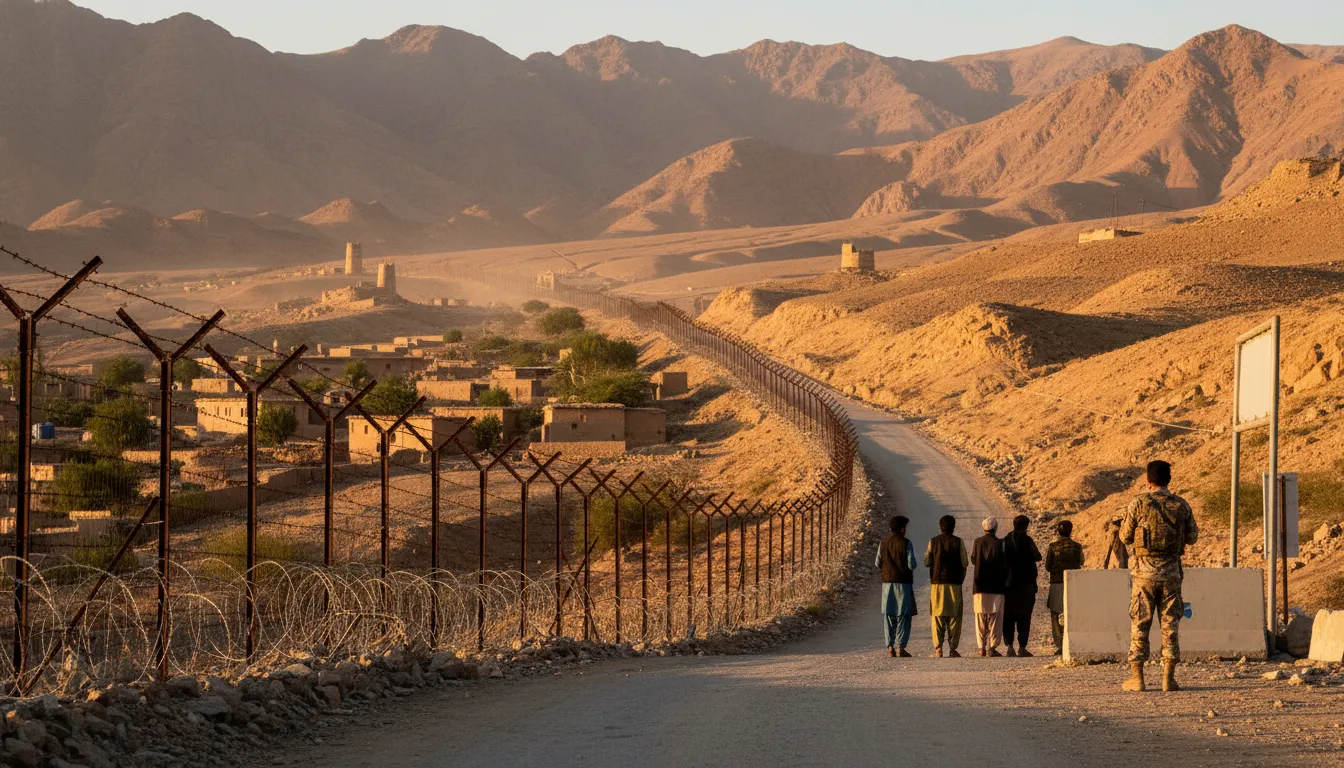
In 2017, Pakistan began constructing a massive border barrier: twin chain-link fences standing 3.6 metres high, separated by concertina wire, and monitored by surveillance cameras and infrared sensors. By 2023, over 98 percent of the fencing was complete, backed by hundreds of new border forts.
Pakistan credits the fence with reducing militant infiltration. But the barrier has also divided families, destroyed cross-border livelihoods, and inflamed Afghan anger. The Taliban government has repeatedly condemned the fence and, in some cases, physically torn sections down.
Why It Keeps Fuelling War
The Durand Line is not merely a cartographic relic. It is the fault line along which modern violence erupts. Pakistan accuses Afghanistan of harbouring the Tehreek-e-Taliban Pakistan (TTP), a militant group that launches deadly attacks from Afghan soil. Afghanistan accuses Pakistan of airstrikes and artillery bombardments that kill civilians.
In early 2026, these tensions escalated into open cross-border warfare, with Pakistani strikes on Afghan territory displacing over 115,000 people and killing dozens of civilians, according to UN reporting. The conflict underscored what analysts have long warned: until the political status of the Durand Line is resolved—or at least managed through sustained diplomacy—it will continue to generate instability across South Asia.
The Outlook
No resolution is in sight. Afghanistan views the line as illegitimate; Pakistan views it as non-negotiable. The Pashtun communities caught in between bear the human cost. UN experts have called for lasting peace mechanisms, but the 130-year-old line remains what it has always been: a razor's edge that neither side can safely cross—or ignore.